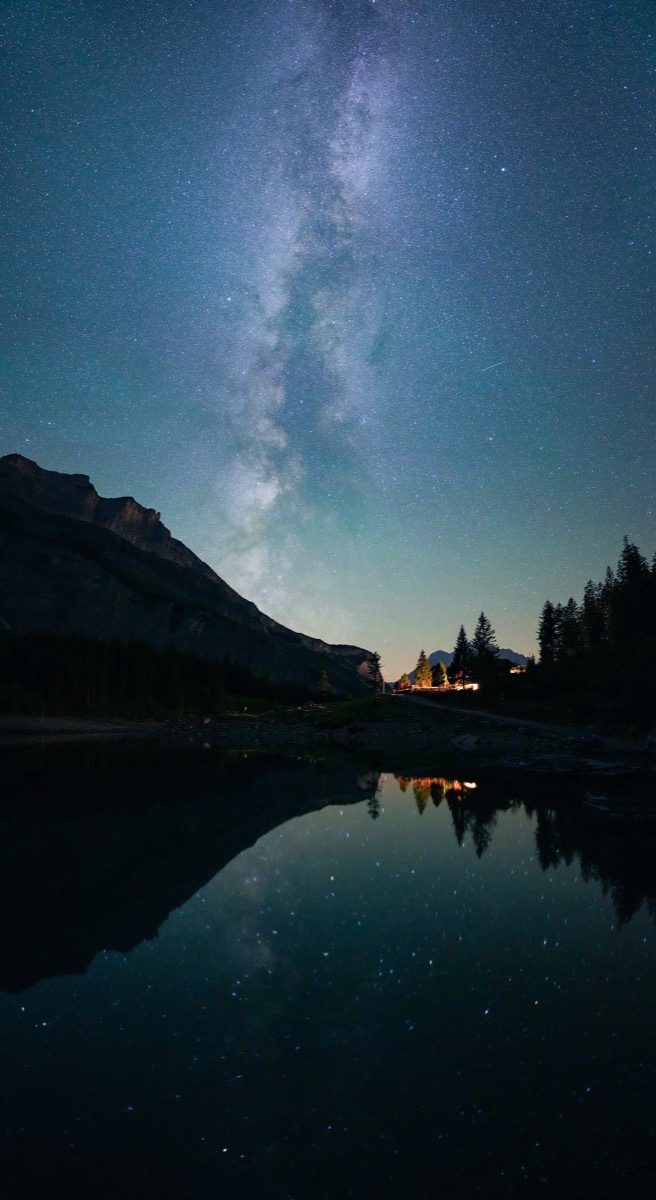
Take two assumptions that sound harmless. The universe is endless, and it is uniformly populated with luminous stars. Then every you could pick must eventually end on the surface of a star, so the night sky should be bright everywhere with no dark gaps between the stars. It plainly is not. The question is which assumption the darkness is refusing.
The answer is time, not geometry. If the assumptions are accepted, the simplest resolution is that the average of stars is far too short for light to have reached the Earth yet from very distant stars. In the context of an the argument runs similarly: the universe is too young for light to have reached us from very distant regions. Darkness is a statement about age.
is a cosmological puzzle about something anybody can check. If the universe is endless and uniformly populated with luminous stars, then every line of sight must eventually terminate at the surface of a star. Contrary to observation, that argument implies the night sky should everywhere be bright, with no dark spaces between the stars.
The history is older than the name. The paradox was discussed in 1823 by the German astronomer Heinrich Wilhelm Olbers, and its discovery is widely attributed to him. The problem had been considered by earlier investigators, and it traces back to Johannes Kepler. In 1610 he advanced it as an argument against the notion of a limitless universe containing an infinite number of stars.
Various resolutions have been proposed at different times. If the assumptions are accepted as stated, the simplest is that the average luminous lifetime of stars is far too short for light to have yet reached the Earth from very distant stars. The sky is dark in those directions because nothing has arrived from them.
In the context of an expanding universe the argument runs similarly: the universe is too young for light to have reached the Earth from very distant regions. Either way the resolution is temporal rather than spatial, which is what makes the paradox worth keeping. A dark sky is not evidence that the universe is small. It is evidence that it has a finite age.
wat. The night is dark because the universe has not been shining long enough to fill every line of sight.
wat wat
A paradox with no apparatus and no budget still told cosmologists something. The dark sky anybody can walk outside and see is evidence that the universe has not been shining forever.
How do we know?
Britannica sets out the paradox, attributes its 1823 discussion to Heinrich Wilhelm Olbers, traces it back to Kepler in 1610, and gives the proposed resolutions.
What is still unknown
Britannica presents the paradox and the simplest resolutions rather than adjudicating between all the resolutions proposed over two centuries. The argument also depends on accepting the two assumptions in the form stated.
Learn something?
Where to next
 Who discovered dark matter?cosmology
 Can every department admit women at a higher rate and the university still not?paradox
 Can one ball be cut up and reassembled into two of the same size?paradox