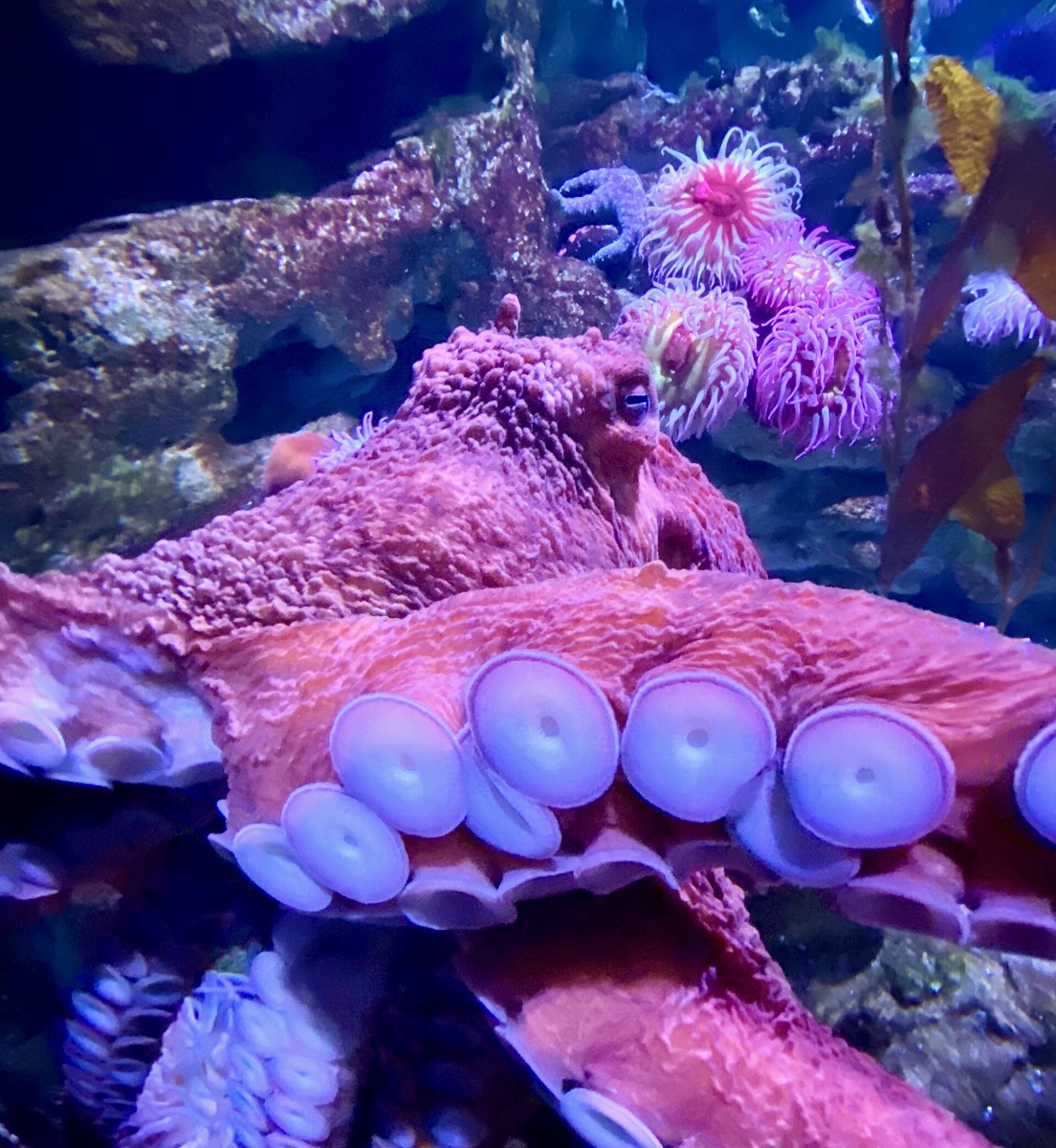
An octopus exploring a crevice it cannot see identifies what it finds by touching it, and the molecules worth identifying down there are greasy ones that never dissolve into the water. The receptors doing the work are , which evolution built out of a receptor for a neurotransmitter. Allard and colleagues took a structure of one and set it beside its ancestor. What had to change?
The pocket, and almost nothing else. The channel architecture that lets ions through and passes the signal on is conserved between the two. What diverged is the , under , which is where new molecules get recognized. The structure also turned up something unplanned: the octopus binding pocket is exceptionally hydrophobic, suited to greasy compounds rather than the small polar molecules a neurotransmitter receptor handles.
An octopus arm works largely out of sight, pushing into crevices and reading what it finds by contact. The useful information down there is chemical, and much of it sits in compounds that are insoluble and never diffuse into the water for a nose to catch.
The solution is chemotactile receptors, a cephalopod-specific innovation in the suckers. They did not appear from nothing. They diverged from nicotinic acetylcholine receptors, which in most animals sit at synapses and respond to a neurotransmitter, and were repurposed into sensors pointed at the outside world.
Allard and colleagues solved the structure of one by cryo-electron microscopy and put it next to the nicotinic version. The channel architecture, the part that lets cations through and converts binding into a signal, is conserved. The orthosteric ligand-binding site is not; it shows the signature of diversifying selection, which is where the ability to detect new molecules comes from.
A detail they did not go looking for makes the point concrete. The octopus binding pocket is exceptionally hydrophobic, which suits greasy compounds, while a canonical neurotransmitter receptor handles small polar molecules. One pocket rebuilt for a different chemistry, with the signalling machinery left alone, and a new way of exploring the seafloor follows from it.
wat. Evolution kept the wiring and replaced the keyhole, which is how a nerve receptor became a sense organ for grease.
wat wat
It shows the atomic-level edit behind a new behavior: keep the machinery that fires a signal, rewrite only the part that decides what counts as a signal worth firing.
How do we know?
Allard and colleagues solved the structure of an octopus chemotactile receptor by cryo-electron microscopy and compared it against nicotinic acetylcholine receptors, alongside evolutionary and biophysical analyses.
What is still unknown
A structure describes what a protein can bind, not what the animal does with it, and the hydrophobic pocket is an inference about function from shape rather than a catalog of what the octopus detects.
Learn something?
Where to next
 Why does a cat walk past a bowl of sugar?taste
 Where is most of an octopus’s brain?octopus
 Why do cicadas come out every 13 or 17 years exactly?evolution