Treasure hunters dug a bronze disc out of a hill called in Germany in nineteen ninety-nine, as part of a with two axes, two swords and a chisel. Their crude excavation damaged the rim and lost a piece of the gold and one of the stars, and they sold it in Switzerland to a dealer in illegal antiquities. Experts recovered it only in two thousand two. Why the suspicion?
Because nothing like it should exist. A professor of European prehistory told the BBC he first assumed it was a joke, then a forgery. The piece was extraordinary enough that a clever forger cooking it up in a backroom would have surprised nobody. Later analysis put the disc at around sixteen hundred BC and traced its metals to a Bronze Age mine in Austria.
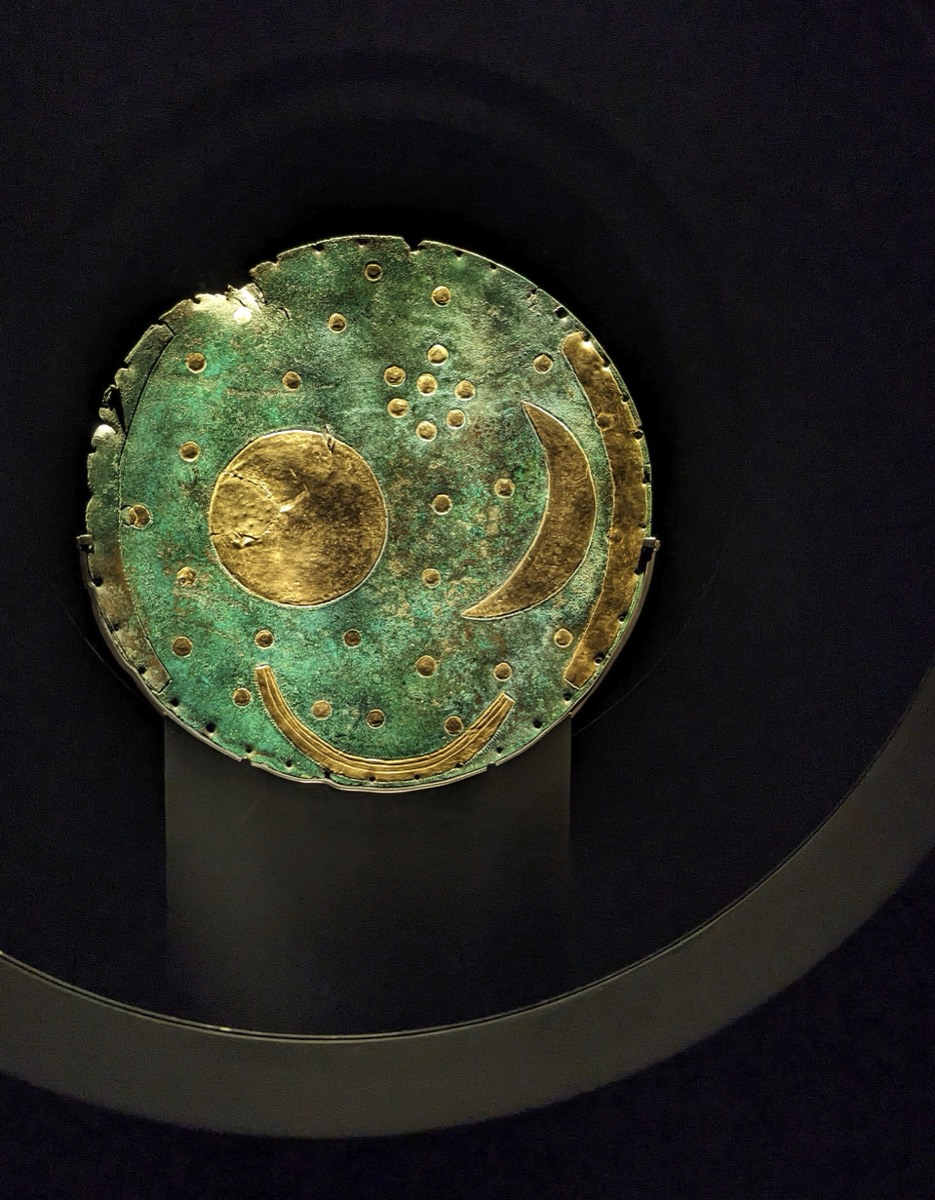
The Nebra sky disc is thought to be the oldest depiction of the night sky made by human hands, dating back some three thousand six hundred years to Late Bronze Age Europe. It bears a blue-green patina on bronze, with gold leaf overlays showing a crescent moon, either the sun or a full moon, and thirty-two stars including a cluster of seven believed to be the . Outer bands convey the horizons and a small arc at the bottom represents a sun boat.
It reached scholarship by the worst possible route. Treasure hunters removed it from Mittelberg in nineteen ninety-nine, damaging the outer rim and losing part of the gold circle and one star, then sold it in Switzerland to a dealer in illegal antiquities. Experts only recovered it in two thousand two, which left years in which no professional examined it.
The astronomical case built up afterwards. Most researchers are confident it worked as a clock for knowing when to plant and harvest, by marking the . Wolfhard Schlosser found the angle between the golden arcs to be eighty-two degrees, matching the sun’s trajectory at Mittelberg. Carbon dating of birch in one of the sword handles from the hoard gave sixteen hundred BC, and the metals were traced to a Bronze Age mine in Austria. The people who used it had also altered it over roughly two centuries, hiding stars and adding symbols for leap months, before burying it.
The dissent is about the ground, not the object. Rupert Gebhard argues the disc is a thousand years younger and closer to Iron Age work, relying on a treasure hunter’s claim to have moved it from elsewhere, and says the Mittelberg site is obsolete. Looting is what makes that argument possible: a securely excavated findspot would have settled it.
wat. An object that good, with no findspot anybody could trust, looks exactly like a forgery.
wat wat
Looting did more than damage the object. It stripped away the context that dating normally depends on, which is why the argument about its age is still running.
How do we know?
All That’s Interesting gathers the discovery, the recovery, the dating evidence, the astronomical measurements and the dissenting arguments about the disc’s age.
What is still unknown
Not everyone accepts the dating. Rupert Gebhard of the Bavarian State Archaeological Collection argues the disc is a thousand years younger and that the Mittelberg findspot is wrong, partly on a treasure hunter’s own account of moving it.
Learn something?
Where to next
 Why did the calendar lose ten days at once?astronomy
 What is pulling the Milky Way, and why can we not see it?astronomy
 What does a photograph of a black hole actually show?astronomy