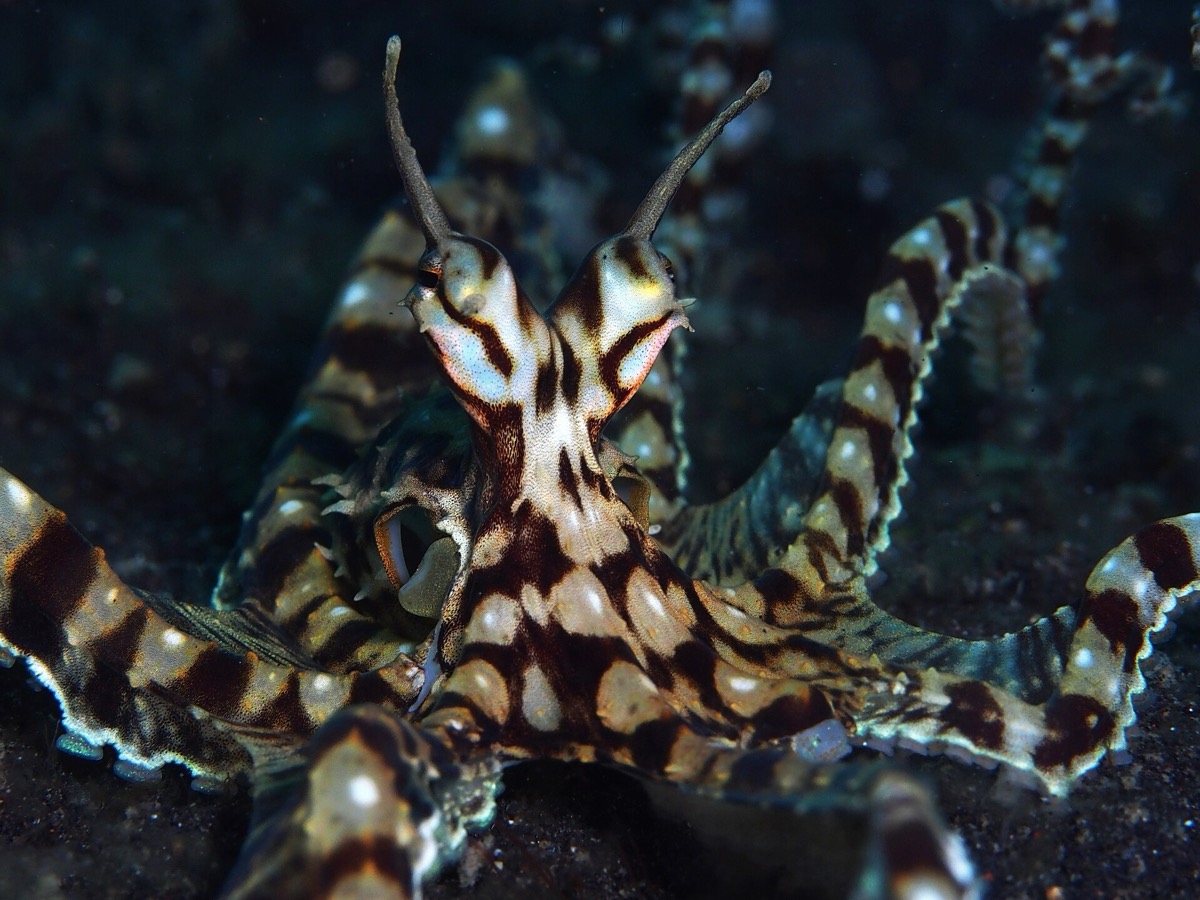
Octopuses generally hide. The does the opposite. It forages in broad daylight on open in the shallow Indo-Pacific, hunting crustaceans and fish where it is exposed and vulnerable, and retreats to a burrow only at night. Something has to compensate for that. Divers found it off Sulawesi in nineteen ninety-eight. What is the trick?
It impersonates things that are dangerous to eat. Like other mimics it changes its coloring, but it also contorts its body to take on the appearance and behavior of several animals, including the lionfish, jellyfish, , a shrimp and a crab. Most animal mimics impersonate one species. This one holds a repertoire and switches between them rapidly.
The mimic octopus is a master impersonator, taking on the appearance and behavior of venomous or bad-tasting creatures to put off predators. What is unusual is the range: most animal mimics impersonate just one animal, while this one impersonates several and can switch between them rapidly.
The repertoire includes the lionfish, the jellyfish, the sea snake, a shrimp and a crab, among others. Coloring changes are only part of it; the octopus also contorts its body into the shape and the movement of the animal in question, which is a performance rather than a pattern.
The sea snake version is the most specific. The octopus tucks into a hole and leaves just two arms out, displaying black bands and rippling them in opposite directions to imitate a snake. According to the entry it only takes that form when bothered by damselfish, which are themselves preyed on by sea snakes.
The need for all of it probably comes from how the animal feeds. It forages in broad daylight on open sand flats, exposed and vulnerable, hunting crustaceans and fish, and hides in a burrow at night. Reproduction is brief and final: a male transfers a sperm packet with his , dies a few months later, and the female dies shortly after laying.
wat. Not one disguise but a wardrobe, and it appears to choose from it according to who is bothering it.
wat wat
A single disguise can be inherited and run automatically. A repertoire selected to fit the threat in front of you is a different kind of problem, and a much harder one.
How do we know?
National Geographic’s reference entry on Thaumoctopus mimicus describes the animal’s range, its feeding behavior, the impersonations it performs and the circumstances in which particular ones appear.
What is still unknown
A species reference entry rather than a study. It reports what observers have seen the animal do, and most sightings come from one country, which limits how general the account can be.
Learn something?
Where to next
 Where is most of an octopus’s brain?octopus
 How does an octopus taste something it has only touched?octopus
 How does a mood travel from one person to another?mimicry