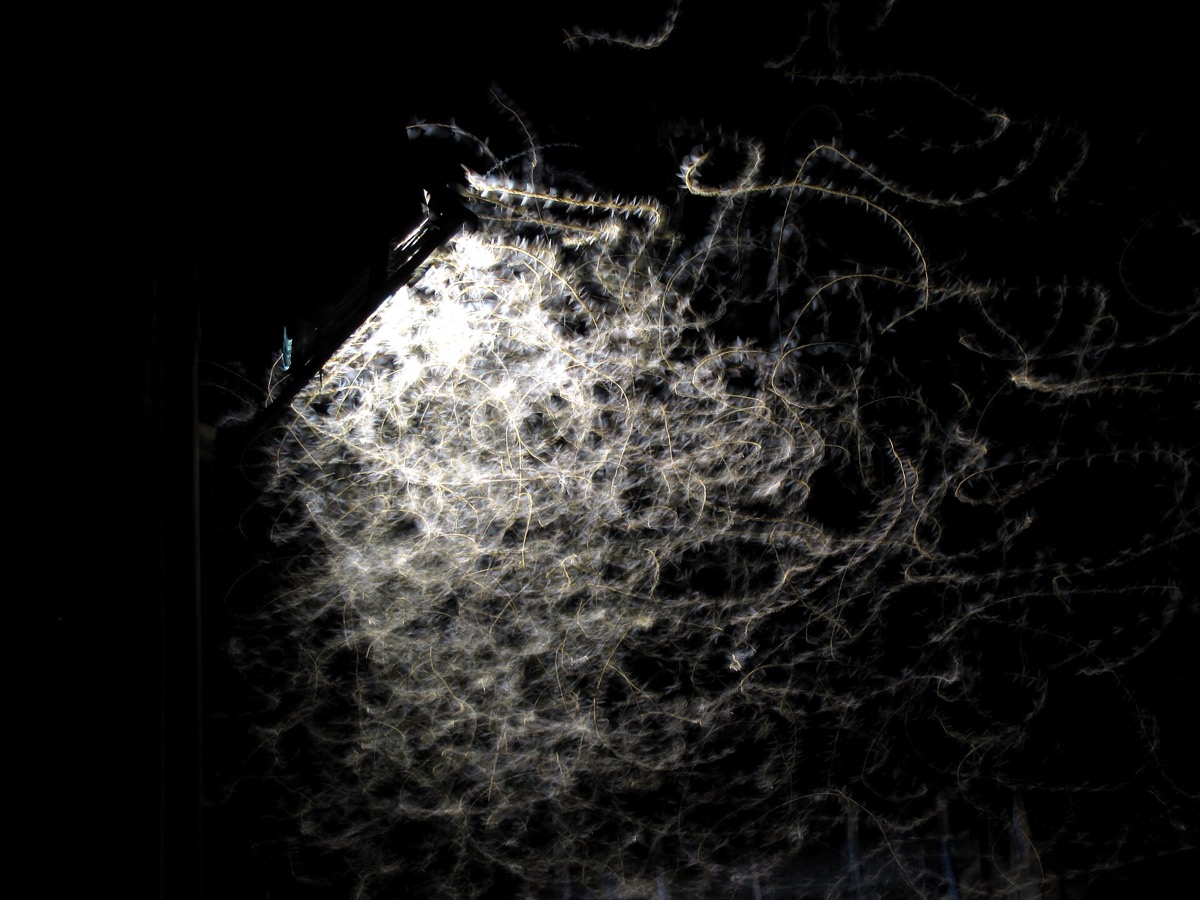
In open air the brightest part of an insect’s visual field is usually the sky, and insects use it to keep their backs pointed upward. Next to a lamp that rule stops working. What happens to them?
The lamp hijacks the stabilizer. of flight near light sources showed that fires by mistake: the insect turns its back toward the lamp instead of flying at it. That is the difference between attraction and a hijacked reflex, and with a close source whose angle keeps changing, holding onto it produces a constant tilt. Hence the circling, the stalling in mid-air and sometimes the flip and dive.
The assumption is that insects are drawn to light, and if that were so they would point their heads at it and get there.
In open air the brightest part of the visual field is the sky, and insects use it to keep their backs upward. It is a simple way to orient with no gravity sensor.
The researchers tracked flight near light sources in three dimensions and found the lamp hijacks that mechanism. is the whole question, and the insect turns its back toward the lamp instead of flying at it. Three-dimensional tracking is needed for exactly this, because the path alone looks similar under either hypothesis.
With the source close and its angle changing, holding onto it produces a constant tilt, and hence the , with a stall in mid-air in between. Understanding the trap can help design night lighting that does less harm. Not every species responded the same way, and the experiments focused on a short range around a light source.
wat. An insect near a lamp mistakes the light at its side for the sky, turns its back to it, and winds itself around the source again and again.
wat wat
Understanding the mechanism of the trap can help design night lighting that does less damage to insects and to the ecosystems that depend on them.
How do we know?
Stereoscopic filming in the field and high-speed motion tracking in the laboratory reconstructed 477 flight paths of insects from ten orders around different light sources.
What is still unknown
Not every species responded the same way, and the experiments focused on a short range around a light source. On their own they do not measure the harm to populations over time.
Learn something?
Where to next
 Why do leaves under a streetlight stay more intact?insects
 How long can a bird stay in the air without landing?flight
 How can a cloud hang motionless over a mountain in a gale?flight