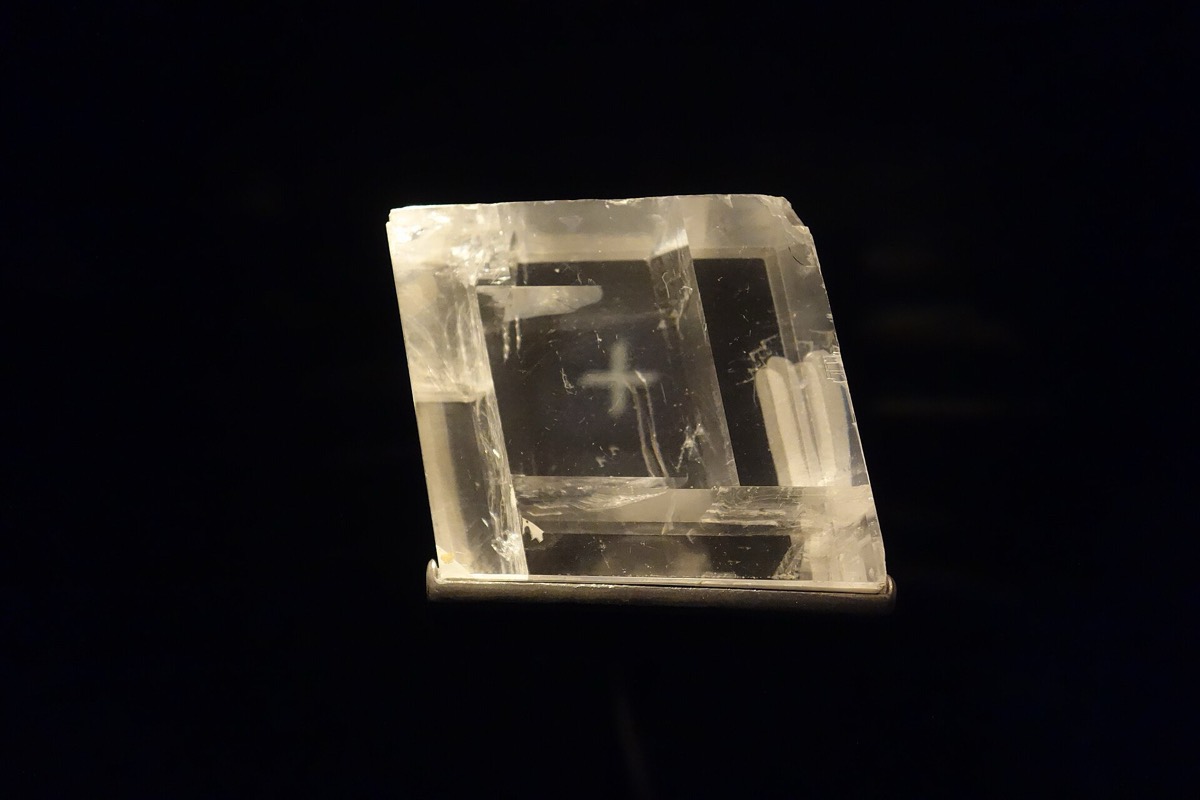
The light of the sky is in a pattern that depends on where the sun is, even when the sun itself is hidden by cloud. Our eyes cannot see polarization. But there is a crystal that responds to it. What can be done with that?
You can read an axis off the sky. in a calcite crystal of the kind splits a ray into two images with different polarization. Turning it until the two images are equally bright gives the direction of the polarization, and from that an estimate of where the sun is. This is the basis for the hypothesis that could have helped navigation in the North Atlantic under cloud.
The light of the sky is polarized in a pattern that depends on where the sun is, and the eye cannot detect it at all. This is information present up there and available only to someone with an instrument to read it.
A transparent calcite crystal splits a ray into two images carrying different polarization, so the ratio of their brightness gives away the polarization direction of the incoming light.
Turn the crystal and look for the position where both images are equally bright, and you have measured an axis in the sky. From there the position of the sun can be estimated even behind cloud.
This is the basis for the hypothesis that a sunstone, mentioned in Norse sources with no account of a mechanism, could have aided navigation in the North Atlantic. Optical and navigation experiments tested the accuracy under different sky conditions and showed the method is possible, and no direct evidence shows that Viking sailors navigated this way.
wat. Iceland spar can reveal the polarization pattern of the sky, and the Viking use of it remains a hypothesis.
wat wat
The method shows that a direction can be extracted from a property of light invisible to the eye, with no magnetic compass.
How do we know?
Optical and navigation experiments tested the accuracy of calcite crystals under different sky conditions, and a review set the results against the archaeological sources.
What is still unknown
The experiments prove the method is possible, and there is no direct evidence that Viking sailors actually navigated using calcite crystals.
Learn something?
Where to next
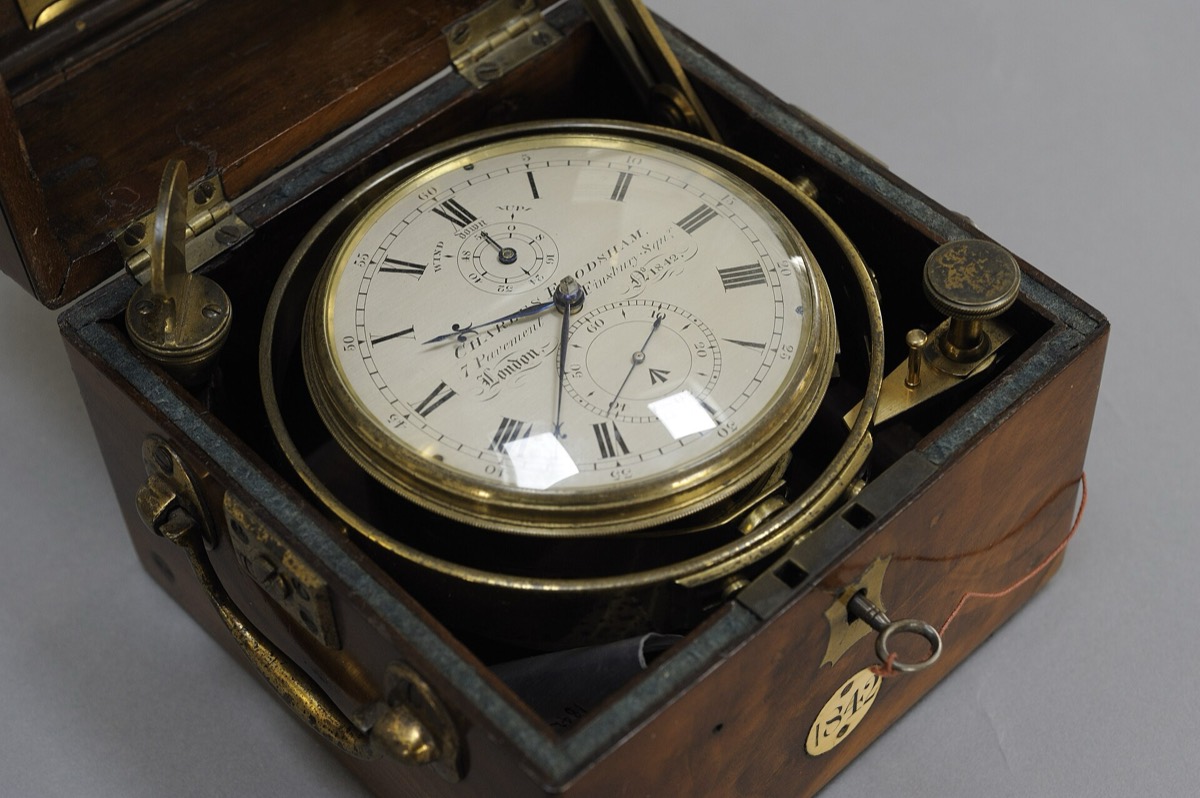 Which problem sank whole ships until one clock was invented?navigation
 Did Vikings wear horned helmets?Vikings
 What would happen to the navigation on your phone without relativity?navigation