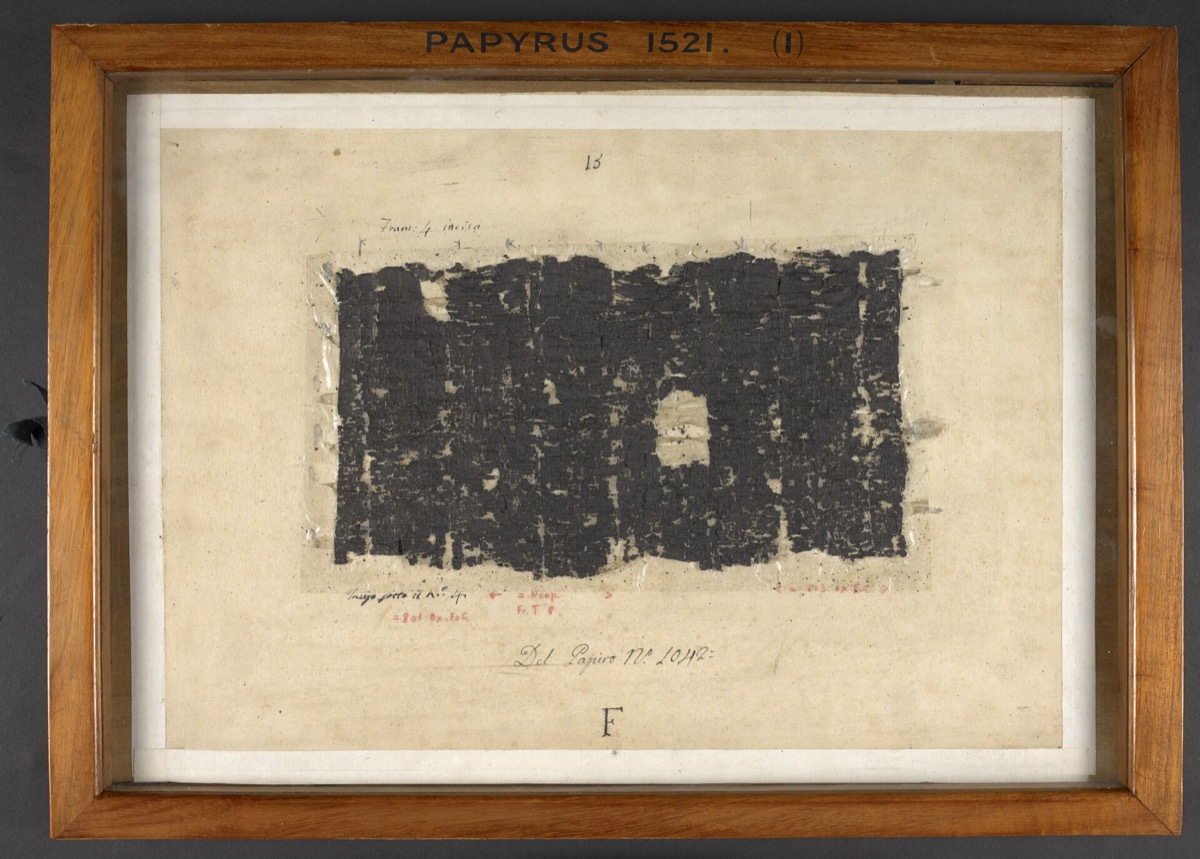
Vesuvius buried Herculaneum under twenty meters of volcanic ash in October of AD seventy-nine, and the scrolls in a villa library there were . Early attempts to open them produced a mess of fragments, and more than six hundred remain intact and unopened. X-ray scanning can see inside. The difficulty is that the ink is carbon, the same density as the papyrus under it. How do you find letters that do not show up?
By texture, not brightness. Brent Seales realized that computed tomography scans might capture tiny differences in surface texture where papyrus is coated with ink, even with no difference in density. Luke Farritor, a twenty-one-year-old computer science student, trained a neural network on exactly those differences and detected Greek letters on several lines of a rolled-up scroll, including the word for purple.
The scrolls were discovered in the eighteenth century when workmen came across the remains of a luxury villa that might have belonged to the family of Julius Caesar’s father-in-law. Hundreds had been buried when Vesuvius left Herculaneum under twenty meters of ash. Most of the identified texts are Greek and relate to the Epicurean school, including work by a little-known philosopher named . Early attempts to open them created fragments, and scholars feared the rest could never be unrolled or read.
Seales spent years building a way to them from computed tomography scans, and proved the approach in twenty sixteen on a charred scroll from , recovering sections of Leviticus. That ink contained metal and glowed on the scans. Herculaneum ink is carbon-based, essentially charcoal and water, with the same density as the papyrus it sits on, so it does not show up at all.
His insight was that density is not the only signal. Scans might still capture tiny differences in texture where the papyrus is coated with ink. He trained an artificial neural network to read letters in X-ray images of opened fragments. Then, in twenty nineteen, he carried two intact scrolls from the Institut de France to a synchrotron near Oxford and scanned them at four to eight micrometres per voxel.
Rather than work alone, the team released all their scans and code and launched the Vesuvius Challenge, on the grounds that reading the contents sooner mattered more than hoarding the method. Around fifteen hundred teams gathered on Discord, with each milestone’s winning code released for everyone to build on. Luke Farritor took the first letters prize of forty thousand dollars, and Youssef Nader of the Free University of Berlin came second.
wat. The ink is charcoal on charcoal, invisible to the scan, and the letters were found in the roughness of the surface instead.
wat wat
Most classical texts survive only through centuries of copying by scribes. The Herculaneum library holds works not known from any other source, direct from their authors.
How do we know?
Jo Marchant, writing for Nature and Scientific American, reports the Vesuvius Challenge result, the method behind it and the reactions of papyrologists and historians who reviewed the findings.
What is still unknown
This is more than ten characters in a four square centimeter area of one scroll. The main Vesuvius Challenge prize, for reading four or more passages, was still unclaimed at the time of the report.
Learn something?
Where to next
 What can a Roman sewer tell you that a villa cannot?herculaneum
 Does a plant under stress make any sound you could pick up?machine learning