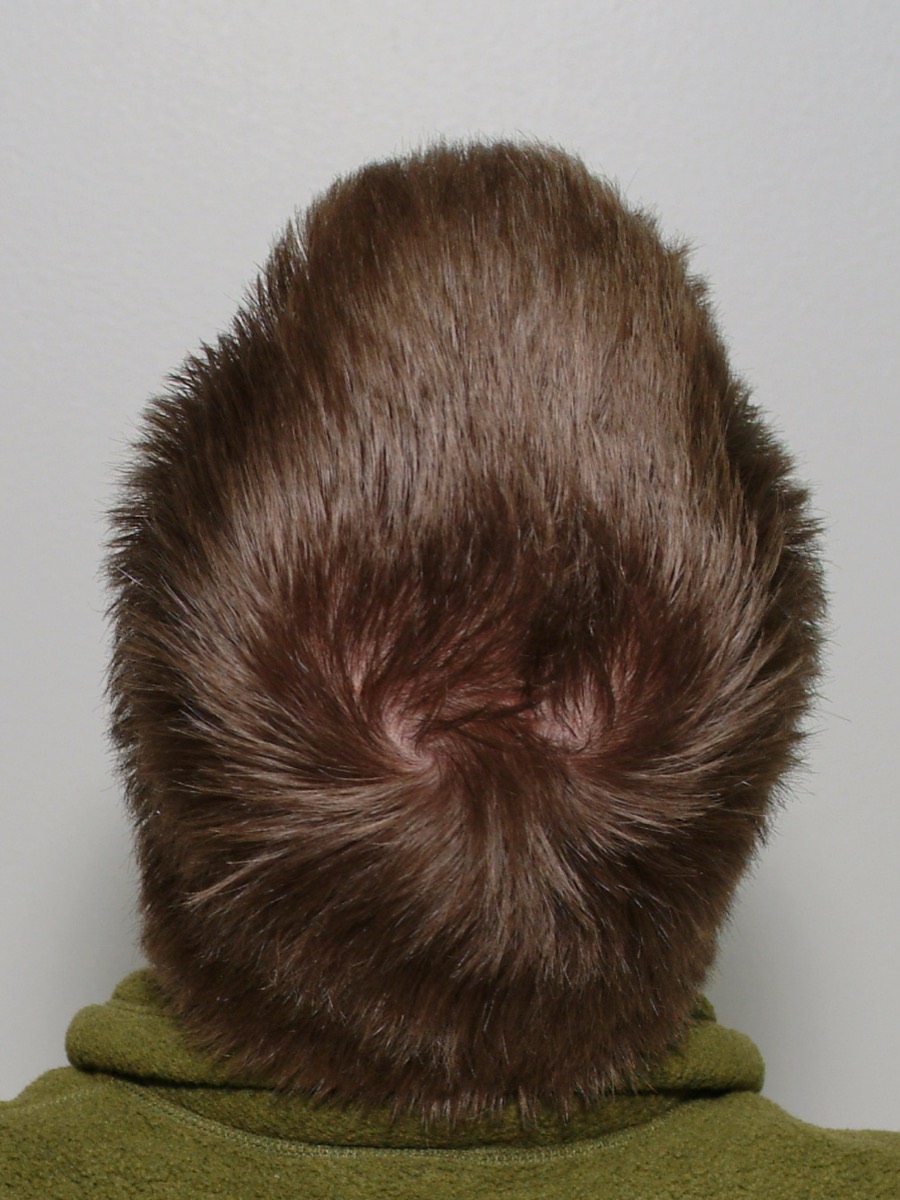
The mechanisms setting the side and the of a are unknown, which is odd for something visible on every head. Twins are the obvious test of how much of it is genetic. And because vortex phenomena elsewhere depend on which side of the equator you are, the authors also compared children born in France against children born in Chile. What did the twins show?
Twins tend to whorl the same way. Across 37 twin pairs, the odds of two twins having opposite rotation directions differed from the no-association value, meaning whorls rotated preferentially in the same direction within a pair. The comparison used all possible pairings of unrelated children as . The authors conclude whorl formation is a genetically determined developmental process that extrinsic environmental factors can still influence.
Nobody knows what determines the laterality or the rotation direction of a hair whorl. It is a visible, binary, early-forming trait, which makes the gap in the literature more conspicuous than important, and also makes it tractable: you can count whorls on a lot of heads quickly.
The design had two parts. Twins test the genetic contribution, because a trait set by DNA should match within a pair more often than chance allows. And since vortex phenomena in other settings depend on geography, the authors added comparative data from children born in the Northern hemisphere, in France, and the Southern hemisphere, in Chile.
Three groups were included retrospectively: a Northern hemisphere general population, a Southern hemisphere general population, and same-sex Northern hemisphere twins. Rotation direction, whorl position and were recorded. For the twins the variable of interest was binary, whether a pair shared a rotation direction or not, and all single combinations of unrelated children served as virtual twins for comparison.
Seventy-four twins, in 37 pairs, and 50 children from each hemisphere’s general population were included. The odds of opposite rotation directions between two twins differed from the value expected under no association, meaning whorls rotated preferentially in the same direction within a pair. The authors conclude that whorl formation is a genetically determined developmental process which extrinsic environmental factors can nonetheless influence. Read it as a small retrospective study pointing a direction, not settling one.
wat. Twins usually whorl in the same direction, which makes the pattern largely inherited and not entirely so.
wat wat
A whorl is a visible trace of how the skin and hair follicles organized themselves very early in development. Anything that pins down what sets its direction is a window on that process.
How do we know?
Willems and colleagues retrospectively included 74 same-sex Northern hemisphere twins, in 37 pairs, plus 50 children from the general population of each hemisphere, recording rotation direction, whorl position and twinning type.
What is still unknown
Seventy-four twins and 50 children per hemisphere is a small study, and it is retrospective. The authors leave room for environmental influence rather than claiming the genetics settle the matter.
Learn something?
Where to next
 Where did the tool for rewriting genes come from?genetics
 What keeps time in a body that has no clock in it?genetics
 Why does no two people share a fingerprint, not even identical twins?development