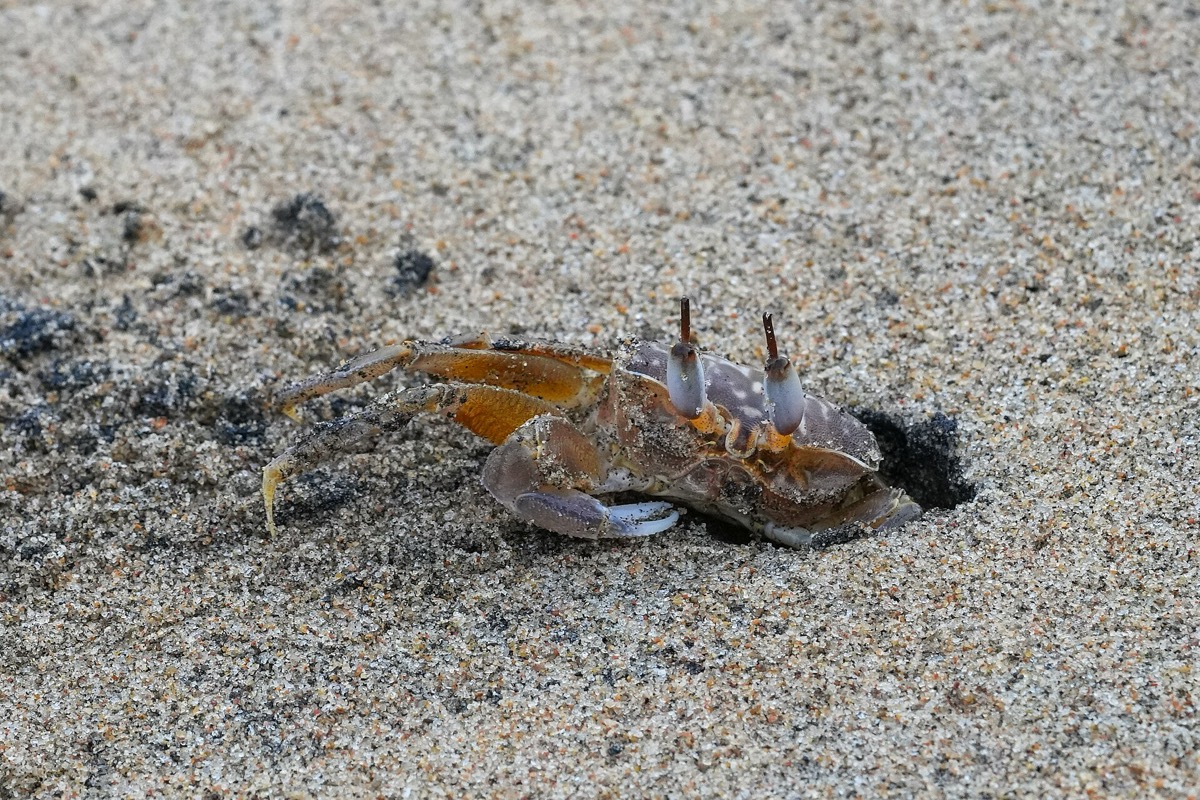
Counting visitors does not measure the damage to a beach: one person walks through leaving nothing, another leaves litter behind. Looking for a more sensitive gauge, several crab species were compared along a of urbanization, visitors and rubbish. What turned up?
Two species that track the pressure. The Atlantic ghost crab and one other were especially sensitive along the gradient, which lets them serve as of environmental change. The researchers measured visitors, litter and separately rather than rolling them into one index, and that separation is what shows people and rubbish are distinct pressures.
The problem being solved here is a measurement problem. Counting visitors does not measure damage to a beach: one person passes leaving nothing, another leaves rubbish, treads on burrows and brings a dog. So you need a gauge that responds to what happened on the sand rather than to what came through the gate.
The idea is to use a creature as the gauge. Ghost crabs live in burrows in the wet sand strip, and they are common enough to count at night with no complex equipment. They are also sensitive to trampling, to light and to changes in the sand. Whatever meets those three conditions is a candidate indicator.
The researchers compared several crab species along a gradient of beach urbanization, and measured visitors, waste and organic matter separately instead of combining them into one index. The separation matters, because it shows what is actually doing the harm: not every urban beach is dirty, and not every dirty beach is crowded.
Two species stood out for their sensitivity along the gradient, which lets them serve as an early signal. What an indicator species does not do is explain: it says where there is a problem and not what causes it, and a correlation between waste and does not identify a single mechanism. The results also come from Brazilian beaches and do not transfer automatically to every coast.
wat. Ghost crabs revealed that litter and visitor numbers are separate pressures, so counting people alone misses part of the damage.
wat wat
A common animal can measure an impact invisible on a short visit, and separate the load of people from the load of rubbish.
How do we know?
Models linked crab abundance along a gradient of beach urbanization to separate measurements of visitors, waste and organic matter.
What is still unknown
A correlation between waste and abundance does not identify a single mechanism, and results from Brazilian beaches do not carry over to every coast.
Learn something?
Where to next
 Can you count park visitors from the pictures they post?tourism
 Why do people choose to visit a place tied to disaster or death?tourism
 How does a sponge keep its own filter from clogging?waste