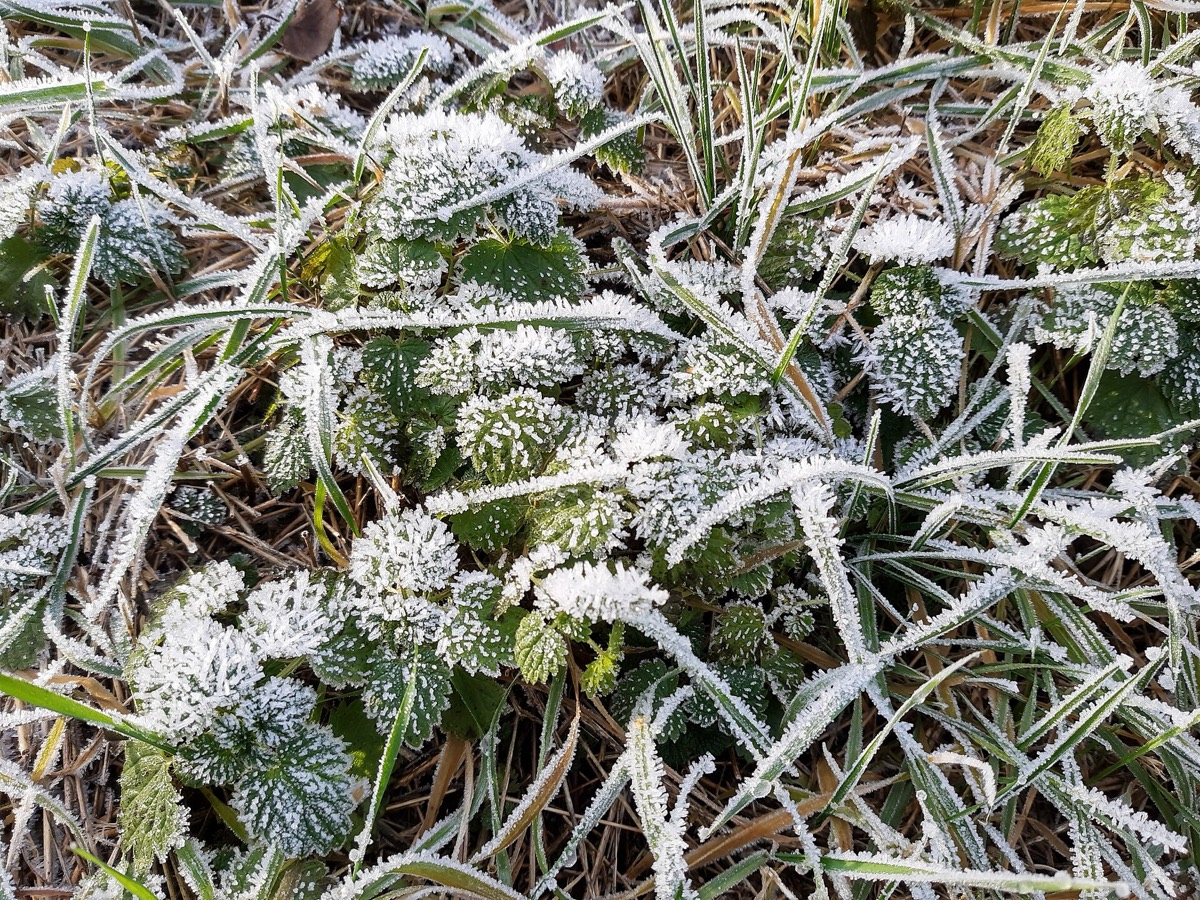
No. Frost is the fuzzy layer of ice crystals on a cold object that forms by of water vapor to solid ice. There is no liquid stage. , the proper name for the interlocking hoar crystals you find on branches and wires, forms much as dew does, except that the object’s temperature must be below freezing.
Which object matters. Hoarfrost favors things of small diameter freely exposed to the air: tree branches, plant stems, leaf edges, wires and poles. It appears when air with a dewpoint below freezing is brought to saturation by cooling. The same deposition also happens in unheated buildings and vehicles, in caves, in crevasses, on snow surfaces and in .
The common assumption is that frost is frozen dew, and the definition rules it out. Frost is the fuzzy layer of ice crystals on a cold object, such as a window or a bridge, that forms by direct deposition of water vapor to solid ice. The water never passes through a liquid stage on the way.
The word also carries a second meaning, which is the condition that exists when the temperature of the earth’s surface and earthbound objects falls below freezing. Frost may occur in several forms, depending on air temperature, dewpoint and the temperature surface objects reach. They include a general freeze, hoarfrost or white frost, and dry freeze or black frost. A frost severe enough to end the growing season is a killing frost.
Hoarfrost is the version most people picture. It is a deposit of interlocking hoar crystals, formed by direct deposition on objects usually of small diameter freely exposed to the air: tree branches, plant stems, leaf edges, wires and poles. Its deposition is similar to the process forming dew, except that the befrosted object must be below freezing, and it forms when air with a dewpoint below freezing is brought to saturation by cooling.
It appears in more places than the garden. Beyond freely exposed objects, which gives air hoar, hoarfrost forms inside unheated buildings and vehicles, in caves, in crevasses, on snow surfaces and in the air spaces within snow, especially below a snow crust. It can even form on an aircraft skin when a cold aircraft flies into warm moist air. Hoarfrost is more fluffy and feathery than , which is in turn lighter than glaze. One caution: these are glossary definitions, with no temperatures or rates attached.
wat. Frost never was water; it went straight from vapor to ice.
wat wat
Skipping the liquid phase is why frost looks the way it does. Crystals grown straight from vapor interlock and branch, which is a different structure from water that froze where it sat.
How do we know?
The American Meteorological Society’s Glossary of Meteorology defines frost and hoarfrost separately, gives the deposition mechanism, lists the surfaces and settings involved, and ranks the resulting deposits against rime and glaze by density.
What is still unknown
Glossary definitions, compact by design. They give forms, settings and comparisons without temperatures, rates or the crystal physics behind the branching.
Learn something?
Where to next
 Does cloud seeding actually work?weather
 Who punches an almost perfect circle through a layer of cloud?ice
 How does a round disk of ice start turning on still water?ice