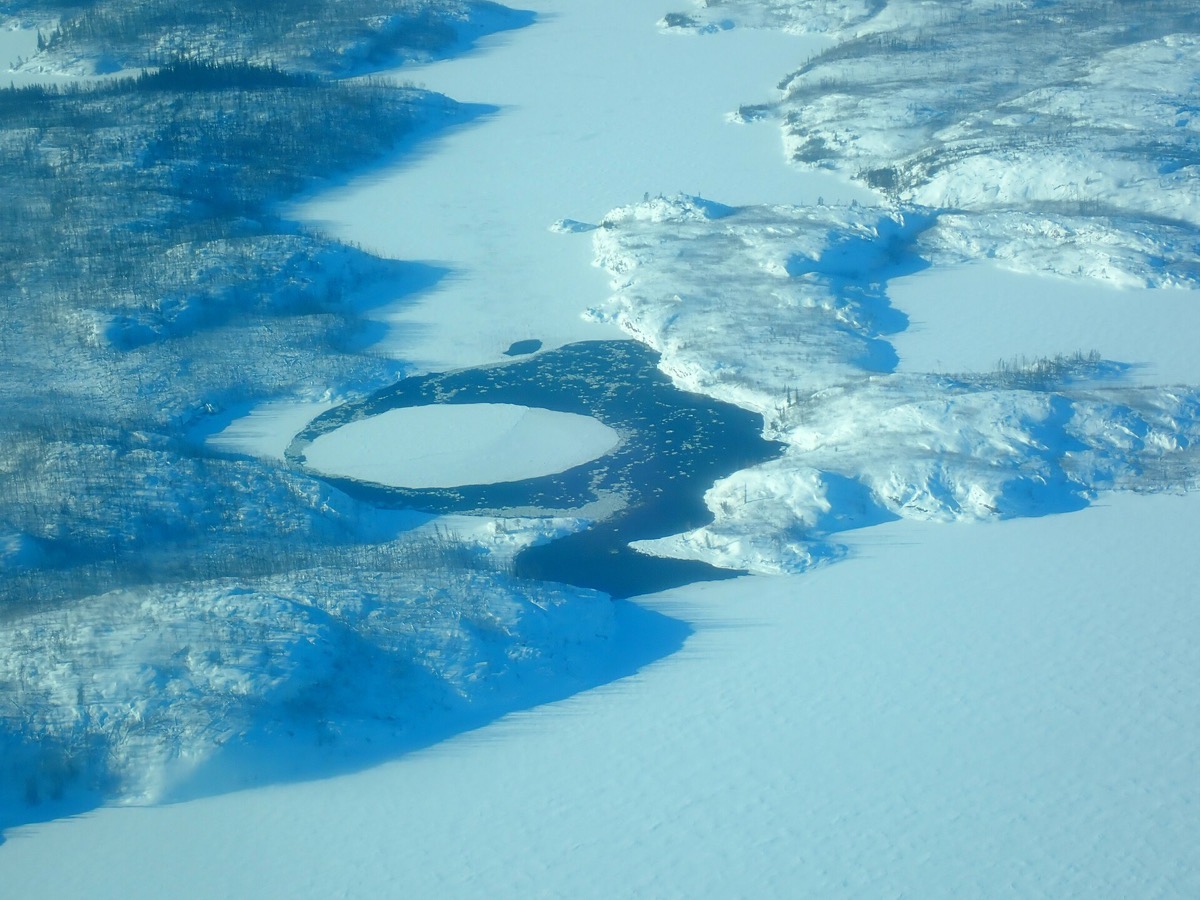
Ice circles turn slowly on rivers and lakes, and an earlier laboratory study concluded that a melting disk can induce its own rotation, with the cold meltwater sinking beneath it. A later team went back to the experiment, paying attention to how carefully the water was held still. Does a disk really turn itself?
Not on its own. Placed on nominally quiet fresh water, the disks behaved unpredictably: some stayed motionless, others turned clockwise, others counterclockwise. Those that did move averaged less than half the rotation rate reported before. Disks of plastic cooled to the same temperature, which do not melt at all, also rotated, though more slowly, so melting is not what starts the motion.
A disk of ice turning slowly on a river is one of those sights that demands an explanation. A laboratory study in 2016 appeared to give one: in controlled conditions, melting disks induce their own rotation.
The mechanism sounded right. Meltwater is colder and denser than the water around it, so it sinks beneath the ice as a plume. A sinking flow in a confined space tends to organize itself into rotation rather than falling straight down.
Returning to the experiment, a later team found the behavior was not reliable. On nominally quiescent fresh water some disks sat still, others turned clockwise and others counterclockwise, and the ones that moved averaged less than half the previously reported rate.
The decisive test used a that cannot melt. Polyethylene disks chilled to the same temperature, within about 4 percent of the same mass, rotated too, if more slowly. The authors conclude that already present in the water are the underlying trigger, with the turbulent amplifying them. The original self-rotation claim looks like an artifact of how still a tank can really be.
wat. Ice disks on still water turn in either direction or not at all, which points at residual motion in the water rather than at the melting.
wat wat
A tidy explanation that everybody repeated turns out to rest on how still the water in the tank really was, which is a lesson about experiments rather than about ice.
How do we know?
Schellenberg, Newton and Hunt repeated the floating-disk experiment with attention to technique. They compared melting against non-melting polyethylene disks, cooled to the same temperature and differing in mass by only about 4 percent.
What is still unknown
This is a freshwater tank at laboratory scale. Natural ice circles also meet river currents, eddies and collisions, and the conclusion concerns what triggers rotation rather than everything that sustains it.
Learn something?
Where to next
 Who punches an almost perfect circle through a layer of cloud?ice
 How fast did salmon return to a river after the dams were taken out?rivers
 What arranges stones into stripes and circles on cold ground?ice