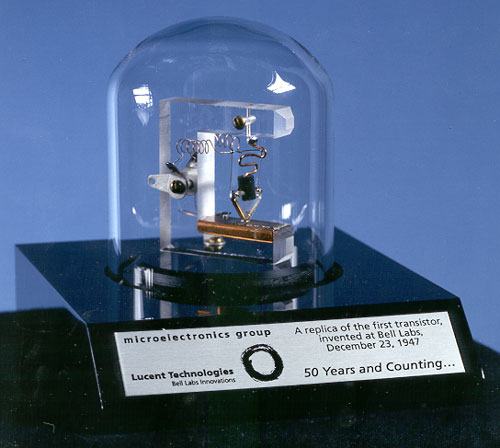
A way to unblock a blocked contact. Bardeen and Brattain moved a tiny probe across a surface under a microscope, using a micrometer screw, mapping the region near a negative electrode where the charge carriers had fled. When they made the probe positive and close to the electrode, the blockade lifted. The probe was injecting , and that is .
The useful part is how little it costs. A current in a rectifier can be controlled by injecting rather few holes, around which the negative carriers gather, and the holes do not require much energy. The result works much like a radio valve, but smaller, and with no current needed to heat a filament. Hearing aids, computing machines and telephone stations all needed exactly that.
Electrical engineering grew up on two extreme classes of material: metallic conductors, with a mobile charge carrier for roughly every atom, and insulators, with almost none. The speech puts the ratio memorably. If the Easter pilgrims in Piazza San Pietro represented the carriers in a metal, an insulator would resemble the Antarctic with one solitary traveler.
Semiconductors sit between, and they can be tuned. A pure element such as germanium or silicon has very few carriers, but small additions change that. A phosphorus atom forced as a lodger onto silicon donates one negative electron. A boron atom instead steals an electron from its host, leaving a hole that migrates and acts as a positive carrier. A few parts in a hundred thousand make a good semiconductor.
By the nineteen thirties, based on semiconductors were finding important uses, and attempts were made to control them with an extra electrode, just as a radio valve is controlled by its grid. These attempts failed. Then in 1948 the discovery of transistor action gave Shockley, Bardeen and Brattain the key to the control mechanism, and a new tool for investigating semiconductors generally.
The experiment itself was patient and small. The physicists at Murray Hill set out to map the carrier-poor region near a negative electrode, using a movable probe on the semiconductor surface. It is done much as one prospects electrically for ore, at an entirely different scale. Bardeen and Brattain moved their tiny probe under the microscope with a micrometer screw, and found that making it positive close to the electrode lifted the blockade: the probe was injecting holes. One caution: this is a ceremony speech, which teaches by analogy and divides credit in a sentence.
wat. A tiny positive probe, a lifted blockade, and the valve stopped needing a hot filament.
wat wat
People had tried for years to control semiconductor rectifiers with an extra electrode, as a radio valve is controlled by its grid, and had failed. The discovery supplied the missing control mechanism.
How do we know?
The presentation speech for the 1956 physics prize, by Professor E. G. Rudberg, describes the probe experiment at Murray Hill, the discovery of transistor action in 1948, and the experiments that followed.
What is still unknown
An award ceremony speech written for a general audience, which explains the physics by analogy and compresses the division of work between three laureates into a few sentences.
Learn something?
Where to next
 Why did a blue light take thirty years longer than a red one?semiconductors
 What did Gordon Moore actually predict, and for how long?semiconductors