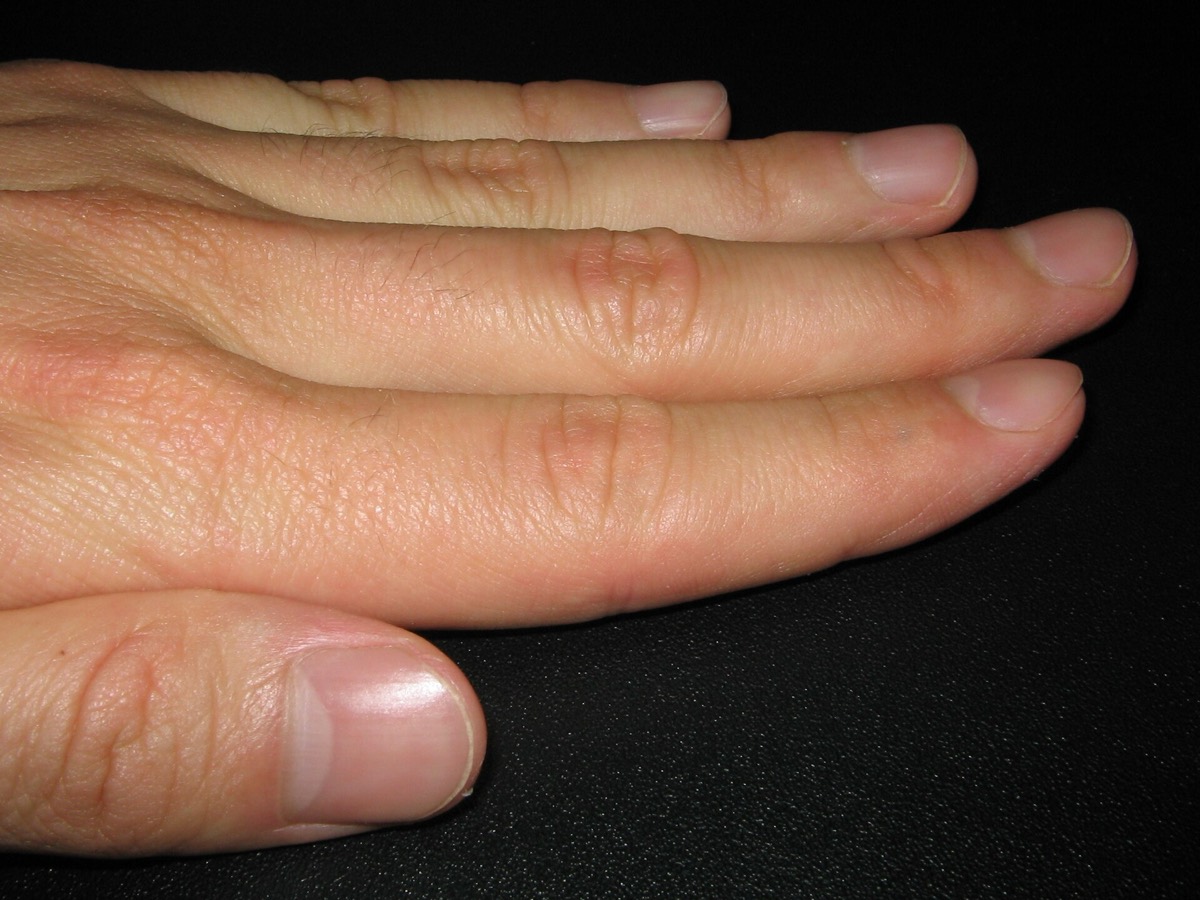
The physician William Bean marked and measured the same fingernail over and over for thirty-five years. It is a sample of one person, and there is almost no other record this continuous on a living human being. What did it show?
A slow decline nobody would catch otherwise. On the left thumbnail the average growth rate fell from 0.123 millimeters a day at 32 to 0.095 at 67, which is almost a quarter. The value of a study like this is consistency rather than representativeness. Comparing young people against old mixes differences between generations into differences of age, and here age was the only thing that changed.
A physician marked and measured his own nails over and over for thirty-five years, from the age of thirty-two to sixty-seven. A , and .
The measure itself is simple: millimeters a day, from a fixed mark to the edge. It is one of the easiest biological measures to repeat precisely across decades.
On the left thumbnail the average fell from a little over twelve hundredths of a millimeter a day to under ten, a decline of almost a quarter.
The value of a study like this is not in being representative but in being consistent. A one-off comparison between young and old people mixes generational differences into differences of age, and here age was the only variable that moved. Which leaves , and this answers one: it is one person studying himself, so it cannot give the average rate of decline in a population.
wat. Across 35 years of follow-up, one thumbnail slowed its growth by almost a quarter between the ages of 32 and 67.
wat wat
A long follow-up can expose a slow change that a one-off comparison between young and old people may miss entirely.
How do we know?
Bean tracked the growth of his own nails repeatedly from the age of 32 to 67, and published the full series of measurements.
What is still unknown
This is one person studying himself, so it cannot give the average rate of decline in a population.
Learn something?
Where to next
 What happened to the memory of mice when their gut bacteria were swapped?aging
 Does treating hearing loss slow cognitive decline?aging
 Is there an animal that can start its life over?aging