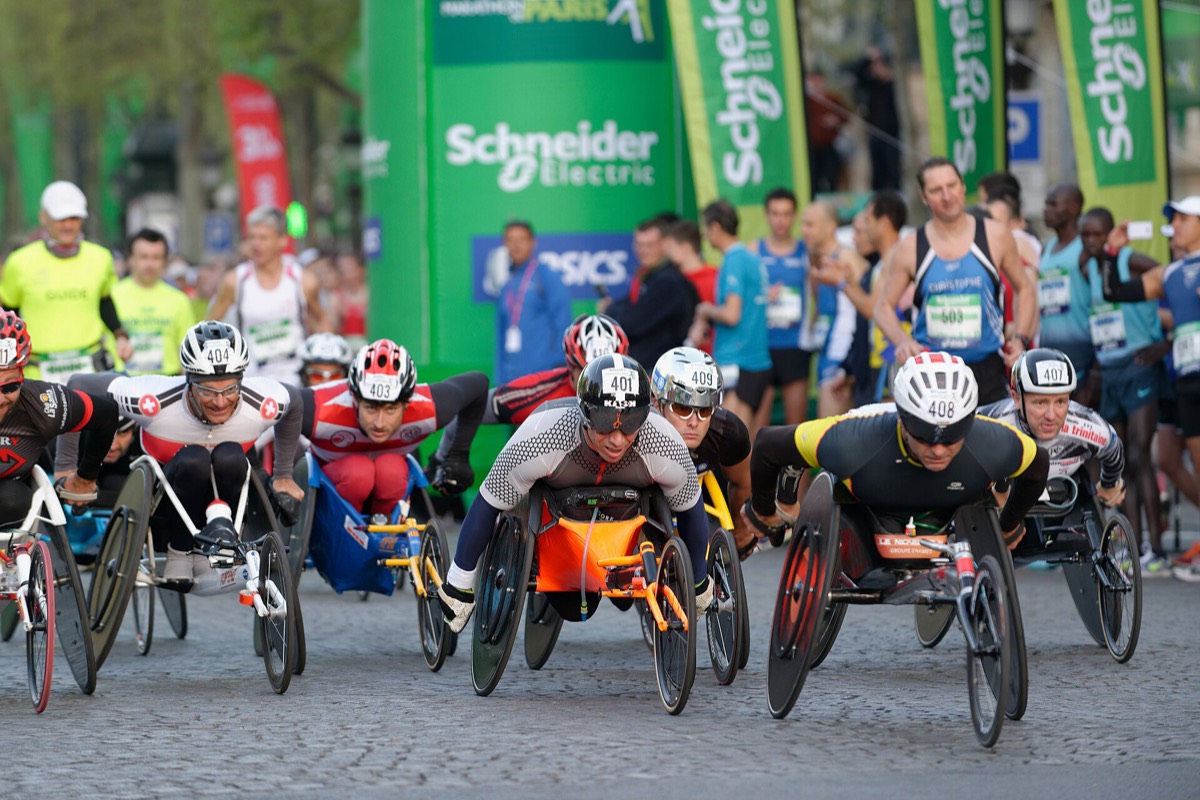
Yes, and the gap is large. Ristanović and colleagues took the official splits of two hundred and eight thousand finishers at the Vienna City Marathon and half-marathon between 2006 and 2018. Everyone slowed over the course of the race. But the slowest quartile of men changed speed by about 7.9 percent in the marathon, against 4.14 percent for the fastest quartile.
The same pattern holds for women, at about 5.83 percent in the slowest quartile against 3.16 percent in the fastest. It holds in the half-marathon too, where everyone’s pacing is steadier than over the full distance. So the finding is not that good runners avoid slowing down. It is that they slow down less, and more smoothly.
Pacing is the distribution of effort over a race, and a great deal of advice exists about how to do it. Ristanović and colleagues had an unusually large body of evidence to test it against. They used the official results and split times of two hundred and eight thousand seven hundred and sixty finishers of the Vienna City Marathon and half-marathon between 2006 and 2018.
The method divides each race into and measures how speed changed across them. For the marathon the segments run to the tenth kilometer, then ten to twenty, twenty to thirty, thirty to forty, and from forty kilometers to the finish. Half-marathon segments are half those lengths. Runners were then grouped into quartiles of placement, separately for each sex and race.
turned up everywhere. Every performance group in both sexes and both races slowed down over the course of the event, which is a useful corrective to the idea that only amateurs fade. What separated the groups was the size of the change. The low-level groups showed an of about 7.9 percent for men and 5.83 percent for women in the marathon. The high-level groups showed about 4.14 percent and 3.16 percent.
The authors’ summary is that better runners showed more even pacing than slower runners, and that half-marathoners paced more evenly than marathoners across all . Two cautions. The race effect in women was statistically significant but carried a very small effect size. And this is observational, so whether even pacing produces fast running or fast running permits even pacing is not something race splits can settle.
wat. Everyone fades in a marathon; the good ones just fade less.
wat wat
Pacing advice usually assumes the even split is a technique anyone can adopt. This shows it tracks performance level closely, which leaves open whether steady pacing makes a fast runner or a fast runner makes steady pacing.
How do we know?
Official results and split times came from seventy-five thousand marathon and a hundred and thirty-three thousand half-marathon finishers. Each race was divided into five segments, and the change of speed across them was calculated for performance quartiles by sex and race.
What is still unknown
An observational analysis of race results, so it cannot say which way the causation runs. Speed change is also a crude measure of pacing, and the race effect in women was significant but with a very small effect size.
Learn something?
Where to next
 How much time does a marathon runner save by staying inside a pack?marathon
 Why do so many marathon runners finish just before a round hour?marathon
 What is the human body unusually good at?running