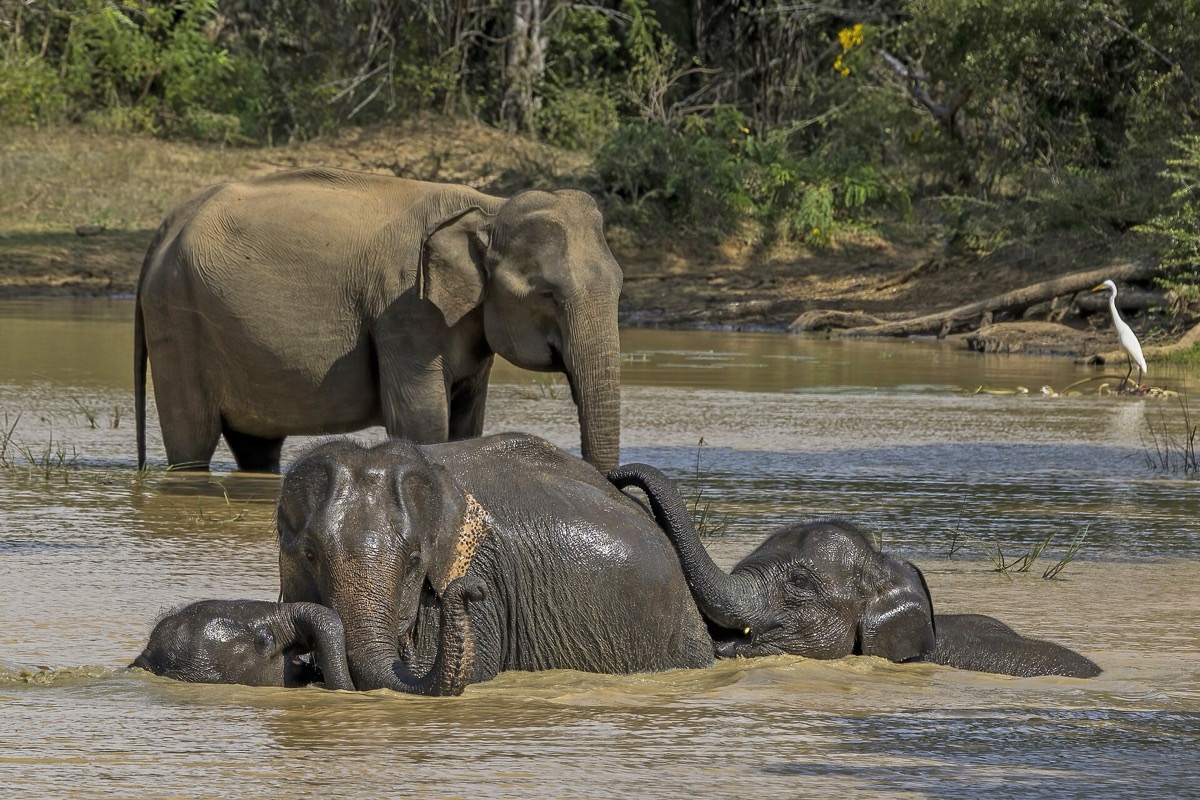
Cooperation pays when joint action produces more than each animal could get alone, and selection also rewards whoever can grab the shared result. How animals keep that second pressure in check has been argued mostly over primates. Li and colleagues set semi-wild Asian elephants on a loose-string apparatus that only works if two pull together, and then varied how much food was on offer. Where does it break?
It holds until the reward gets thin. Across forty-five sessions the elephants cooperated at an average rate of about eighty percent, handling competition with a repertoire of strategies: block, fight back, leave, move side, and submission. Which one they used depended on rank and . When the food reward was limited, the costly behaviors, monopoly and fight, rose significantly and cooperation broke down rapidly.
Cooperation is everywhere in the animal kingdom because joint action can produce more than solo action. The same logic rewards an individual who lets others do the work and then takes the result, so any stable cooperation needs some way of keeping competition in check. That question has been fought over largely in primates.
Li and colleagues took it to Asian elephants, semi-wild animals that know each other, using a where the food only arrives if two individuals pull together. Across forty-five sessions the cooperation rate averaged around eighty percent, which is high.
Competition did occur, and the elephants met it with a set of the authors coded as block, fight back, leave, move side and submission. The choice tracked the social relationship. They tended to fight back as a when the initiator was low ranking or closely affiliated, and to submit when the initiator outranked them or was not a close associate.
Then the reward was made limited, and the picture changed fast. Costly competitive behaviors, monopoly and fight, increased significantly, and cooperation broke down rapidly. The instability that follows a reduction in benefit is the part the authors note resembles human society, which points at shared principles underlying how cooperation evolves rather than at elephants being like us.
wat. Eighty percent cooperation while there was enough to go round, and a fast collapse once there was not.
wat wat
Cooperation looks stable right up until the moment the benefit shrinks, and the elephants’ collapse under scarcity mirrors something uncomfortably familiar in human arrangements.
How do we know?
Li and colleagues ran semi-wild Asian elephants on a loose-string pulling apparatus across forty-five sessions, coding cooperative and competitive acts and varying the size of the food reward.
What is still unknown
Semi-wild elephants that already know each other, on one apparatus with one kind of reward. The strategies are coded from observed behavior, so the labels carry the observers’ interpretation.
Learn something?
Where to next
 What do elephants hear through the soles of their feet?elephants
 How does a group of male elephants decide it is time to leave?elephants
 Do elephants call each other by name?elephants