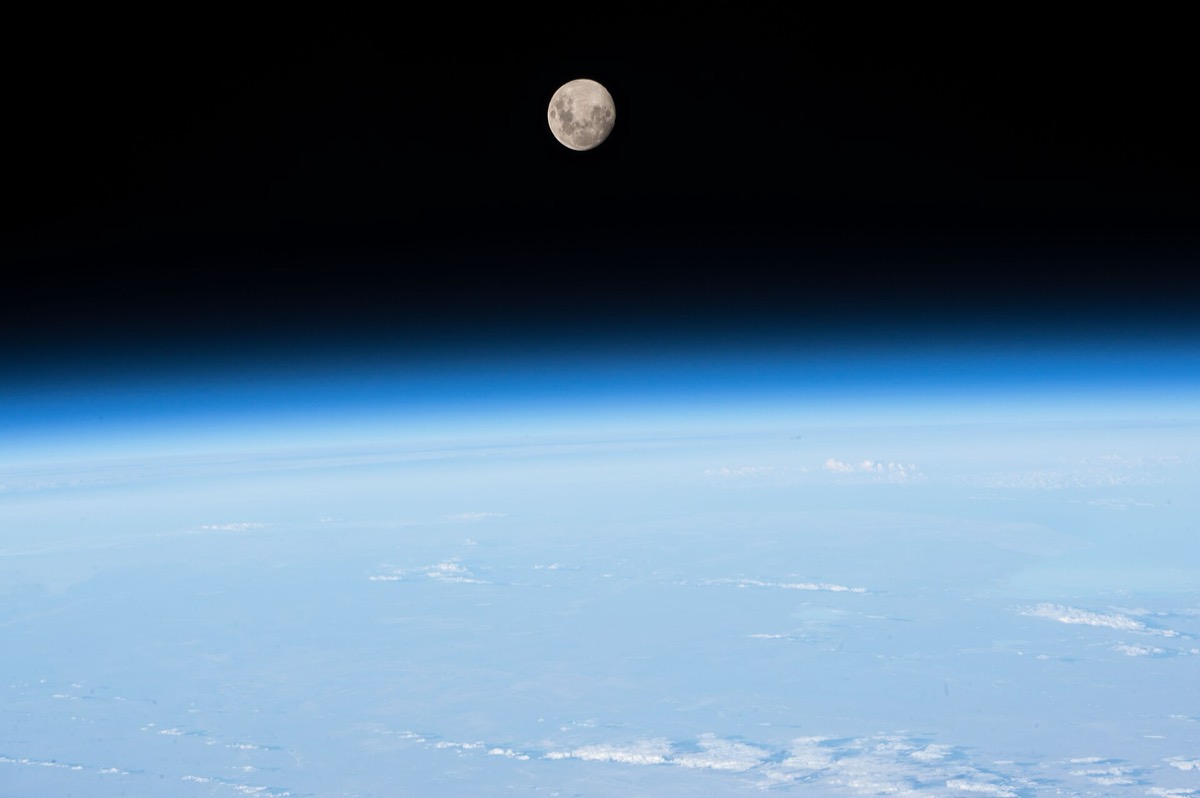
A sliver at the bottom. The starts at the ground and extends up to about ten kilometers, and nearly all weather happens inside it, along with most clouds, because ninety-nine percent of the atmosphere’s water vapor is there. The boundary conventionally taken as the edge of space sits at about a hundred kilometers.
Above the troposphere the air thins fast. At the bottom of the , about fifty kilometers up, air pressure is already well below one percent of sea level pressure. In the the air is so thin that UCAR calls it in many ways more like outer space than part of the atmosphere, even though its temperature runs to hundreds or thousands of degrees.
The atmosphere is a series of layers, each with its own traits: moving upward from ground level, the troposphere, , mesosphere, thermosphere and exosphere, the last fading away into interplanetary space. Written as a list they sound comparable. In terms of where anything happens, they are not.
The troposphere extends from ground level up to about ten kilometers, a little over six miles. We live in it, nearly all weather occurs in it, and most clouds appear in it, mainly because ninety-nine percent of the atmosphere’s water vapor is found there. Air pressure drops and temperatures get colder as you climb through it.
Above that the behavior changes twice. The stratosphere reaches to about fifty kilometers and gets warmer with height, because ozone molecules absorb high-energy ultraviolet light and convert it to heat. That rising profile means the stratosphere lacks the turbulence and updrafts beneath it, which is why commercial jets fly in its lower part. The mesosphere, up to about eighty-five kilometers, cools again, and holds the coldest temperatures in the atmosphere at around minus ninety degrees Celsius.
The numbers for thinness are the striking part. At the bottom of the mesosphere, air pressure is already well below one percent of sea level pressure and keeps dropping. The thermosphere above it absorbs X-rays and ultraviolet radiation, which raises its temperature to hundreds or thousands of degrees, and yet the air is so thin it would feel freezing. The Kármán Line, the approximate boundary with outer space, sits inside it at about a hundred kilometers. One caution: these are round educational figures, and the boundaries shift with latitude, season and solar activity.
wat. Nearly all the weather, and all the breathing, happens in the lowest ten kilometers.
wat wat
The habitable layer is thinner than the distance many people drive to work. Everything that makes weather, grows food and holds breathable air occupies the first few kilometers.
How do we know?
UCAR’s Center for Science Education sets out the atmosphere’s five layers in order. It gives the altitude of each boundary, the temperature behavior within each, and where air pressure has fallen to a fraction of its sea level value.
What is still unknown
An educational summary, so altitudes are given as approximate round figures. The layer boundaries themselves vary with latitude and season, and the top of the thermosphere moves with solar activity.
Learn something?
Where to next
 Does cloud seeding actually work?weather
 Why does rain sometimes stop halfway to the ground?weather
 What rolls a field of snow into doughnuts overnight?weather