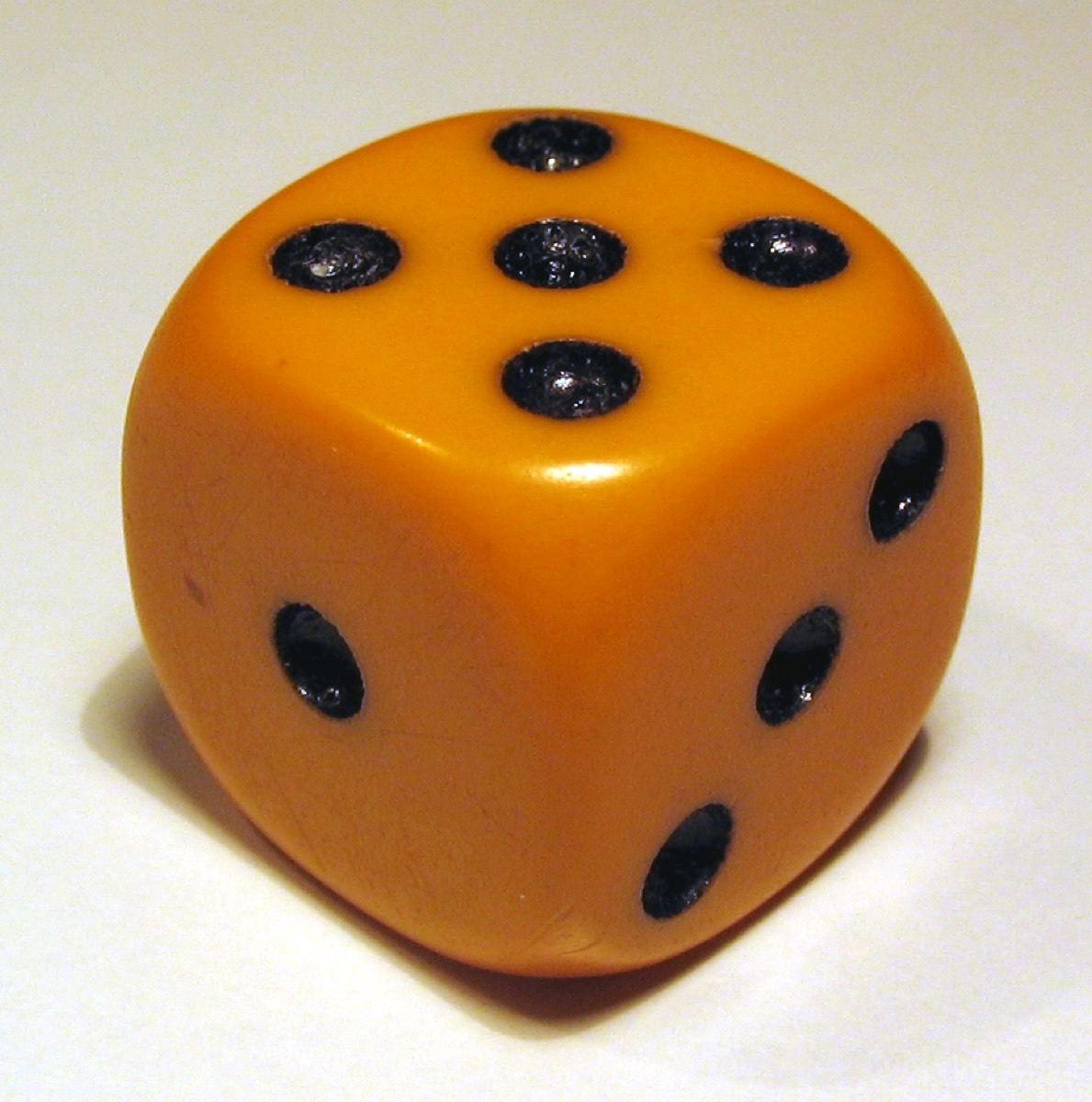
Beating somebody at dice feels like it should be transitive: if A usually beats B and B usually beats C, surely A usually beats C. Martin Gardner presented the famous paradox showing otherwise in 1970, with Efron’s dice. What was left open is how far the trick can be pushed.
For any number of them, and there is a limit on how strongly. Komisarski gives an that for each n there exists a of n , each beating the next with a probability bounded below by an expression involving a cosine. He also shows that bound cannot be replaced by any larger number.
The paradox of dice is old and well known. Martin Gardner presented Efron’s dice in 1970, a set in which each die beats the next more often than not, and the last beats the first.
The question this paper answers is how general that is. For each n, the author proves there exists a cycle of n independent random variables such that each takes a value smaller than the next with a probability bounded below by an explicit expression.
That expression involves a cosine, which is the trace of the geometric argument behind it. The proof is explicit and geometric rather than an abstract existence result, so the cycles can be constructed rather than merely known to exist.
The second half of the result is what makes it sharp. The author also shows that the bound cannot be replaced by any larger number, so this is the strongest the cyclic advantage can be, for every cycle length at once.
wat. Each die beats the next, all the way round, and back to the start.
wat wat
The intuition that beating is transitive is wrong, and this says exactly how wrong it is allowed to get.
How do we know?
Komisarski’s proof in the American Mathematical Monthly is geometric and explicit, generalizing the dice paradox from the specific sets Gardner popularized to cycles of arbitrary length.
What is still unknown
A result about independent random variables, which dice realize but do not exhaust.
Learn something?
Where to next
 How many people does it take before two of them share a birthday?probability
 How can you estimate pi by dropping needles on a floor?probability
 What if the famous study disproving the hot hand had the maths wrong?probability