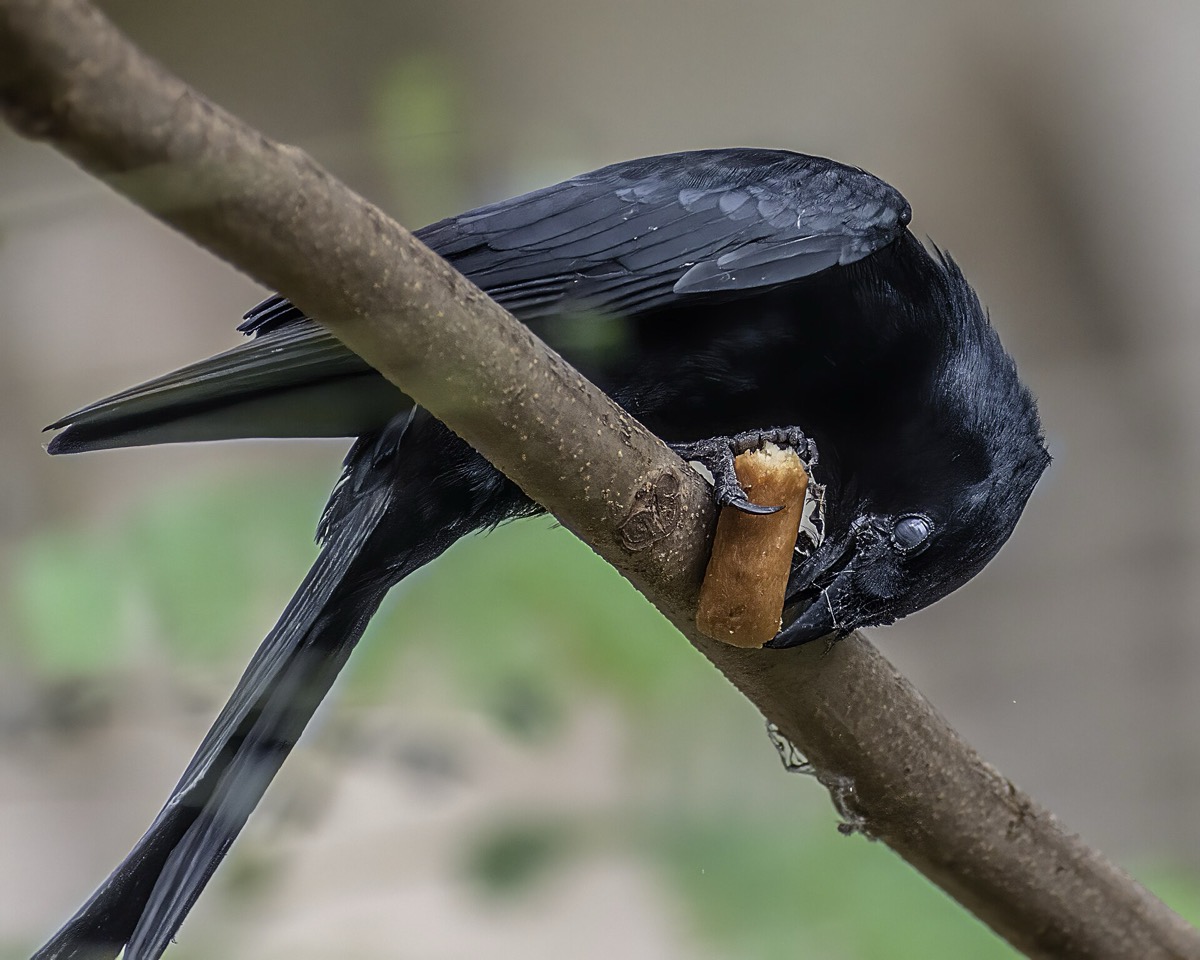
Putting non-functional parts together into something that works requires anticipating what the finished object will do, before it exists. Outside a few observations in captive great apes, no animal has been seen doing it, and in human children the ability arrives late. Bayern and colleagues gave eight New Caledonian crows combinable elements, each too short to reach the food. Does anything get built?
Four of the eight built one. They spontaneously combined elements into functional tools, with no demonstration and no training, and they did it conditionally on where the food was placed rather than indiscriminately. One bird went on to make tools of three and four pieces when the distance required it. does not account for the result, since the combination worked the first time.
Building a novel out of elements that do nothing on their own requires anticipating the of an object that does not exist yet. Outside a few observations in captive great apes, it is unknown in animals, and in human development the ability to innovate one appears late.
Bayern and colleagues set the problem up plainly. Eight naive New Caledonian crows, a species that habitually makes and uses tools, were given combinable elements, each too short to reach the food targets on offer.
Four of the crows spontaneously combined elements into functional tools, and they did so conditionally on the position of the food, assembling when the distance demanded it rather than as a fixed habit. One bird made three-piece and four-piece tools when that was what the task required.
The results are not accountable by direct reinforcement learning, which would predict gradual shaping rather than a solution arriving early. In humans, individual innovation of this kind is often tied to planning, complex task coordination, executive control and even language, so a crow doing it unprompted is awkward for those claims. The authors are careful: the underlying cognitive processes remain opaque, and likely involve the species’ propensity to use tools, its judgement of affordances, and some ability to innovate through cognitive simulation.
wat. Each stick was too short to be worth anything. The bird saw the one that would exist once it pushed two together.
wat wat
In humans, compound tool construction gets linked to planning, executive control and sometimes language. A crow doing it unprompted loosens every one of those connections.
How do we know?
Bayern and colleagues presented eight naive New Caledonian crows with combinable elements too short to retrieve food targets, and varied the position of the food across trials.
What is still unknown
Eight birds, four of which succeeded, in a laboratory apparatus. The authors are explicit that the cognitive processes behind it remain opaque, and nothing here shows what the crow was representing.
Learn something?
Where to next
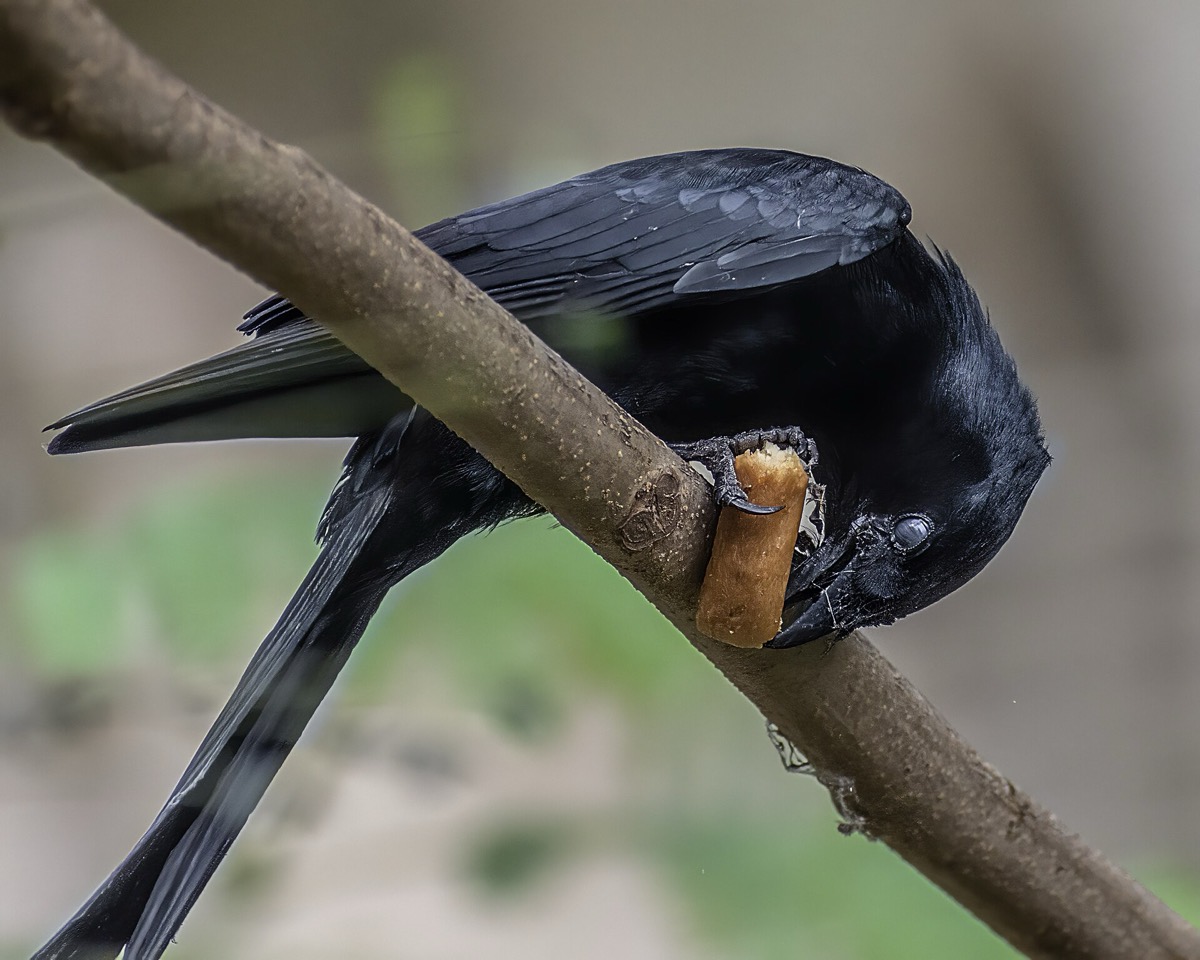 Is handedness something only humans have?tools
 Can a bird see what makes a square different from a lopsided shape?crows
 Can a bird decide in advance how many times to call?crows