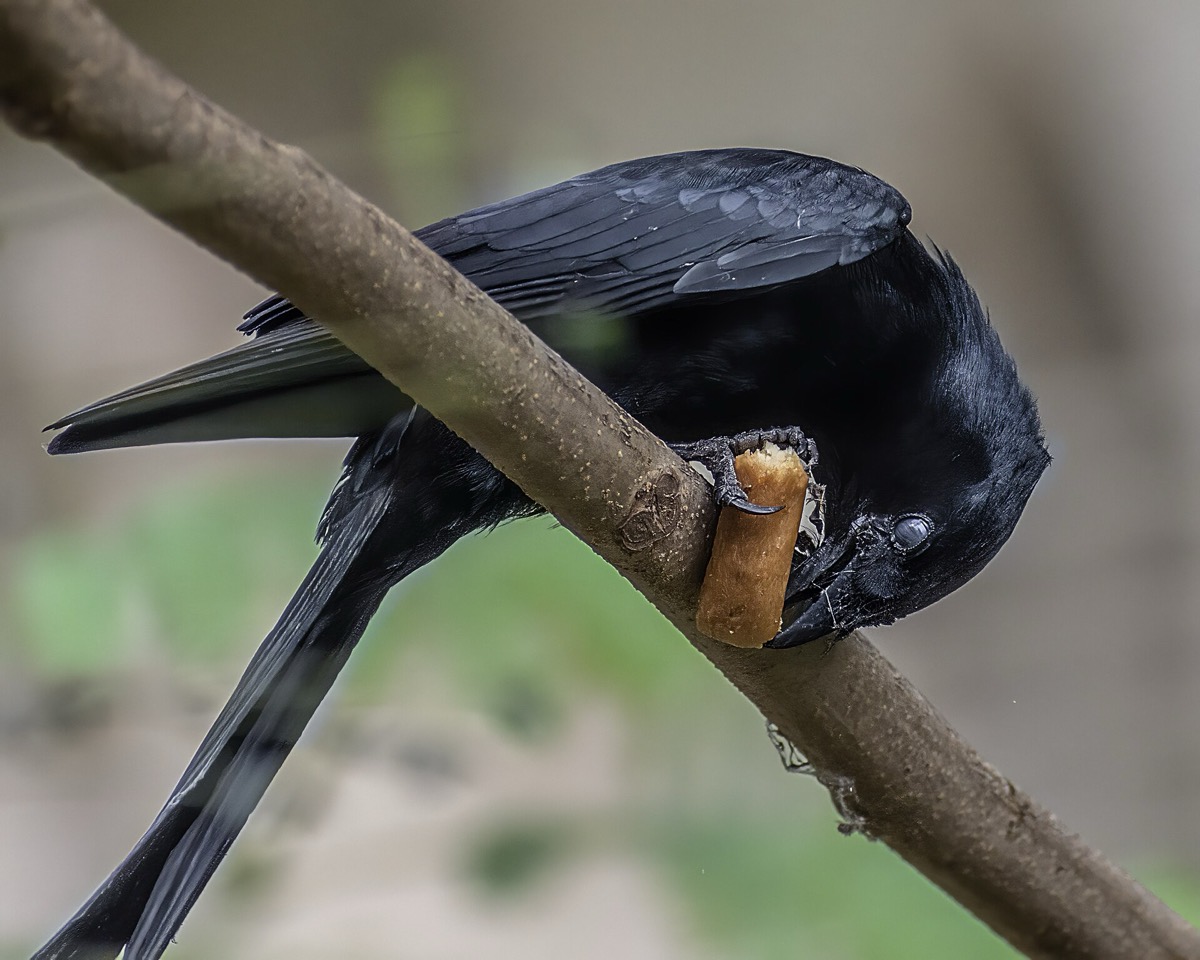
cut tapered probes out of the long narrow leaves of trees, tearing from either the left edge or the right one. A side preference across a whole species has been treated as a uniquely human trait. Hunt and colleagues recorded which edge the crows worked from at localities far apart on the island. Does one side win?
One side wins, across the whole island. Crows from widely separated localities tore their probes from the same edge, which rules out a habit copied inside one group or a quirk of one patch of forest. at the level of a species, in the act of making a tool, had never been found outside humans. The bias sits in the crow, not in the neighborhood.
New Caledonian crows do not merely use tools, they make them. One design is a tapered probe cut from the long narrow leaf of a pandanus. The bird tears along the leaf so the strip narrows toward a working tip, then uses it to winkle invertebrates out of rainforest vegetation.
A tear has to begin at one edge or the other, which turns tool manufacture into a left-or-right question with a countable answer. Hunt and colleagues counted it in crows from different localities on the island, far enough apart that a shared habit would be hard to account for.
One edge was favored, and it was favored everywhere. Had the bias come from , or from something peculiar to a particular patch of forest, it should have varied from place to place. It did not, which puts the preference in the species rather than in the neighborhood.
A side bias across a whole species had been taken as a uniquely human trait. This was, by the authors’ account, the first demonstration of species-level laterality in a manipulative skill outside humans. It does not make a crow brain like ours. It does make the asymmetry considerably less special.
wat. A whole population leaning one way, in a bird, in the act of making a tool, which until then looked like a human signature.
wat wat
A population-wide side bias was one of the last behavioral traits claimed for humans alone, and finding it in a bird that manufactures its own tools moves it out of our column.
How do we know?
Hunt, Corballis and Gray recorded which leaf edge New Caledonian crows worked from while making pandanus probes, sampling birds at separate localities across the island.
What is still unknown
The paper reports the bias without explaining it, and a preference in tearing a leaf need not come from the same brain asymmetry that human handedness does.
Learn something?
Where to next
 Can an animal build a tool out of pieces that are each useless?tools
 How do penguins decide who has to stand on the cold outside?behavior
 Why does a wombat go to the trouble of leaving its mark up high?behavior