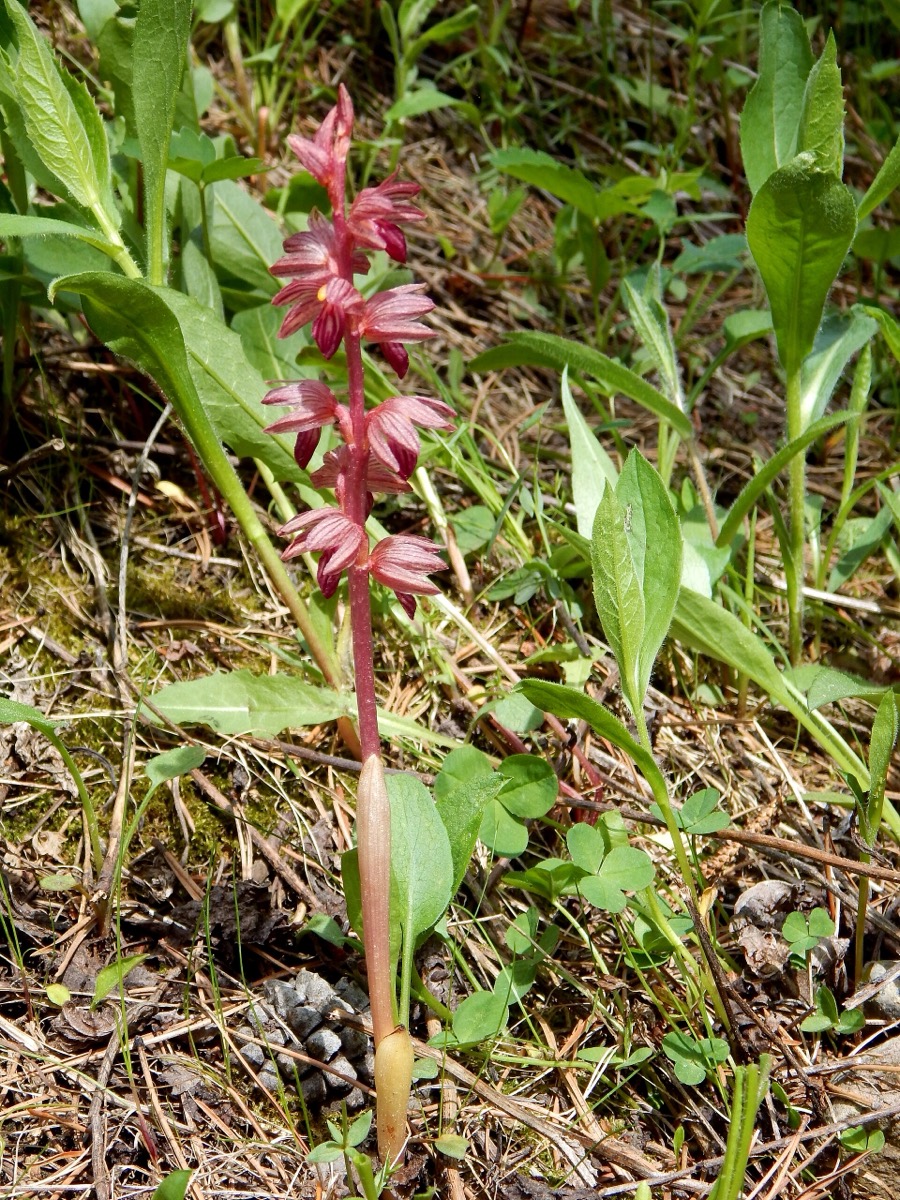
Corallorhiza striata has no green leaves and makes no food, taking everything from a fungus it parasitizes, which is one deception already. Its flowers carry no nectar either, so whatever pollinates them is getting nothing. Running both cheats at once in a single life stage had been called highly improbable. Freudenstein and Barrett watched the plants in the field and worked through thousands of photo records. Who is being fooled?
Male wasps, by a fake mate. The only pollinators with clear evidence behind them were males of the wasp Pimpla pedalis, visiting the nectarless flowers and behaving as though mating. The differs structurally from the bee- and fly-pollinated species in the genus, and the wasps came to flowers with the visual cues removed. The orchid cheats for food and for sex in the same life stage.
Orchids get themselves pollinated by every available means, from tightly specific mutualisms to outright deceit, sexual deception included. The family also contains more leafless parasitic species, , than any other plant family, which is a second kind of cheating entirely.
Doing both at once, in the same individual and the same life stage, had been judged highly improbable. A plant stealing its carbon from a fungus is already paying a price in specialization, and a flower that offers no reward has to work harder to get visited at all.
Freudenstein and Barrett studied Corallorhiza striata in the field, documenting what pollinators actually did on the plants, comparing floral structure against other species in the genus, and testing for nectar. They then went through more than six thousand iNaturalist photo records to widen the search for visitors.
The only pollinators with clear evidence were male ichneumonid wasps, Pimpla pedalis, visiting nectarless flowers and showing mating-type behavior, and they were attracted even when visual cues were absent. That makes this the first orchid known from North America, and only the second genus known to deceive a wasp of that family. Several other mycoheterotrophs do the same double trick, so rare does not mean impossible.
wat. It steals its food from a fungus and its pollination from a wasp looking for a mate, and pays for neither.
wat wat
Two simultaneous deceptions were thought too costly to coexist, and a plant that lives entirely off a fungus turns out to be a good place to look for exactly that combination.
How do we know?
Freudenstein and Barrett documented pollinator behavior on Corallorhiza striata in the field, compared floral structure against other species in the genus, tested for nectar, and searched over six thousand iNaturalist photo records.
What is still unknown
Field observation of pollinator behavior rather than an experiment on attraction chemistry, and the identification of the deceived wasp rests on the visitors the observers and photographers happened to catch.
Learn something?
Where to next
 Do trees really help each other underground?fungi
 What is a glowing mushroom glowing for?fungi
 What tells a soil fungus to start building a snare?fungi