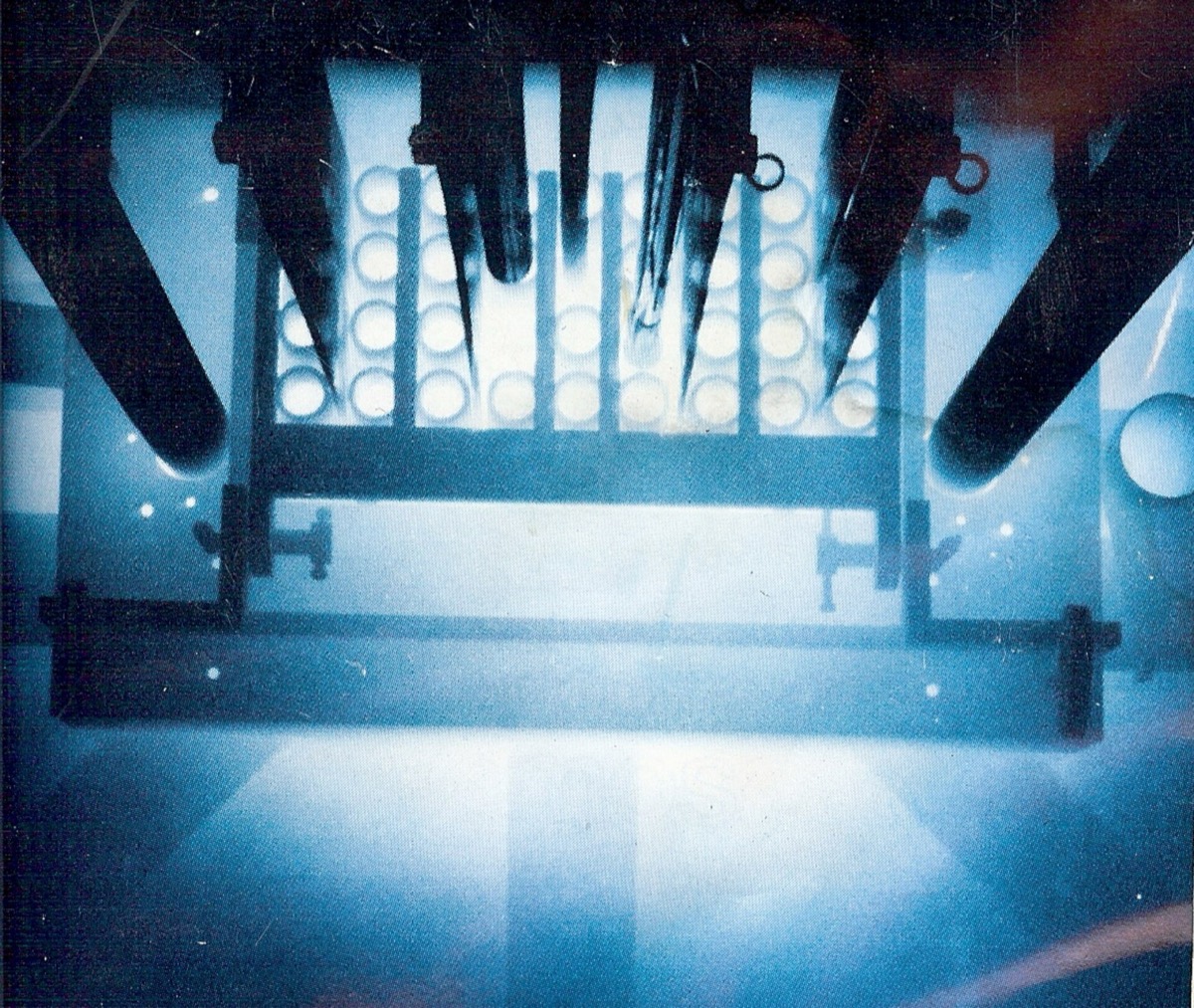
An electron is outrunning light. Not light in a vacuum, which nothing beats, but light in water, which travels more slowly. A charged particle moving faster than light does in the surrounding medium builds a , exactly as a boat does when it outpaces the waves on the water. The bow wave here is visible blue light.
The analogy is testable at a kitchen table. Drop an object into a bowl of water and watch how fast the circular wave front spreads. Then move the object across the surface, slowly at first and then faster. Once it exceeds the wave speed you observed, a bow wave forms, angling backwards in the familiar way. A jet passing the sound barrier does the same thing, and bangs.
At the Lebedev Institute in Moscow in the early nineteen thirties, Pavel Cherenkov was given a thesis problem by his teacher Vavilov. He was to study what happens when radiation from a radium source penetrates and is absorbed in different fluids. Many scientists had looked at this before, and many had seen the weak bluish glow in the liquid. On apparently good grounds, it had always been taken for .
Cherenkov was not convinced, and his first experiments supported his doubt. The radiation turned out to be essentially independent of the composition of the liquid, which fluorescence cannot explain. By observing the glow even in , he ruled out minute impurities. He then found the radiation was polarized along the direction of the incoming radium radiation, and that the fast were its primary cause, which he confirmed by irradiating liquids with electrons alone.
His papers between 1934 and 1937 established the general properties of the new radiation, but not a mathematical description. Two colleagues in Moscow supplied that. The work of Frank and Tamm in 1937 gave an explanation that was simple, clear and mathematically stringent. The picture it rests on is a bow wave. A vessel moving through water faster than the water waves travel leaves a wake angling backwards behind it.
For light the condition is the same, with one subtlety. Relativity forbids anything exceeding the speed of light in empty space, but in a medium light travels more slowly, and the speed varies with wavelength, as any school prism experiment shows. An ultra-fast electron from a radioactive source can therefore outrun light in a liquid. The liquid then glows with what the speech calls the blue magic shine from the hectic race of the electrons with the out-distanced light. The core of a swimming-pool reactor is aglow with it, bright enough to photograph by.
wat. The blue light is the wake of something going faster than light can in water.
wat wat
The glow had been seen for years and filed under fluorescence. The discovery came from one student declining to accept the label and testing it instead.
How do we know?
The presentation speech for the 1958 physics prize, by Professor K. Siegbahn, sets out Cherenkov’s experiments ruling out fluorescence, and the explanation given by Frank and Tamm in 1937.
What is still unknown
An award ceremony speech, which explains the mechanism through analogies rather than equations and compresses a decade of Russian-language publications into a paragraph.
Learn something?
Where to next
 What does the color of a soap bubble know about its own thickness?light
 What had to change before glass could carry a phone call?light
 Why did a blue light take thirty years longer than a red one?light