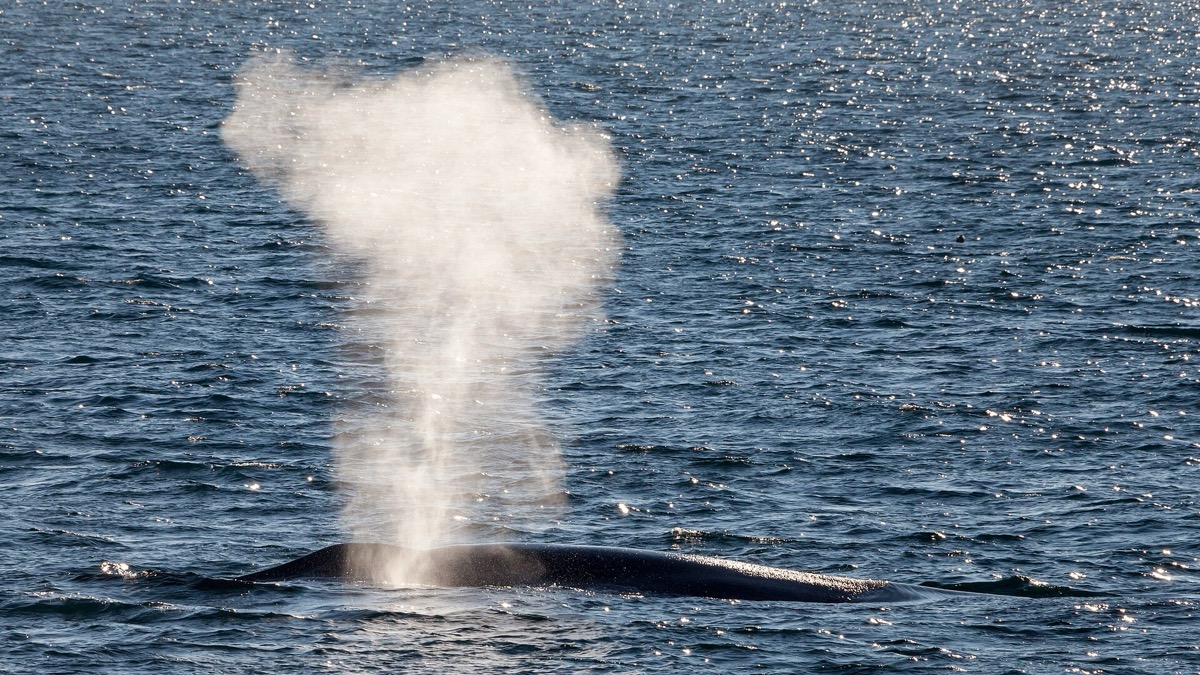
A diving animal slows its heart to make the oxygen in its blood last, and a blue whale is the extreme case of a big body with a slow pulse. The complication is how it eats. swallows a room full of water at a time and costs a great deal of power. Goldbogen and colleagues tagged a foraging whale with a heart monitor that also logged depth. What does the heart do during a lunge?
It runs at the edge in both directions. During dives as deep as one hundred and eighty-four meters the heart typically beat four to eight times a minute, and at one point twice. Back at the surface it ran twenty-five to thirty-seven, close to the estimated ceiling for an animal that size. Each feeding lunge drove the rate up roughly two and a half times above the diving minimum, then let it sag through the long glide.
A large animal has a slow heart, and a diving animal has a slower one still. during a dive stretches the blood’s oxygen over more time, which is how a whale stays down. For a blue whale both effects point the same way, toward a pulse that sounds impossible.
Then there is how it eats. Lunge feeding means accelerating into a swarm of krill with the mouth open and engulfing a volume of water comparable to the whale itself. That is a burst of very high power in the middle of a dive built around spending as little as possible.
Goldbogen and colleagues got an and depth recorder onto a foraging animal. On dives reaching one hundred and eighty-four meters and lasting up to sixteen and a half minutes, the heart typically managed four to eight beats a minute and at the lowest point two. At the surface afterwards it reached twenty-five to thirty-seven, close to the estimated maximum for a heart that size.
The lunges show up clearly inside the dives. During the powered ascent of a lunge the rate climbed to about two and a half times the diving minimum, then eased down through the long glide while the engulfed water drained through the baleen. Those swings explain the of a rorqual, wide and elastic enough to hold one beat’s worth of blood and keep it flowing until the next arrives.
wat. Two beats a minute at depth and nearly forty at the surface, with the aorta smoothing out everything in between.
wat wat
The spread between the floor and the ceiling is what sets an upper bound on body size, because a heart cannot be scaled up without the plumbing keeping pace.
How do we know?
Goldbogen and colleagues attached a suction tag carrying an electrocardiogram and a depth recorder to a foraging blue whale, and logged heart rate against dive profile.
What is still unknown
A single instrumented animal over a limited number of dives. The ceiling for surface heart rate is an estimate the measurements approach rather than a limit anybody has measured directly.
Learn something?
Where to next
 Why does a failing heart hurt in the arm?heart
 What sets the limit on how tall a tree can get?physiology
 How does one rodent survive 18 minutes with no oxygen?physiology