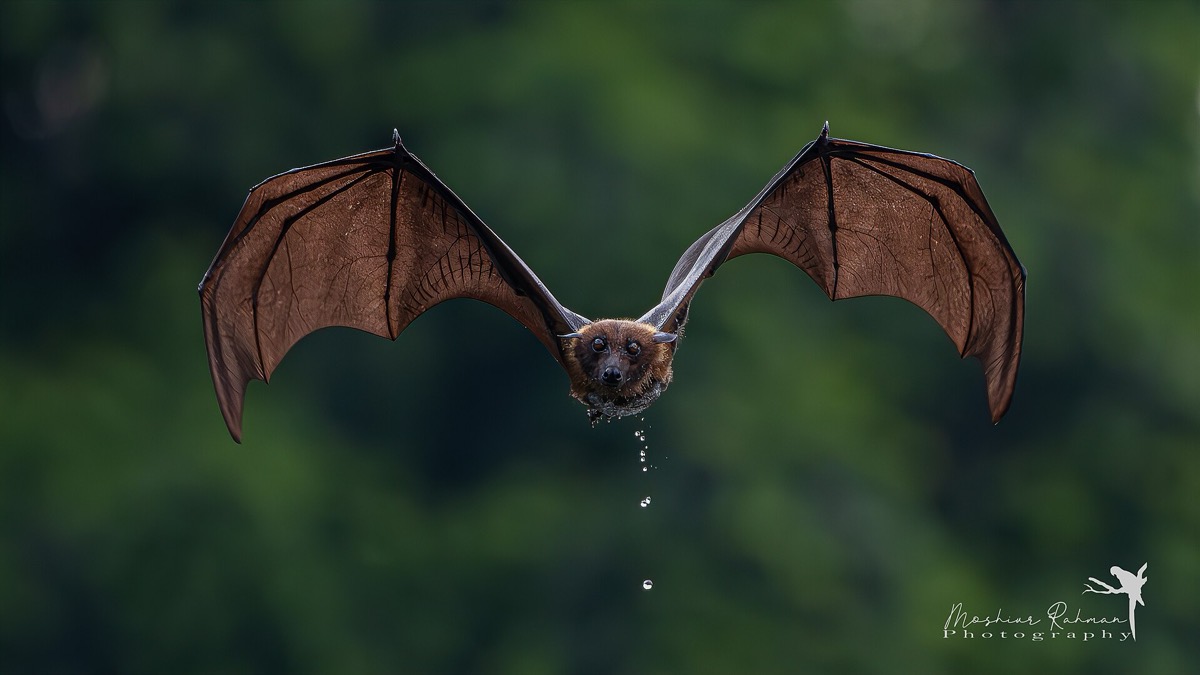
A bat needs water for drinking, for hunting over and for orienting by, and it has to find it by in the dark. Reading a single insect-sized target off an echo is well understood. How a bat classifies a large extended surface is not. Greif and Siemers put smooth plates out for wild bats of fifteen species, and for juveniles that had never seen water. What makes a surface read as a pond?
Smoothness, and nothing else gets a vote. Bats of fifteen species across seven genera and three distantly related families treated any extended, surface as water, even when other senses said otherwise. Naive juveniles that had never encountered a water body in their lives showed spontaneous drinking responses to smooth plates. The recognition is innate rather than learned, which had not been shown for a habitat cue in a mammal before.
Most animals have to locate the specific habitats they need, and in vertebrates remarkably little is known about which sensory cues do that job. A bat is a sharp test case because water is essential to it, for drinking, for hunting over and for orientation, and it has to be found in the dark.
Echolocation research has largely addressed point targets, the insect-sized echoes a hunting bat tracks. Recognizing and classifying a spatially , a surface rather than an object, was an open problem.
Greif and Siemers worked with wild bats of fifteen species, seven genera from three phylogenetically distant families. Any extended, echo-acoustically smooth surface was perceived as water, and the bats held to that reading even when other senses carried conflicting information. The echo overrules the rest.
The second experiment settles where the rule comes from. Naive juveniles that had never encountered a water body produced spontaneous drinking responses from smooth plates, which is the first evidence for of a habitat cue in a mammal. It also explains an awkward real-world consequence, since a smooth road or roof returns the same echo a pond does.
wat. A bat does not learn what a pond sounds like. It is born knowing that a smooth echo means water, and a metal roof will do.
wat wat
It identifies the actual cue behind habitat recognition in a mammal, and it predicts a failure mode: any large smooth surface a bat meets will be read as water.
How do we know?
Greif and Siemers offered smooth plates to wild bats of fifteen species in flight, tested them against conflicting information from other senses, and repeated the test with naive juveniles.
What is still unknown
A strong cue is not the only cue, and showing that smoothness is sufficient in these trials does not establish what weight it carries against other information in the wild.
Learn something?
Where to next
 What sets the limit on how tall a tree can get?water
 Do any other animals babble the way human babies do?bats
 Is there a best angle for skipping a stone?water