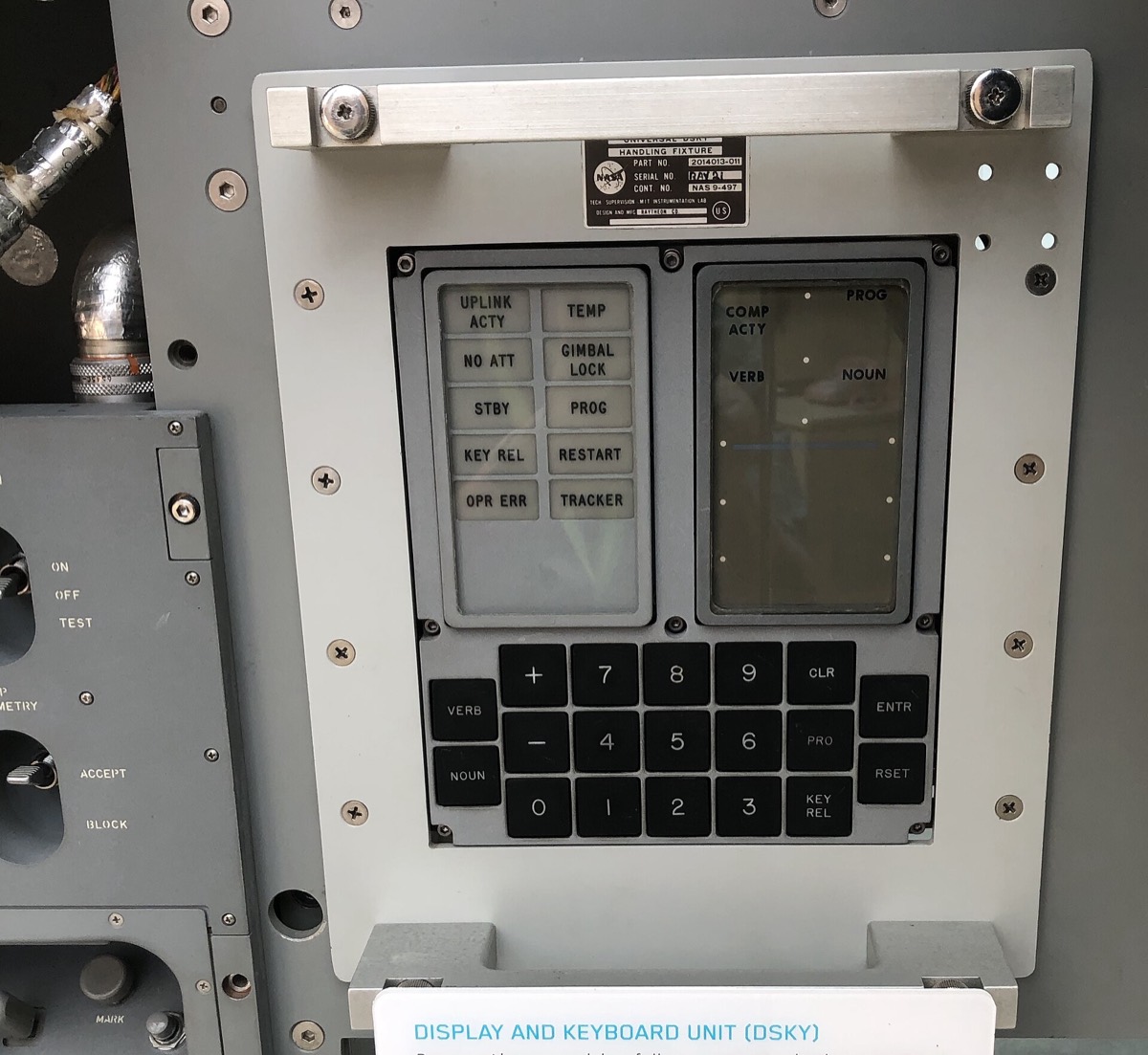
had separated from Columbia and dropped to within fifteen thousand meters of the surface before firing for the powered descent. Then, five separate times on the way down, the raised an alarm: its memory was full. Somebody on the ground had to decide, in seconds, whether a landing could continue on a computer that kept complaining.
They kept going, because the answer was already known. NASA simulations run before the mission had shown a landing could still happen despite the alarm, so Mission Control told the astronauts to continue the descent. The alarms, labeled twelve-oh-two and twelve-oh-one, were a computer saying it had more to do than it could hold, not a computer failing.
The landing sequence began with a drop. By firing Eagle’s propulsion system, Armstrong and Aldrin moved from a nearly circular orbit onto an elliptical course whose closest approach to the Moon was only fifteen thousand meters, about fifty thousand feet. At that low point they fired the engine again for the powered descent initiation maneuver.
Five times during that descent the guidance computer triggered an alarm, called twelve-oh-two or twelve-oh-one, reporting that its memory was full. The decision not to abort rested on work already done: NASA simulations before the mission had shown that a landing could still happen despite the alarm, and so Mission Control told the astronauts to continue.
The last stretch was flown by hand. At about a hundred and fifty meters above the surface Armstrong began maneuvering manually, although the main engine stayed under automatic control, to avoid landing in a rock-strewn crater. For roughly a minute and a half he hovered, moving Eagle sideways with the until he found a clear area.
Then the came on, triggered by the probes dangling a hundred and seventy-two centimeters below the footpads. One second later the descent engine cut off as the astronauts watched lunar soil blown radially in every direction. At seventeen minutes past four in the afternoon, Eastern Daylight Time, Armstrong radioed that Tranquility Base was here and the Eagle had landed. The site in the Sea of Tranquility had been chosen for its level and smooth terrain.
wat. The computer said it was overloaded five times in four minutes. The right answer, worked out in advance, was to carry on.
wat wat
The work that saved the landing had been done months earlier in a simulator. By the time the alarm appeared, the only new thing needed was the confidence to ignore it.
How do we know?
Britannica’s account of the Apollo 11 mission, which covers the descent, the alarms during it, the instruction from Mission Control, and Armstrong’s manual maneuvering in the last stretch.
What is still unknown
An encyclopedia account of the mission. It records that the alarm meant a full memory and that simulations had cleared it, without explaining what the computer was doing with the capacity it had.
Learn something?
Where to next
 What exactly did Ada Lovelace write that people call the first program?computing
 What did Gordon Moore actually predict, and for how long?computing
 What did Douglas Engelbart show an audience in 1968?computing