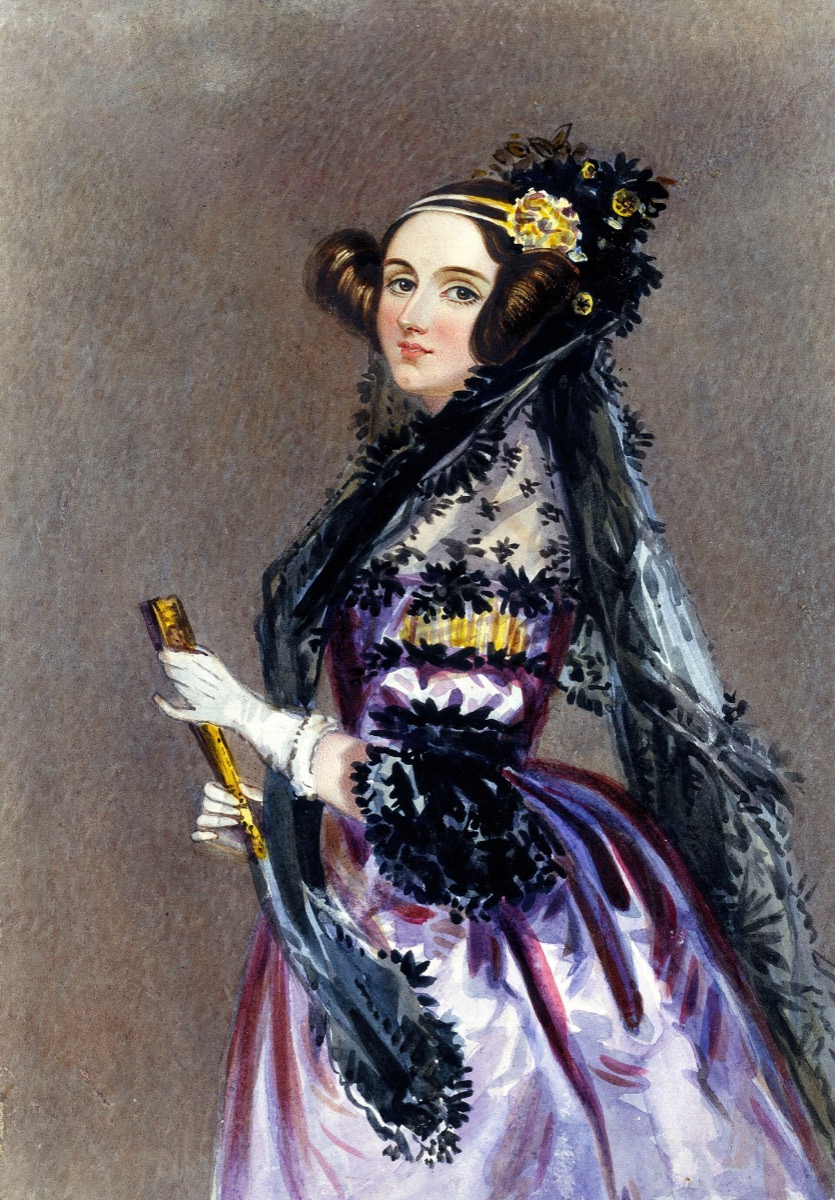
Charles Babbage began designing his in the mid-eighteen thirties, a calculating machine meant to pause mid-calculation and use what it had already worked out to choose between two next steps. It was never built. In eighteen forty-three Ada Lovelace published a translation of a French account of it, with appendices of her own running to forty-one of the paper’s sixty-six pages. What is in the last one?
A table, and it is not quite a program. Note G works through the calculation of the , showing how each quantity is fetched from the Store, used in and moved back according to the cards. Lovelace described it as a complete simultaneous view of the successive changes in the machine, which is what computer scientists now call an .
Babbage started on the Analytical Engine in the mid-eighteen thirties, wanting a machine that could pause during a calculation and use the values it had already determined to choose between two possible next steps. The basic operations he listed are what is needed to compute anything a modern computer can, which makes the design a general-purpose computer, a concept Alan Turing only identified in the nineteen thirties.
The machine was never built, though the designs were recorded in immaculate detail. It was to be programmed with punched cards like those in Jacquard’s weaving looms. Separate decks held the instructions and the starting values, and a mechanism could repeat a deck so as to execute a loop. The Mill would stand fifteen feet tall and the Store twenty feet long. Babbage estimated three minutes to multiply two twenty-digit numbers.
In eighteen forty, Italian scientists invited Babbage to Turin, where Luigi Menabrea heard him lecture and published the first account of the Engine in French. Charles Wheatstone asked Lovelace to translate it, and Babbage suggested she add appendices. The paper appeared in Taylor’s Scientific Memoirs in August eighteen forty-three, signed only with her initials, with forty-one of its sixty-six pages hers.
Note G, the final appendix, puts the machine to work on the Bernoulli numbers, with a large table whose columns track the data, the variables and the intermediate results through each stage. It is often called the first computer program. Lovelace put it more precisely, as a complete simultaneous view of the successive changes, which is an execution trace. The imagination is elsewhere. She saw that operations are separate from data, and that an engine able to act on things other than number might compose elaborate music, given the right way to express the relations of pitched sounds.
wat. The famous table shows what the machine does, step by step. The program was the deck of cards that made it do so.
wat wat
She saw the principle that matters most about the machine: the operations defined by the cards are separate from the data they act on. That separation is what makes a computer general rather than a calculator.
How do we know?
BBC Science Focus carries an account by the authors of Ada Lovelace: The Making of a Computer Scientist, drawing on Babbage’s designs and on mathematical manuscripts held by the Bodleian Library in Oxford.
What is still unknown
The precise nature of her contribution has been argued over for decades. Babbage’s designs are also unclear about how the cards would be manipulated, so the actual program behind the table is hard to reconstruct.
Learn something?
Where to next
 What do you do when the computer flying you to the Moon says its memory is full?computing
 Why do cicadas come out every 13 or 17 years exactly?mathematics
 Why do we picture compound interest as weaker than it is?mathematics