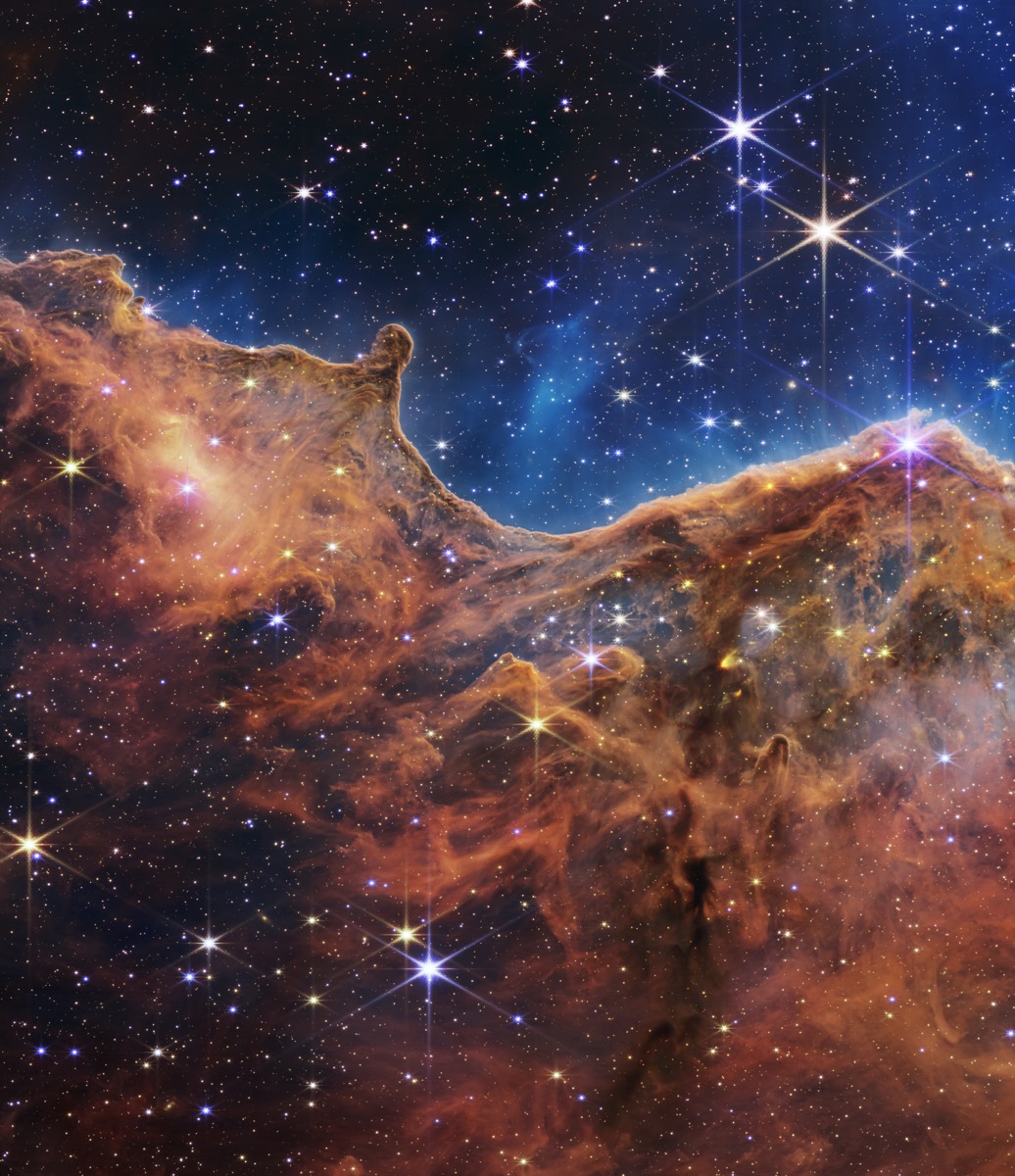
The Cosmic Cliffs look like craggy mountains on a moonlit evening, and they are the edge of a gaseous cavity in the star-forming region in the Carina Nebula, about 7,600 light-years away. Dust hides what forms inside such a region. Infrared gets through it.
Stars, in the hundreds. Captured in infrared by the Near-Infrared Camera on the James Webb Space Telescope, the image reveals previously obscured areas of star birth. It unveils hundreds of previously hidden stars and numerous , none of which visible light could reach through the dust.
What looks much like craggy mountains on a moonlit evening is actually the edge of a nearby, young, star-forming region in the Carina Nebula. The region carries the catalogue number NGC 3324, one of thousands in the New General Catalogue. The feature is called the Cosmic Cliffs, and it is the edge of a gigantic gaseous cavity roughly 7,600 light-years away.
The cavity was not always there. It has been carved from the nebula by intense ultraviolet radiation and from extremely massive, hot, young stars located in the center of the bubble, above the area shown in the image.
That carving continues. The high-energy radiation from those stars is sculpting the nebula’s wall by slowly eroding it away, so the shape in the picture is a process caught mid-step rather than a structure.
The instrument is the point. Captured in infrared light by , with its crisp resolution and unparalleled sensitivity, the image reveals previously obscured areas of star birth, unveiling hundreds of previously hidden stars and even numerous background galaxies.
wat. The cliffs are a cavity wall, and the infrared view fills it with stars the dust was hiding.
wat wat
What a telescope can see is set by the wavelength it works in, and this is the same sky with the dust taken out of the way.
How do we know?
NASA describes the image as taken in infrared light by NIRCam, and names the cavity, its distance and the massive young stars whose radiation and winds carved it.
What is still unknown
This is an image and its accompanying description, which identifies features rather than reporting measurements of them.
Learn something?
Where to next
 What enormous wave is moving through the stars around us?star formation