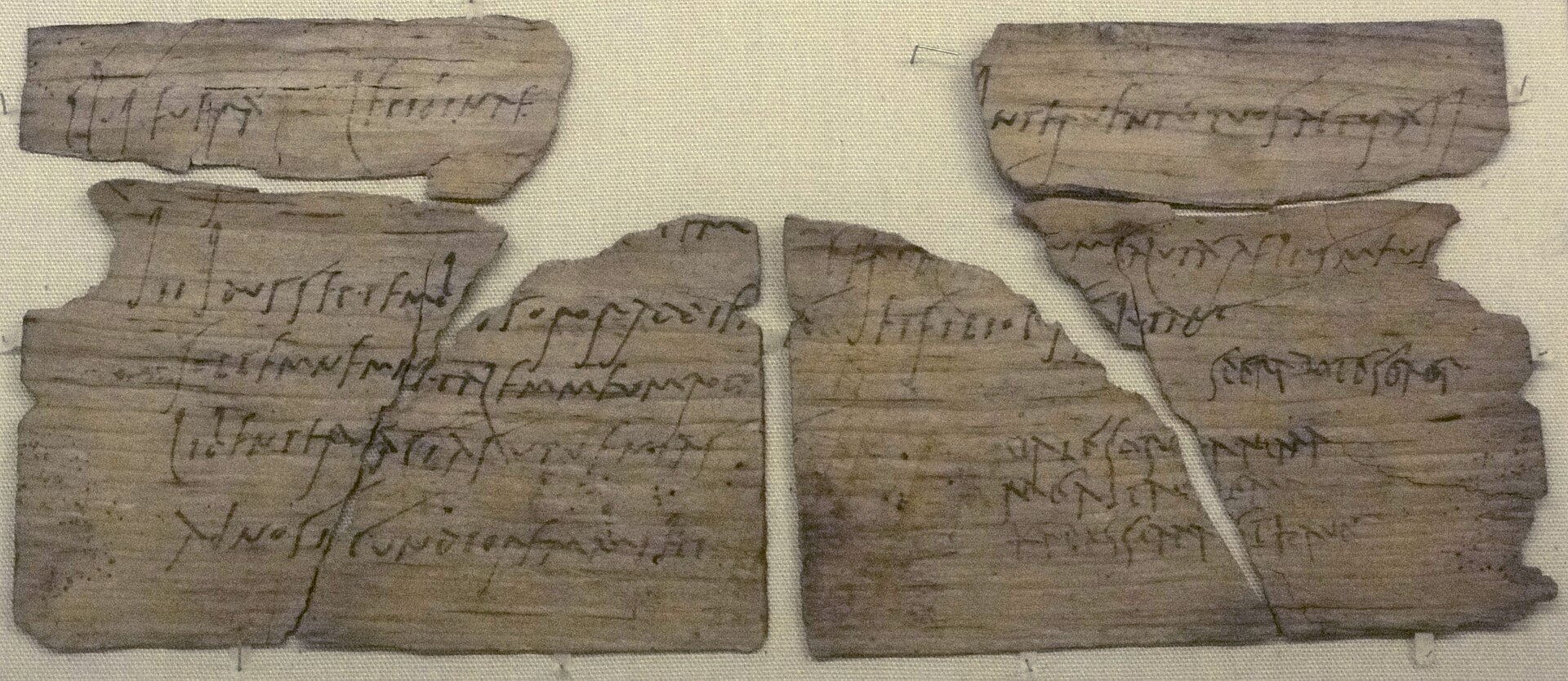
was a fort in Northumberland, near what became Hadrian’s Wall, and writing from there survives on thin sheets of wood inked between about ninety-seven and one hundred and three. One tablet, now in the British Museum, carries a letter from Claudia Severa to Sulpicia Lepidina, the commander’s wife. Two different hands wrote it. What is it about?
A birthday party. Severa writes to invite Lepidina to the celebration of her birthday on the eleventh of September, calling her sister throughout and sending greetings from her husband and small son. A second hand then adds a short closing. That closing is one of the earliest known examples of writing in Latin by a woman, so a party invitation carries the record.
The object is a wood , ninety-six millimetres high and two hundred and twenty-three long, excavated at Vindolanda in Northumberland and produced between ninety-seven and one hundred and three. It carries a party invitation written in ink, in , from Claudia Severa to Lepidina.
The content is domestic. Severa writes about the third day before the Ides of September, the eleventh, for the celebration of her birthday, and asks Lepidina warmly to come, saying her arrival would make the day more enjoyable. She sends greetings to Lepidina’s husband Cerialis, and passes on greetings from her own Aelius and their little son.
Then the hand changes. A second writer adds a brief closing, calling Lepidina sister and dearest soul. The address on the back identifies the recipient as Sulpicia Lepidina, wife of Cerialis, who was prefect of the Ninth Cohort of Batavians, which makes this a letter between two officers’ wives at the frontier.
The museum singles out that second hand. It is one of the earliest known examples of writing in Latin by a woman. It survives because somebody at a fort in northern England threw a used sheet of wood into ground wet enough to keep it for nineteen centuries.
wat. The oldest Latin we have in a woman’s handwriting is the bit at the end of a party invitation.
wat wat
Almost everything surviving from the Roman world was written by men, officially, to last. This is a private note between two women that was never meant to be read by anybody else.
How do we know?
The British Museum’s catalogue record for the tablet gives the Latin text, a translation, the dating, the findspot at Vindolanda and the curator’s note on its significance.
What is still unknown
One tablet from one fort. It establishes that Severa wrote in her own hand and says nothing about how widely women in the Roman world could write.
Learn something?
Where to next
 What does the brain do differently when writing a poem and when editing one?writing
 Pen or keyboard for a child who is just meeting letters?letters
 Are contracts impenetrable because of the law, or because of the prose?writing