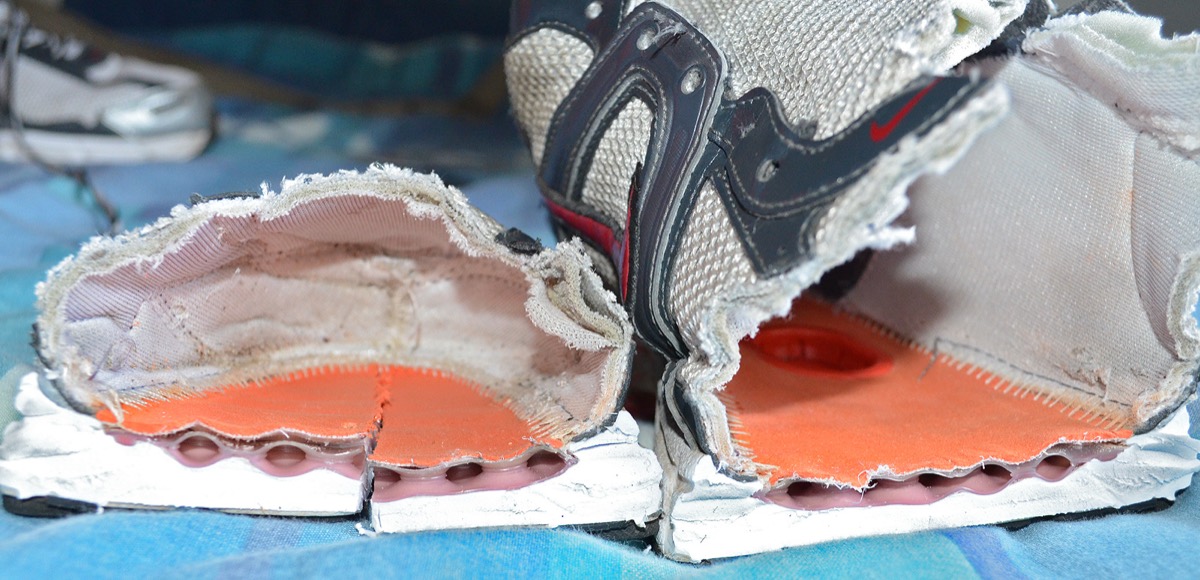
The shoe is named after a 4 percent claim, and the comparison behind such numbers is usually against a runner’s own training shoes. A lightweight is a different benchmark, because it is also light and also stiff. Eighteen recreational runners ran against both.
Against their own shoes the advantage is clear and against a racing flat it is not. Oxygen consumption fell 4.3 to 4.4 percent in the Vaporfly and 2.7 to 3.4 percent in the flat, both against the runners’ own shoes. Between the Vaporfly and the flat the gap was 1.0 to 1.7 percent and not significant.
The comparison ran across three conditions: Nike Vaporfly 4 percent, Saucony Endorphin lightweight racing flats, and the runners’ own habitual shoes. Eighteen male recreational runners attended four sessions about a week apart.
The first session set the speeds. A peak oxygen uptake test gave each runner their own 60, 70 and 80 percent intensities. Later sessions measured treadmill and 3 km in each shoe, in a randomized counterbalanced order.
Oxygen consumption was lower in the Vaporfly by 4.3 to 4.4 percent and in the flat by 2.7 to 3.4 percent against the runners’ own shoes. Between the Vaporfly and the flat the gap was 1.0 to 1.7 percent and not statistically significant.
Performance told a slightly stronger story than economy. The Vaporfly time trial beat own shoes by 16.6 seconds and the flat by 13.0 seconds, and 11 of 18 runners ran their fastest trial in it. The authors stress the variability, from a 10.3 percent worsening to a 13.3 percent improvement in economy, and conclude that shoe responses are individualized.
wat. The Vaporfly beat the runners’ own shoes clearly and a racing flat only slightly.
wat wat
What a shoe is compared against decides how large its advantage looks, and the honest comparison is against the best alternative rather than against whatever you own.
How do we know?
Hébert-Losier and colleagues tested treadmill running economy at 60, 70 and 80 percent of peak speed plus a 3 km time trial in each of the three shoes, in a randomized counterbalanced crossover design.
What is still unknown
Eighteen male recreational runners on a treadmill, and the individual responses ranged from a 10.3 percent worsening to a 13.3 percent improvement in running economy.
Learn something?
Where to next
 What is the human body unusually good at?running
 Should an endurance athlete train at altitude or only sleep there?running
 Do the fastest marathon runners also run the steadiest race?running