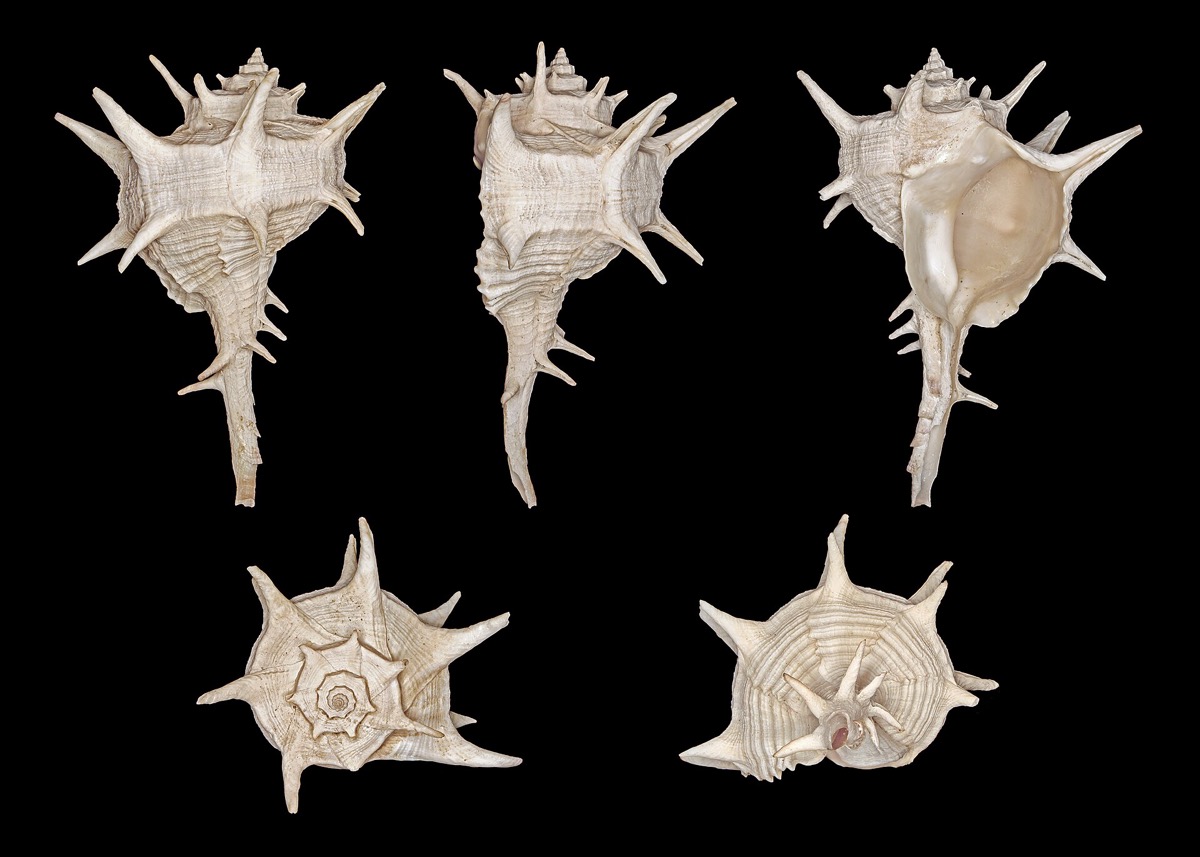
Several species of sea snail carry a gland that secretes of a dye, and after exposure to air and light they turn purple. Each snail yields a minute quantity. How many snails does one cloak take?
About twelve thousand for a gram and a half. Once the tissue is opened and meets air and light, reactions begin that produce , 6,6-dibromoindigo among them. Indigo is familiar from dyeing jeans, and the two bromine atoms, which come out of the seawater, are what shifts the shade to purple.
A purple cloak in antiquity was a mark of rule, and the reason is economic rather than aesthetic: the quantity of dye one snail yields is minute.
Several species of sea snail carry a gland that secretes the precursors of a dye, which they use for defense and for hunting. The secretion itself is colorless.
Once the tissue is opened and meets air and light, reactions begin that produce brominated indigo compounds. Indigo is familiar from dyeing jeans, and the two bromine atoms, which come out of the seawater, are what shifts the shade to purple.
In one historical trial some twelve thousand snails were needed to extract a gram and a half of pure pigment. Which explains both the price and the left at production sites. The figure comes from a modern extraction of pure pigment, and ancient workshops mixed species and processes.
wat. Some 12 thousand murex snails yielded, in one trial, only 1.4 grams of the pure purple pigment.
wat wat
That minute yield explains why purple was a mark of rule and wealth, and why heaps of shells were left behind at production sites.
How do we know?
Chemists separated the components of the dye, identified their structures, and reconstructed ancient extraction methods and dyeing trials.
What is still unknown
The figure of twelve thousand comes from a modern extraction of pure pigment; ancient workshops mixed species and processes.
Learn something?
Where to next
 Why is one insect red the only one still worth making?dye
 Who was wearing royal purple at a desert copper mine?purple