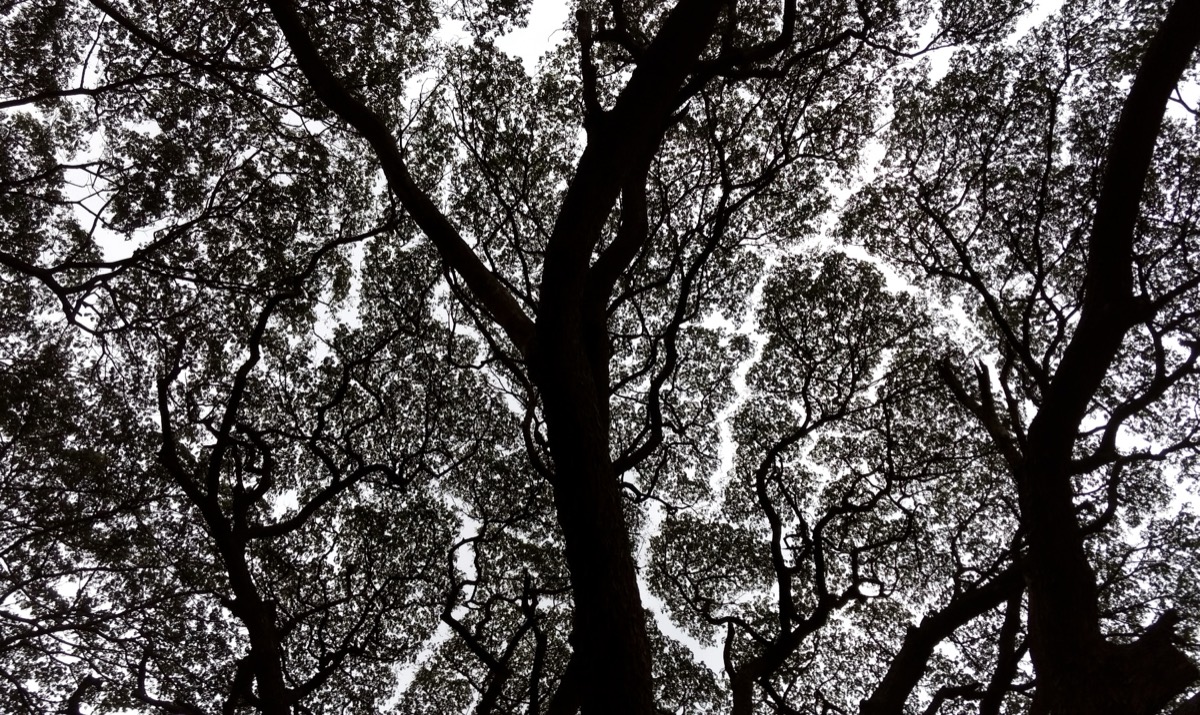
Look straight up in a dense stand and the crowns rarely meet, leaving a network of bright channels between them. Explanations have ranged from chemical signalling to light sensing, and the plainest one is mechanical: in wind, neighboring branches hit each other. Clatterbuck and colleagues measured branch growth, bud toughness and how hard crowns actually swing. Does the mechanical account carry it?
The numbers support abrasion. was greater for most species on the exposed side of a crown, the side with no neighbor to hit. Accelerometers in the outermost branches showed sway acceleration rising faster with wind speed in the growing season, when leaves are on, than in the dormant season. Combining sway with and mass gives the force available to break or abrade a bud at a given wind speed.
Trees growing close together collide. Wind swings the crowns, the outer branches strike their neighbors, and the result is mechanical injury: lost branch tips and lost buds, repeatedly, over the life of the stand.
Clatterbuck and colleagues set out to quantify what that does. They measured branch elongation in crowns where growth was inhibited by an adjacent tree and where it was not, and evaluated bud durability by growing season with a pendulum impact tester. Three-axial accelerometers at the outermost points of the crowns logged movement during wind events.
Branch elongation was greater for most species on the exposed side of the crown, the side free of a neighbor. Acceleration from gusts rose more steeply with wind speed in the growing season, with leaves on the tree, than in the dormant season. Putting sway together with bud mass and durability gives the force available to break or abrade a bud at any given wind speed.
Bud type matters to who wins. Preformed buds from the growth form were more durable than sustained or indeterminate buds. That is why contributes to mixed species stands: by reducing crown size and growth, it lets slower-growing species with tough determinate buds stratify above faster-growing trees whose growing tips keep getting knocked off.
wat. Nobody is being polite. The branches that face a neighbor keep getting knocked back, and the gap is what is left.
wat wat
Crown abrasion turns out to shape which species end up above which, letting slower-growing trees with tough buds stratify over faster-growing ones with fragile tips.
How do we know?
Clatterbuck and colleagues measured branch elongation on inhibited and uninhibited sides of deciduous crowns, tested bud durability with a pendulum impact tester, and logged crown movement during wind with three-axial accelerometers.
What is still unknown
The breaking force is calculated by combining sway, bud mass and durability rather than observed as a bud snapping in the field, and the work covers a set of deciduous species in one region.
Learn something?
Where to next
Why is there a gap of sky between one tree crown and the next?trees Do trees really help each other underground?forest
 What sets the limit on how tall a tree can get?trees