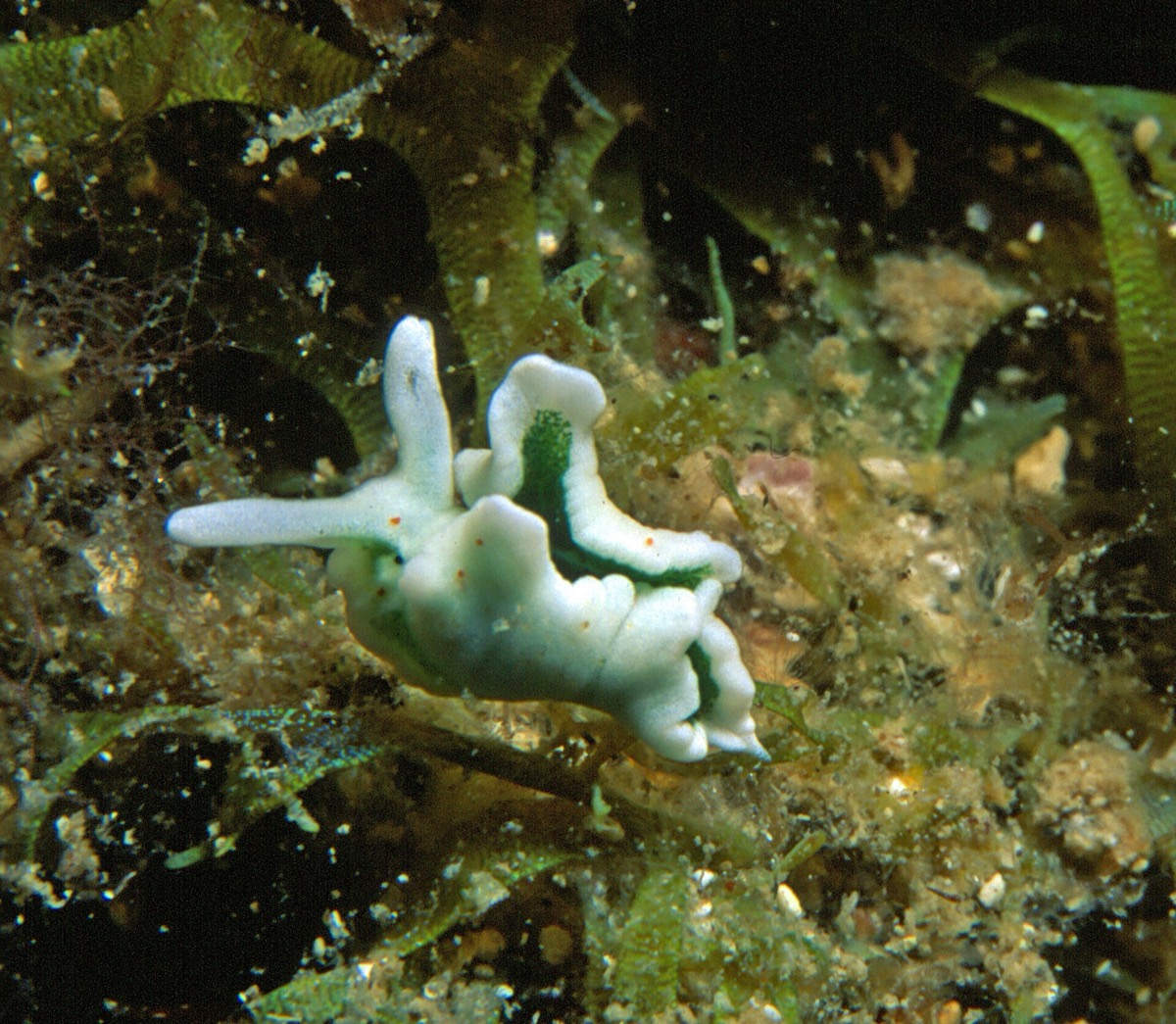
Several animals host living algae inside themselves and live partly off what those algae produce. Corals, giant clams and green hydra all do it, and in each case the partner is a whole organism doing its own work. One sea slug goes further. It keeps no alga at all, only the part of the alga that matters, and then lives like a plant.
Elysia chlorotica, which eats the alga Vaucheria litorea and keeps its . The stolen plastids sit inside the cells lining the slug’s , and their photosynthesis supplies the animal with energy and fixed carbon for its whole lifespan of about ten months. Given only light and air, the slug lives as a plant does.
Animals that live on sunlight are supposed to be impossible, and several of them manage it by proxy. Molluscs, sponges, corals, anemones, hydra, flatworms and ascidians have all evolved ways to capture photosynthetic products, by forming associations with intact unicellular algae or cyanobacteria. Those partners act as , supplying reduced carbon in exchange for nutrients.
Doing it inside a multicellular body is harder than it sounds. The symbiont has to be localized to particular tissues, its environment regulated, proteins and metabolites moved and turned over, and the host immune response evaded or suppressed. For the arrangement to become permanent, the symbiont also has to reach the germ line. Those constraints show up in the bodies. Photosynthetic animals tend to be simple, often two cell layers, with a high surface area to volume ratio. The more complex molluscs get the same ratio from the finely branching diverticula of the digestive tract.
Elysia chlorotica took a different route, keeping only the organelle. It acquires plastids while feeding on the alga Vaucheria litorea and retains them in the cells lining its digestive diverticula, a phenomenon called . Photosynthesis by those plastids then supplies the animal with energy and fixed carbon for its entire lifespan of around ten months, and provided with only light and air it lives as a plant. Adults senesce in the wild, often after mating in the spring.
The puzzle the review is built around is how that lasts. The plastids are not transmitted vertically, being absent from the eggs, and they do not divide in the slug. Yet protein synthesis continues, including plastid-encoded and nuclear-encoded plastid-targeted proteins, despite the apparent absence of algal nuclei. The authors discuss the possibility that genes moved from the alga to the animal, horizontal gene transfer being the non-sexual exchange of genetic material, with the nuclear gene psbO among the candidates. They offer this green animal as a model for how photosynthesis might evolve inside a multicellular heterotroph.
wat. It does not keep the alga. It keeps the solar panels, and they go on working for most of a year.
wat wat
The plastids cannot divide inside the slug and are absent from its eggs, so every generation has to steal its own, and each theft has to last the animal a lifetime.
How do we know?
A review in the Journal of Experimental Biology by Rumpho, Pelletreau, Moustafa and Bhattacharya, pulling together the data on how the captured plastids keep working and setting out hypotheses for what sustains them.
What is still unknown
A review that is explicit about proposing hypotheses rather than settling the question. How photosynthesis is maintained for months without algal nuclei is exactly what remains open.
Learn something?
Where to next
 What happens to a tubeworm’s bacteria when the tubeworm dies?symbiosis