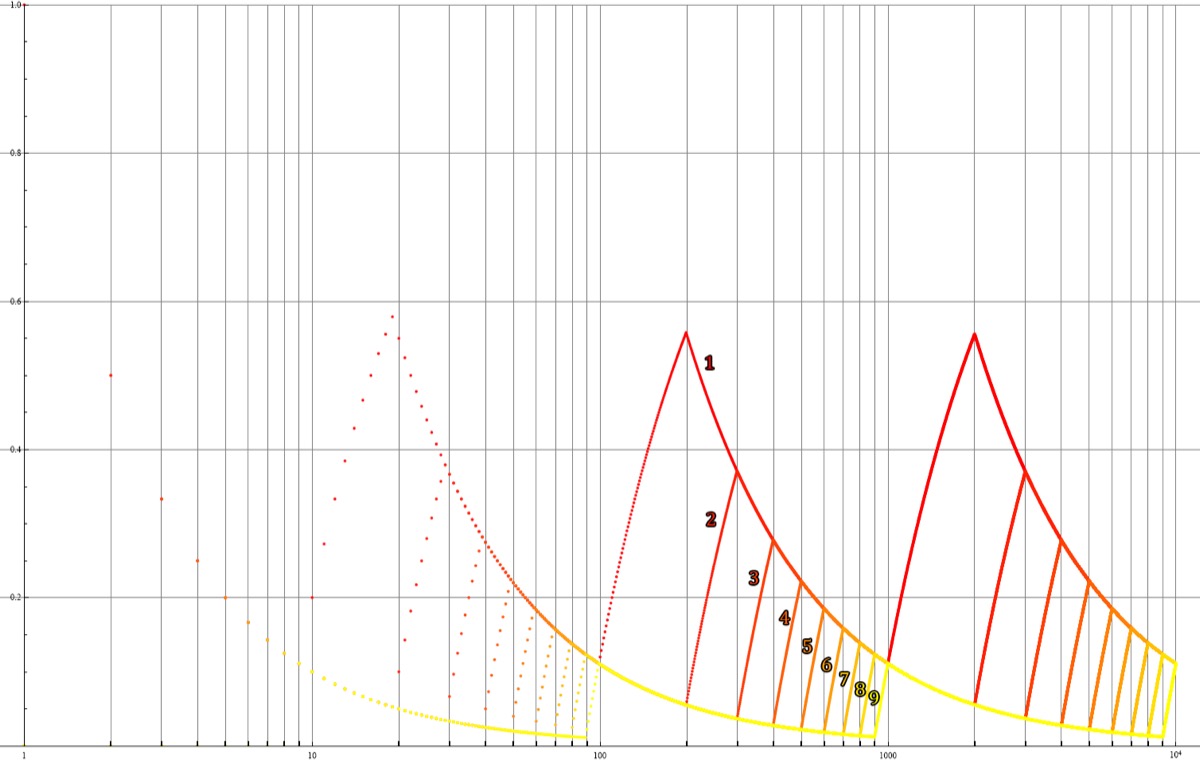
In many real collections of numbers the leading digit is not evenly spread: ones are common and nines are rare, in the pattern called the Newcomb–Benford law. Auditors use that pattern to flag figures somebody may have invented. The awkward part is that no general theory says which genuine data should obey it.
Only once you know which traders it applies to. Working on in a European Union market, the authors first identified the features of the traders whose figures should follow the law when nothing has been manipulated. They then approximated the for cases where the law does not hold, which is what makes a test usable in the first place.
The contrast of fraud in international trade is a crucial task of modern economic regulations. One of the few general handles on invented figures is the Newcomb–Benford law for , which describes how often each digit shows up at the front of a number in real data.
The authors develop statistical tools for the detection of frauds in customs declarations that rely on that law. Their first contribution is to show the features, in the context of a European Union market, of the traders for which the law should hold in the absence of fraudulent data manipulation.
That part is less obvious than it sounds. Their results shed light on a relevant and debated question: no general known theory can exactly predict validity of the law for genuine empirical data. Every application has therefore been running on an untested assumption.
They also provide approximations to the distribution of test statistics when the law does not hold. These approximations open the door to the development of modified goodness-of-fit procedures with wide applicability and good inferential properties.
wat. Before the test can catch a liar, it has to know who tells the truth.
wat wat
A fraud detector that fires on honest data is worse than none, so knowing where the pattern should hold is the whole job.
How do we know?
Cerioli and colleagues built statistical tools for customs data, characterizing where the law is expected to apply and deriving approximations for the distribution of test statistics outside that range.
What is still unknown
The work covers customs declarations in one market, and flags figures for a look rather than proving anyone cheated.
Learn something?
Where to next
 A bee sees a blank card. Is it, to the bee, less than one?numbers
 Can every department admit women at a higher rate and the university still not?statistics
 Which digit starts a number most often?fraud