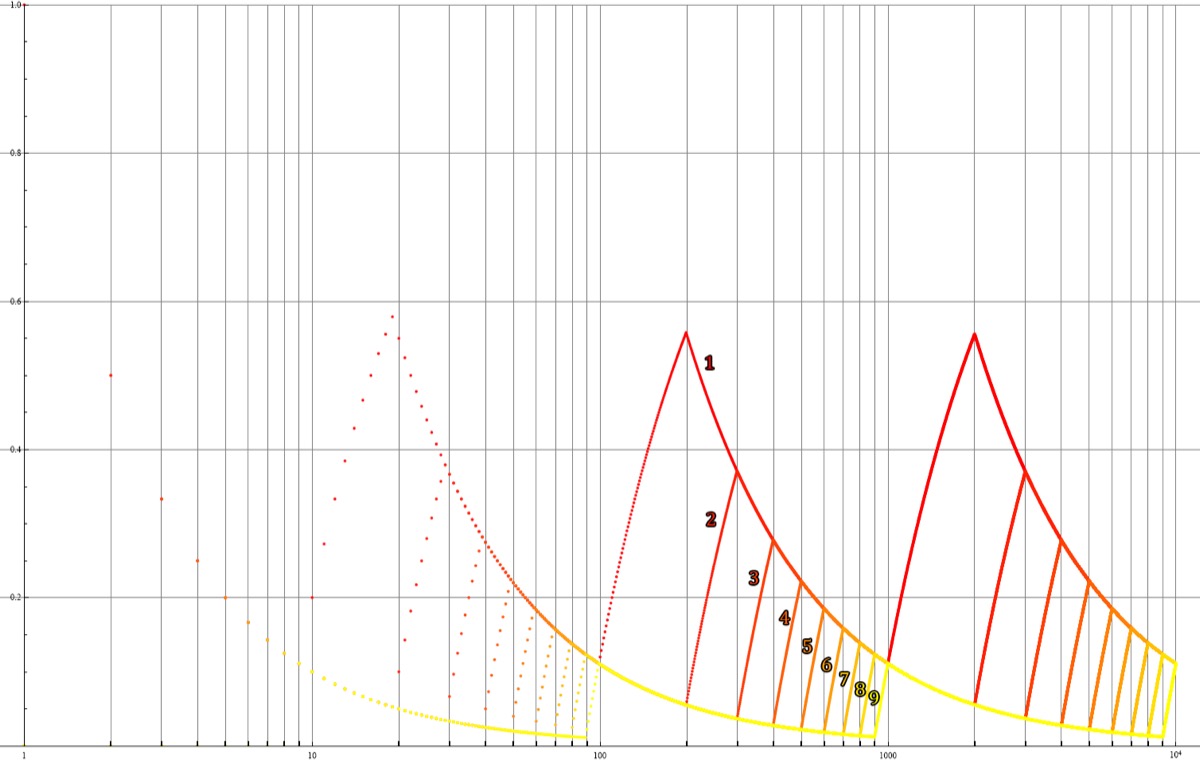
Nine digits can begin a number, so each should lead about 11.1 percent of the time. In 1881 noticed that the first pages of logarithm tables wore out faster than the later ones, which is a strange thing for an evenly used book to do. Benford studied a wide variety of data sets in 1938.
One, by a wide margin. In data that follow the law, the 1 appears about 30.1 percent of the time rather than 11.1 percent, with each later digit rarer than the one before. Many empirical data sets approximately follow this distribution, though it is not a universal law for numerical data.
Benford’s law describes a distribution of significant digits in which the leading decimal digit is far from evenly spread. It is also called the first digit law, the first digit phenomenon or the leading digit phenomenon.
The size of the imbalance is the surprise. The leading digit 1 has probability about 30.1 percent, rather than the 11.1 percent that would result if all nine possible leading digits were equally likely.
The history runs from a worn book to a theorem. Newcomb described the greater wear on the first pages of logarithm tables in 1881, and Benford studied a wide variety of data sets in 1938. Hill gave a statistical explanation under specified in the 1990s.
The condition behind it is exact. A positive random variable has a Benford distribution of significant digits when the fractional part of its logarithm has a . That does not require the data to carry physical dimensions, and many empirical data sets approximately follow the law without it being universal.
wat. Worn logarithm tables gave it away before anyone had the mathematics.
wat wat
Invented figures tend to be spread evenly, which is exactly what real ones are not.
How do we know?
Wolfram MathWorld gives the distribution, its history from Newcomb through Benford, and the statistical explanation Hill supplied under specified sampling hypotheses.
What is still unknown
Not every data set follows it, so a deviation is a reason to look rather than a finding.
Learn something?
Where to next
 How many people does it take before two of them share a birthday?probability
 How can you estimate pi by dropping needles on a floor?probability
 Can the ability to bet against a share restrain financial reporting?accounting