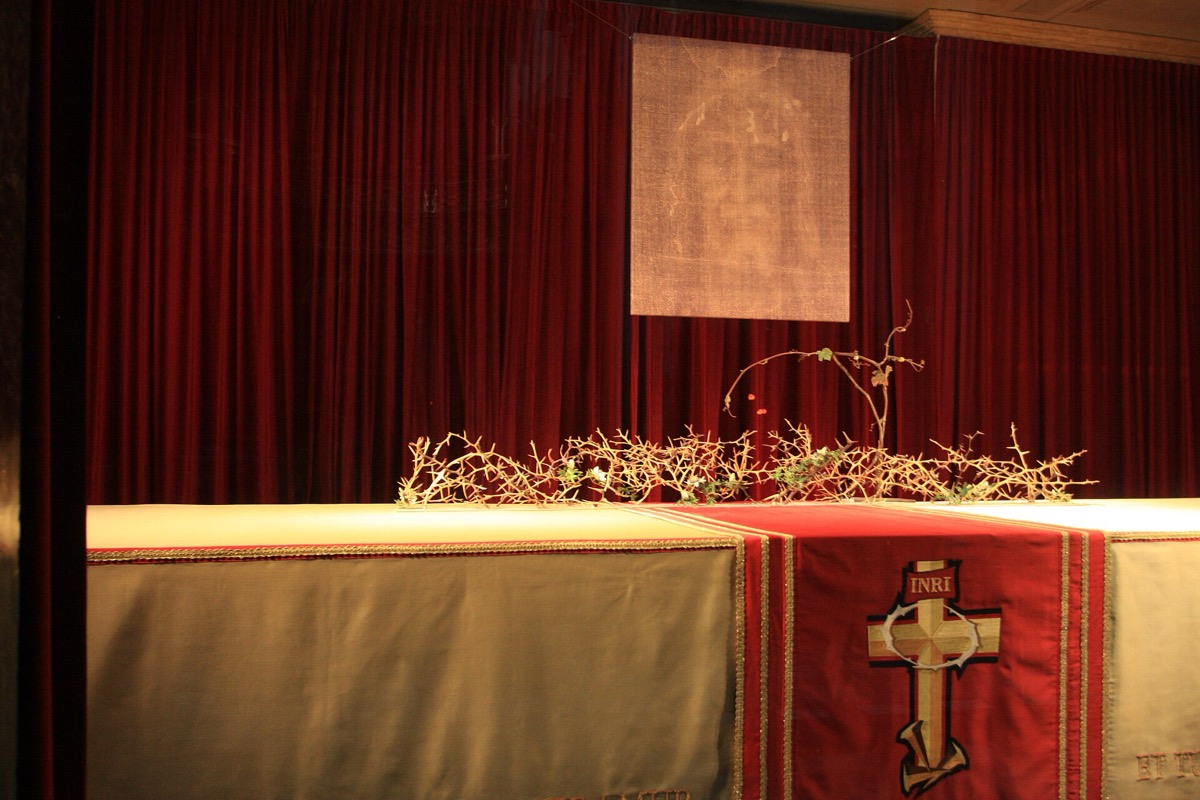
The Shroud of Turin is a cloth bearing the figure of a man, and the argument over its age has run for centuries. In 1988 a single tiny piece was cut from it and divided between three laboratories working separately, each also receiving three whose age was already known. What did the three report?
One window, and a medieval one. The laboratories in Arizona, Oxford and Zurich arrived at the same range: between 1260 and 1390 CE. So the linen is medieval rather than ancient. The control samples came back at their correct ages, which says the method itself worked properly in that round. The Catholic Church has never taken a position on the origin of the cloth, treating it as an object of faith rather than as evidence.
The historical background is narrower than it seems. The first certain written record of the cloth comes from mid-fourteenth-century France, and no document follows it back from there. Even then a local bishop wrote a letter claiming it was the work of human hands. The argument is not modern, then; it has accompanied the object almost from the moment it enters history.
The protocol of 1988 was built to prevent a later dispute. One piece was cut in front of witnesses, divided into three, and alongside each part went three control samples of materials whose ages were known. The laboratories did not know which envelope held what, and did not know what the others had received. A method like that tests not only the object but the testers.
The result was consistent across the three, which is easy to miss. Three laboratories running on different equipment, with different teams, arrived at the same window of time, and their control samples came back correct. Had there been a systematic problem with the method itself, it would most likely have shown up in the samples of known age too.
From then on the discussion concentrated almost entirely on one question: whether the corner that was cut represents the cloth. Several mechanisms were proposed, among them later contamination, a fire that altered the carbon composition, and above all of a damaged area. All of these concern the sample rather than the method, so the way to test them is to test the sample.
And that is what happened. Two textile fragments surviving from the part Arizona received were analyzed by Freer-Waters and Jull in 2026 and compared both with the cloth and with the control fabrics. The finding was that they match the body of the shroud with no sign of contamination. That strengthens the dating without closing the question entirely, because it concerns one part out of three.
wat. Three separate laboratories dated the linen of the Shroud of Turin to the Middle Ages, to a range between 1260 and 1390 CE.
wat wat
This is one of the rare cases where a question loaded with belief was tested by a method agreed in advance, with multiple laboratories and with control samples. Not every argument can be settled that way, which makes it worth seeing what the method closes and what it leaves open.
How do we know?
Accelerator mass spectrometry on tiny samples, at three independent laboratories that did not know what the others had received. The results appeared in Nature in 1989.
What is still unknown
The whole dating rests on one piece, cut from one corner. The main counter-argument is that this corner was repaired in the Middle Ages by reweaving, and so does not represent the cloth. Two textile fragments surviving from the Arizona sample were analyzed and compared with the cloth itself; they matched the body of the shroud with no sign of contamination. That does not close the discussion either, because it concerns one sample out of three.
Learn something?
Where to next
 Did a giant eruption bring down a kingdom in East Asia?dating
 Was pharaoh Ahmose’s great storm the eruption of Santorini?dating
 What did a scan that never touches the wall find in cave paintings?dating