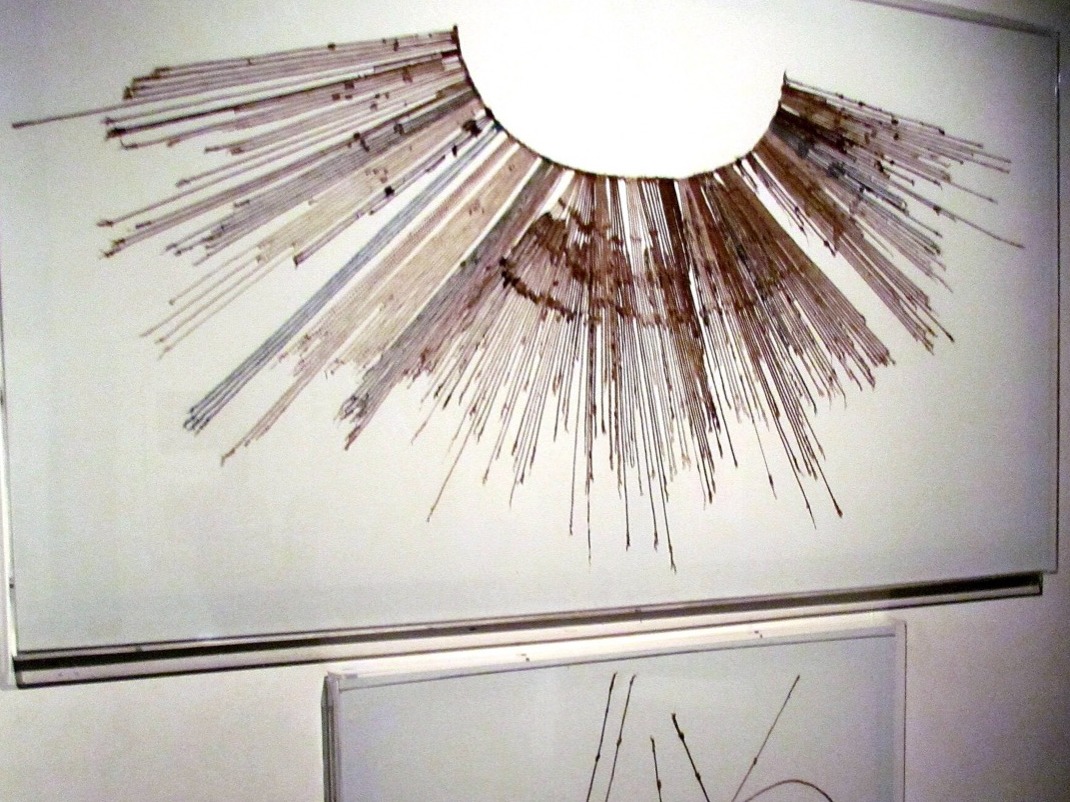
is built from a main cord with colored strings hanging off it, tied with knots. There are no digits there, no ink and no page. And still an exact number can be recorded in it. How does that work?
By . Knots near the end stood for units, and clusters further along for tens, hundreds and thousands. distinguished the digits themselves, and could mark a zero. So the same principle that puts a digit in a different column is written in material: not in ink on a page but in knots along a cord.
A quipu is built from a main cord with colored strings hanging off it, which makes it a recording system you handle rather than read by eye.
The position carries the meaning: knots near the end stood for units, and clusters further along for tens, hundreds and thousands. It is the same principle that puts a digit in a column, except that the column is a distance along the cord.
The form of the knot distinguished the digits themselves, and an empty gap at a defined place could mark a zero, which is the precondition for any positional system.
Researchers compared hundreds of quipus and identified sums that recur between strings and groups, and that is how the correspondences were worked out. The numerical part is better understood than the administrative or narrative information, and most quipus still cannot be read in full.
wat. In a quipu, how far a knot sat from the end of the cord decided whether it was a unit, a ten or a hundred.
wat wat
The quipu shows that a complex recording system can develop as a three-dimensional structure you handle, with no alphabet and no number signs.
How do we know?
Researchers compared hundreds of quipus, identified sums that recur between strings and groups, and worked out the correspondences between kinds of knot and place values.
What is still unknown
The numerical part is better understood than the administrative or narrative information; most quipus still cannot be read in full.
Learn something?
Where to next
 A bee sees a blank card. Is it, to the bee, less than one?numbers
 Which persuades more, numbers or one person’s story?numbers
 Why do so many marathon runners finish just before a round hour?numbers