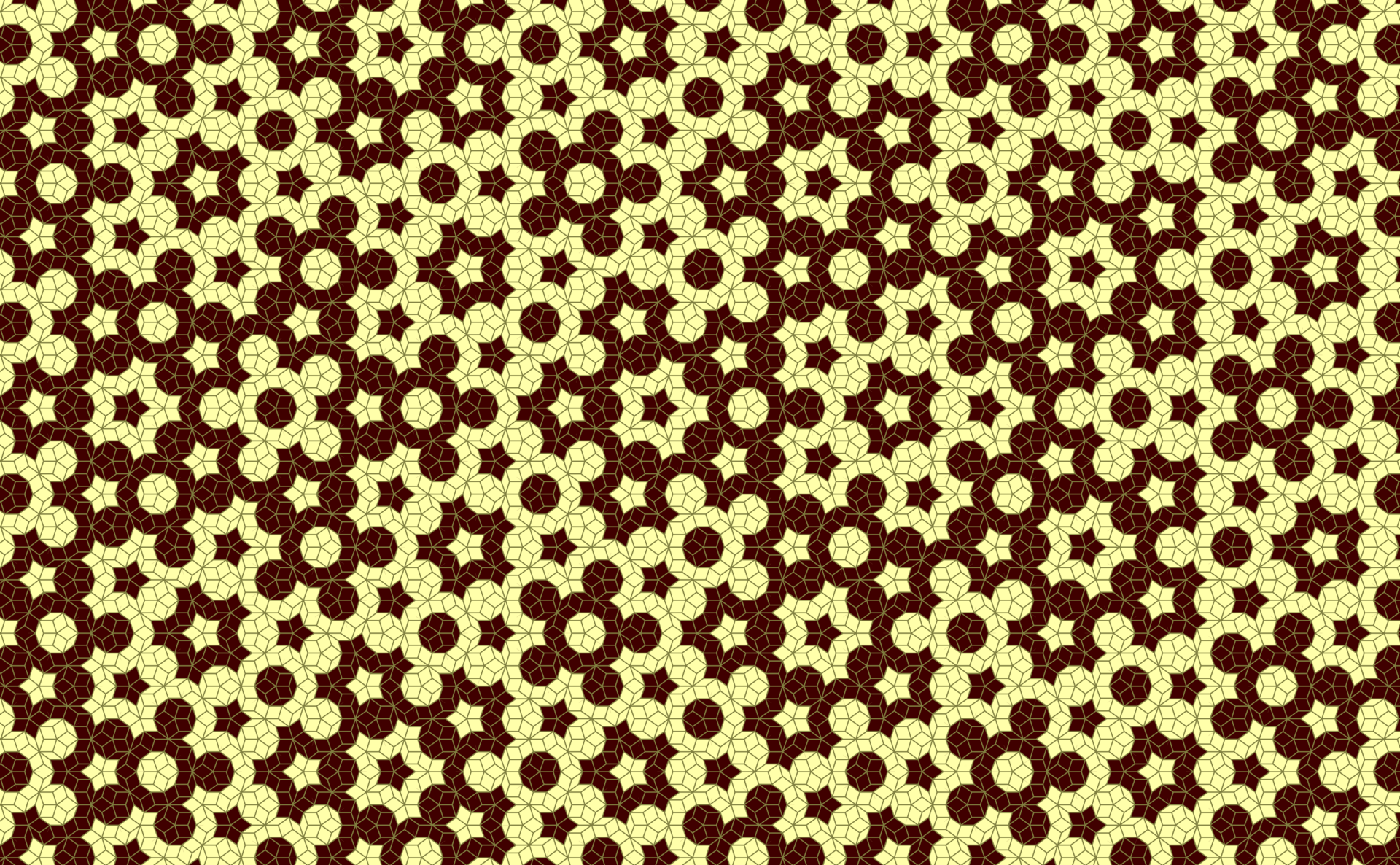
Tile a floor with squares or hexagons and the design repeats: slide the whole pattern far enough and it lands on itself. For a long time that looked like what tiling meant. Penrose produced a pair of shapes for which it is impossible.
Yes, with a and a dart. The Penrose tiles are a pair of shapes that tile the plane only , when the markings are constrained to match at borders. Those matching rules are the whole trick: the two tiles may not be combined into a rhombus, which is what would let a repeating pattern form.
The Penrose tiles are a pair of shapes that tile the plane only aperiodically, provided the markings are constrained to match at borders. The two shapes are called the kite and the dart.
The matching rules do the work. In strict Penrose tiling the tiles must be placed so that the colored markings agree. In particular the two may not be combined into a rhombus, which would open the door to a repeating arrangement.
Other tile sets follow the same idea. Two further types are sometimes defined, the , in fat and skinny varieties, and the pentacles, of which there are six types, both with more complicated matching conditions.
The tilings are generated rather than drawn. Penrose tilings are , whose replacement rules can be expressed as subdivisions of triangular half-tiles, with tile deflation replacing each half-tile by smaller ones. Penrose sued Kimberly Clark in 1997 over quilted toilet paper that allegedly resembled one of his tilings, and the suit was apparently settled out of court.
wat. A pattern that never repeats, from two tiles and a rule about edges.
wat wat
Order without repetition turned out to describe real materials, after being treated as a curiosity.
How do we know?
Wolfram MathWorld sets out the tiles, the matching conditions, the related rhomb and pentacle sets, and the substitution rules by which the tilings are generated.
What is still unknown
The aperiodicity depends on the markings being obeyed; ignore them and the shapes go back to behaving ordinarily.
Learn something?
Where to next
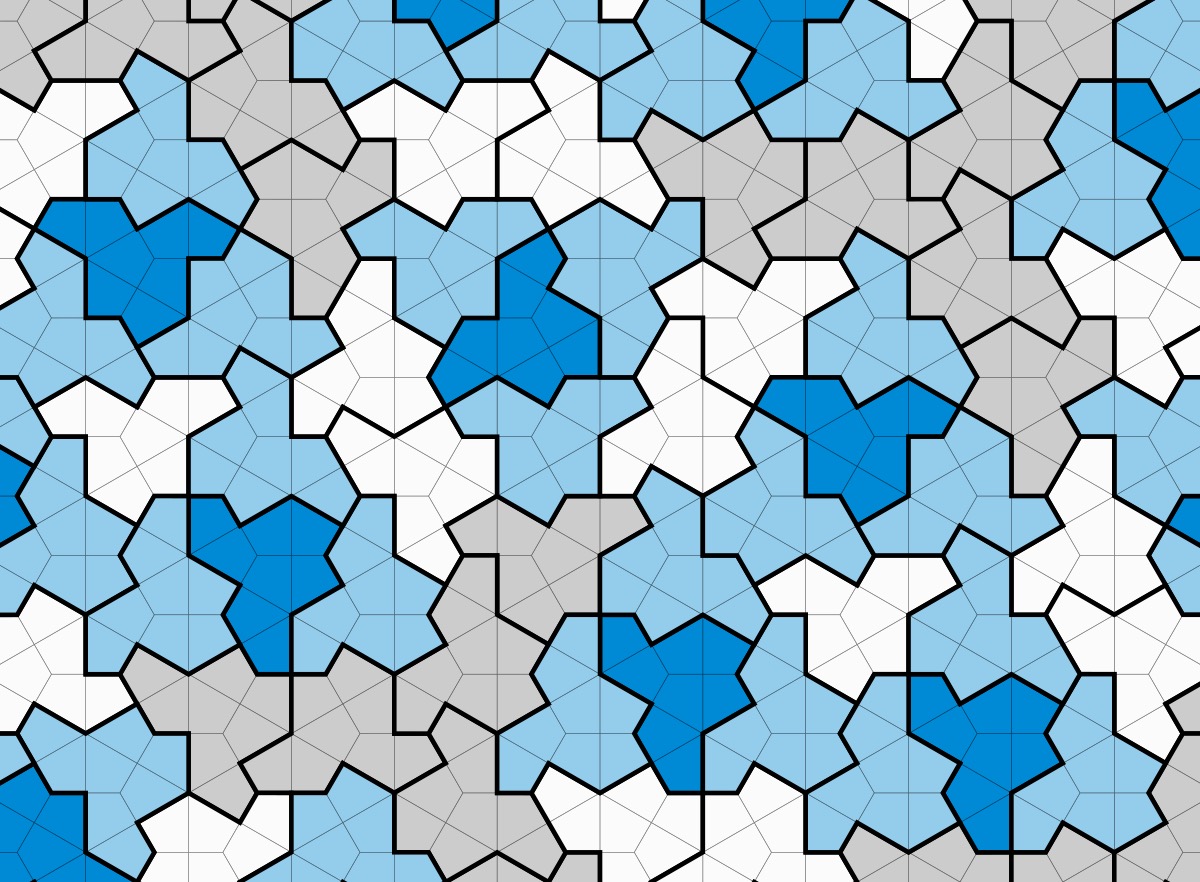 Can one shape tile a floor that never repeats?tiling