goes back to the ancient Greeks and held through the Middle Ages. By the nineteenth century the argument was specific: boiled broth in a sealed flask stayed sterile because sealing also kept out a . Air was the thing in dispute. How do you let air in and nothing else?
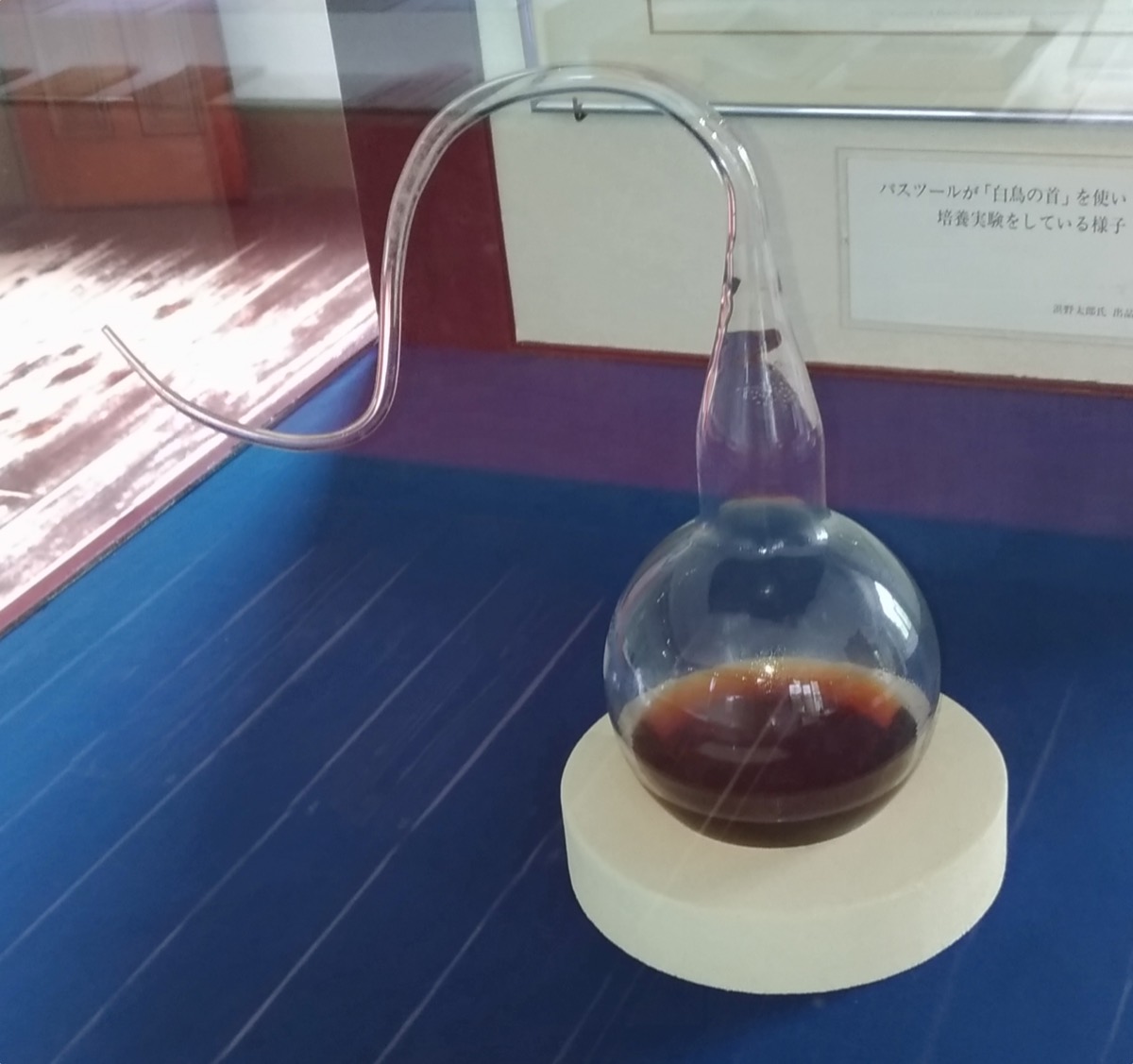
With a bend in the glass. Pasteur made , with long twisted necks, boiled the broth to sterilize it, and left them open, so air could exchange freely while airborne microorganisms got caught in the twists. The broth stayed sterile as long as the neck was intact, and spoiled once it was broken.
The theory of spontaneous generation traces back to the ancient Greeks and was widely accepted through the Middle Ages. Aristotle proposed that life arose from nonliving material if that material contained pneuma, and cited things like fish appearing in a new puddle.
By the nineteenth century the debate had sharpened into a specific defense. Needham argued that microbes arose in broth from a life force, which Spallanzani’s extended boiling destroyed, and which sealing the flasks then kept out. Both sides could explain the same flasks.
The Paris Academy of Sciences offered a prize for settling it, and Pasteur, then studying microbial fermentation and wine spoilage, took the challenge. In 1858 he filtered air through gun-cotton and found it full of microorganisms, which pointed at what air was actually carrying.
Then came the flasks. Boiled broth in long twisted necks stayed sterile while air moved freely in and out, and spoiled when the necks were broken. The experiments disproved spontaneous generation and earned him the Alhumbert Prize in 1862, and in 1864 he put the conclusion as .
wat. Air reached the broth and microorganisms did not, and only the broken necks spoiled.
wat wat
The experiment separated two explanations that had produced identical results for centuries, which is what an experiment is for.
How do we know?
In 1858 Pasteur filtered air through a gun-cotton filter and found the cotton full of microorganisms under the microscope, which told him what air was carrying before he designed the flasks.
What is still unknown
This is a textbook account of a historical experiment, and the swan-neck flasks tested the airborne route rather than every version of the theory.
Learn something?
Where to next
 Why does a glacier in Antarctica run red?microbiology