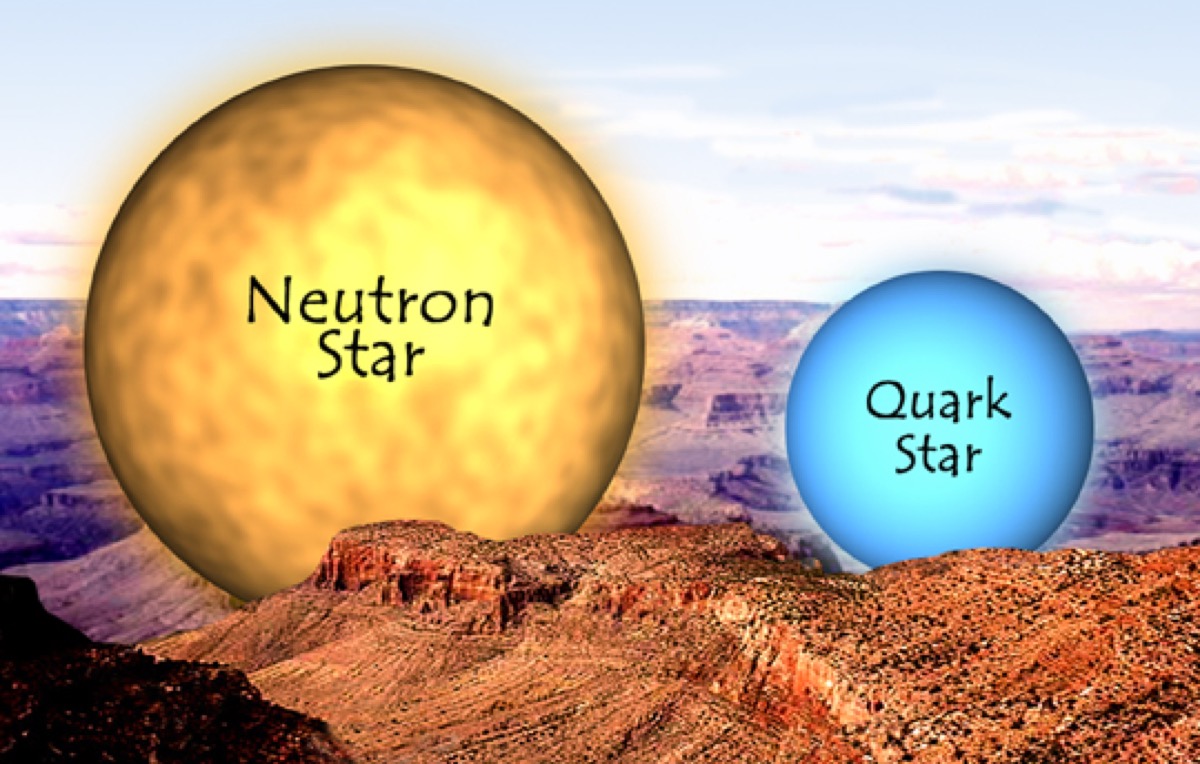
A packs more than the mass of the Sun into something about twenty kilometers across, which is a city rather than a star. Matter cannot normally be compressed anywhere near that far, and the usual way to convey what it means is to imagine taking a small sample of it. So take a teaspoon. What are you holding?
Hundreds of millions of tonnes. for these objects run around a hundred trillion times that of water, so a teaspoon of water at five grams becomes roughly five hundred million tonnes of neutron star material. That density approximates the density inside an , which is why a neutron star can be thought of as one gigantic nucleus.
Start with the size. Neutron stars are a class of extremely dense, compact stars thought to be composed primarily of neutrons, and they are typically about twenty kilometers in diameter. Their masses range between about one and one fifth and two times that of the Sun, with most of them around one and a third solar masses.
Those two numbers together are the whole of the strangeness. Putting that much mass in that little volume gives mean densities of about a hundred trillion times that of water. Since a teaspoon of water comes to roughly five grams, the same spoon filled with neutron star material works out at something like five hundred million tonnes.
The density has a familiar counterpart. It approximates the density inside the atomic nucleus. In some ways a neutron star can be conceived of as a gigantic nucleus, held together by gravity rather than by the strong force but packed to the same degree. That is the comparison the entry reaches for rather than any everyday object.
The interior is layered and partly unknown. The intermediate layers are mostly neutrons and are probably in a state, flowing without viscosity. What sits at the center, where the pressure is greatest, is not known definitively, and the candidates on offer include hyperons, kaons and pions.
wat. A spoonful weighs about as much as a mountain, because you are holding something with the density of an atomic nucleus.
wat wat
The comparison is not a flourish. A nucleus and a neutron star are held up by the same physics, which is why the density of the one tells you the density of the other.
How do we know?
Britannica’s astronomy entry on neutron stars, which gives their typical diameter, the range of their masses, their mean density relative to water, and what is known and unknown about their interior layers.
What is still unknown
The teaspoon figure is arithmetic from the stated density rather than a measurement. What lies at the very center, where the pressure is greatest, is not known definitively.
Learn something?
Where to next
 What is left behind when a star swallows one of its own worlds?stars