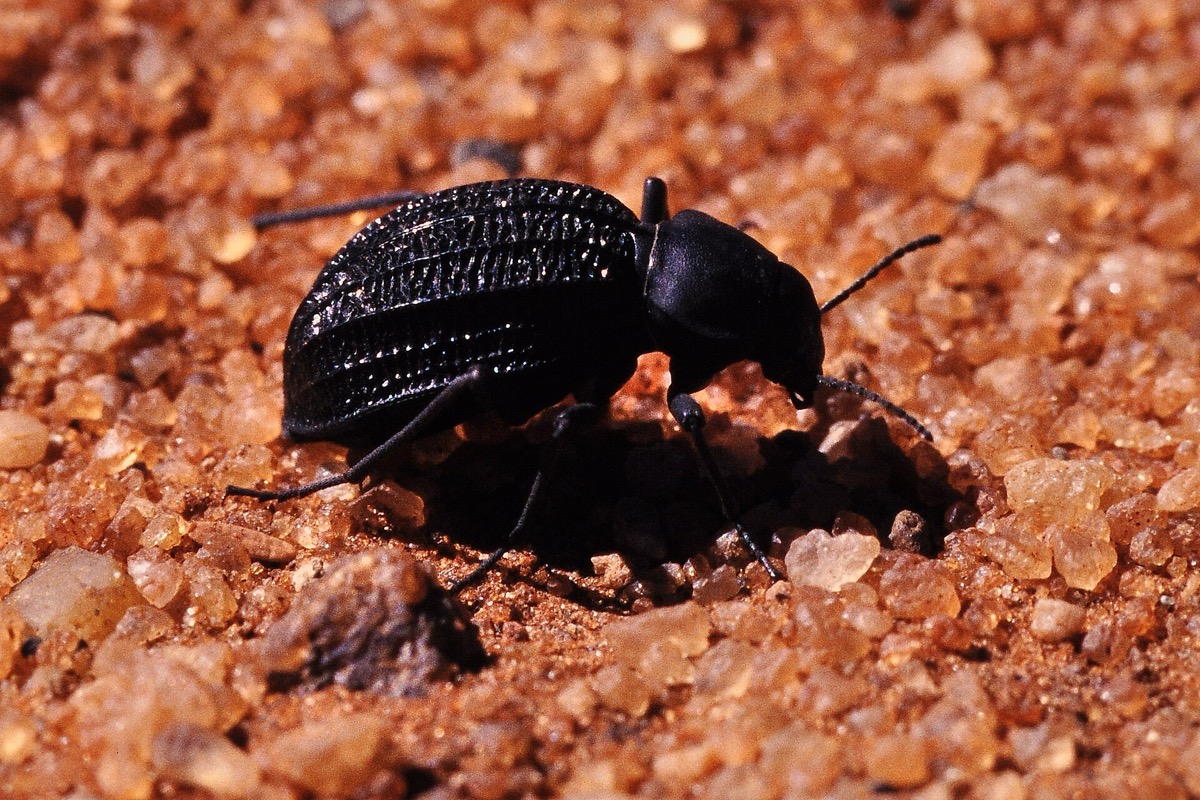
Textbooks and biomimicry papers credit a bumpy-shelled Namib beetle with harvesting fog on the microstructure of its back, and the picture of it standing head-down on a dune is everywhere. Nørgaard and Dacke took four Namib , two smooth-shelled and two bumpy, watched which ones actually fog-bask, and weighed the water each back collected. Who is doing what?
The famous beetle is not the one that does it. Of the four species, only the smooth-shelled Onymacris unguicularis took up the head-standing stance, and fog had to be present to trigger it. Corrected for body size, the best collectors were that beetle and the bumpy Stenocara gracilipes, with the differences between surfaces minor. Every tested came out completely , bumps or no bumps.
In the Namib, fog is the reliable water. Darkling beetles get at it in different ways: some dig trenches in the sand to catch condensation, and some use their own bodies, tipping head-down on a dune ridge so droplets run toward the mouth.
One species became famous for it. A beetle with bumps across its elytra was described as carrying specialized microstructure for capturing fog water, and that design has been copied into water-harvesting surfaces ever since. Nørgaard and Dacke noticed that the behavior and the structure had been attributed to the same animal without anybody checking they went together.
They took four species, the smooth Onymacris unguicularis and Onymacris laeviceps against the bumpy Stenocara gracilipes and Physasterna cribripes, and watched them in fog. Only Onymacris unguicularis, which is smooth-backed, adopted the head-standing fog-basking posture, and it did so only when fog was actually present.
The surfaces mattered much less than the pose. Absolute water collected did not differ between species, and once the numbers were corrected for body size, the best harvesters were Stenocara gracilipes and Onymacris unguicularis, with the large Physasterna cribripes worst. Every elytra examined was completely hydrophobic whatever its bumps, so the behavior, not the structure, is what gets the water in.
wat. The bumps were never the point. One smooth-backed species stands on its head in the fog, and the posture is what does the work.
wat wat
A design copied into real water-harvesting surfaces rested on pairing a structure with a behavior that belongs to a different beetle.
How do we know?
Nørgaard and Dacke observed four Namib darkling beetle species in fog, imaged the microstructure of their elytra, and measured how much water each dorsal surface harvested, corrected for size.
What is still unknown
Four species, and dorsal surface collection only. The result says the bumps add little in this comparison, not that surface structure never matters for condensation anywhere.
Learn something?
Where to next
 How many bacteria are there really in your body per human cell?correction