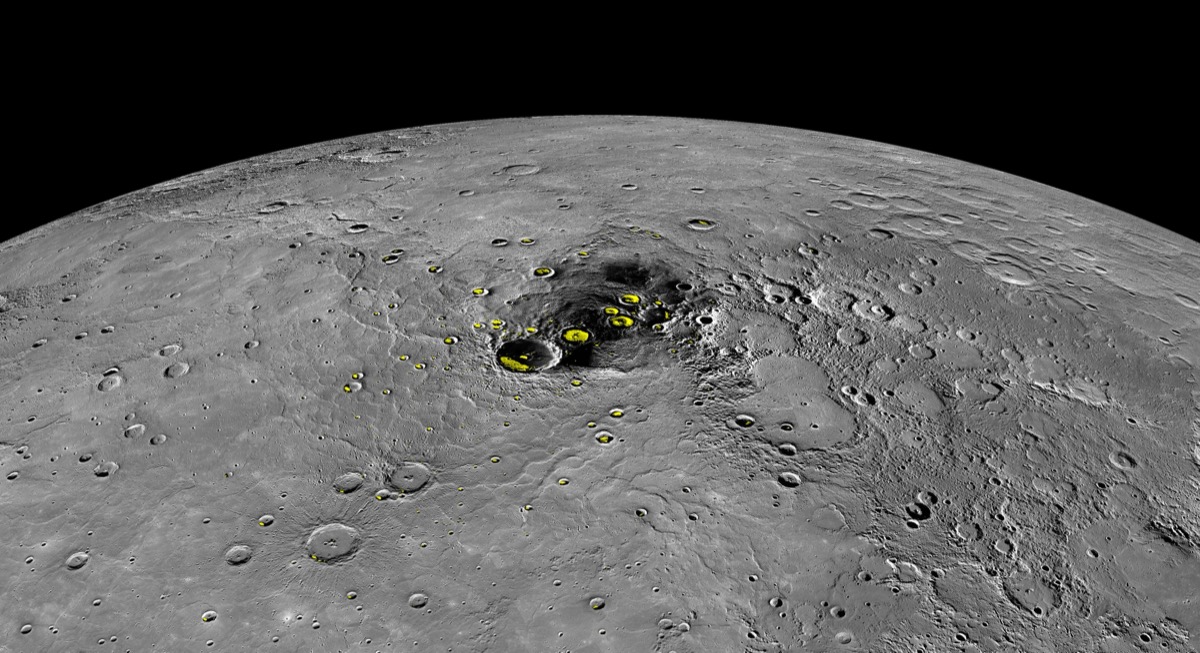
Mercury has almost no atmosphere and daytime temperatures that would boil lead. It also has craters near its poles whose floors never see sunlight, because the planet’s axis barely tilts. Radar from Earth found bright deposits inside them decades ago. Eke, Lawrence and Teodoro set out to measure how much is actually there.
A layer tens of meters thick. An automated crater-finding algorithm, run on a digital elevation model from the , catalogued six hundred and sixty-three craters wider than four kilometers north of fifty-five degrees latitude. The authors then compared topography with radar backscatter in twelve polar craters. The regions sit about fifty meters above the floor.
The question is how much, not whether. Radar observations had established that something bright sits in permanently shadowed craters near Mercury’s poles, and the obvious candidate is water ice, which survives there because the floors of those craters never receive direct sunlight. What nobody had was a thickness.
Getting one required a catalogue first. The authors developed an automated crater finding algorithm and applied it to a digital elevation model built from Mercury Laser Altimeter data on the MESSENGER spacecraft. That produced an objective set of six hundred and sixty-three craters with diameters exceeding four kilometers, north of latitude fifty-five degrees.
From that set they took a subset of twelve larger, well-sampled and fresh polar craters, and looked for correlations between the topography inside them and the same-sense radar backscatter cross-section. The typical associated with the radar-bright regions came out at about fifty meters, give or take thirty-five.
That number, multiplied out over the deposits, gives the inventory. It puts an approximate upper limit on the total polar water ice of three times ten to the fifteenth kilograms. That is three thousand million million tonnes, on the planet nearest the Sun.
wat. The hottest planet keeps ice in the few places its sunlight has never reached.
wat wat
That thickness converts into an inventory. It puts an approximate upper limit of three thousand million million tonnes on the total polar water ice Mercury holds.
How do we know?
An Icarus paper working from Mercury Laser Altimeter data on the MESSENGER spacecraft, correlating the excess height inside fresh polar craters with the same-sense radar backscatter cross-section that marks the bright deposits.
What is still unknown
The typical excess height comes with a large uncertainty, fifty meters give or take thirty-five, and the result rests on twelve well-sampled craters selected from the catalogue rather than on all of them.
Learn something?
Where to next
 What does it take to notice that your chocolate bar has melted?radar