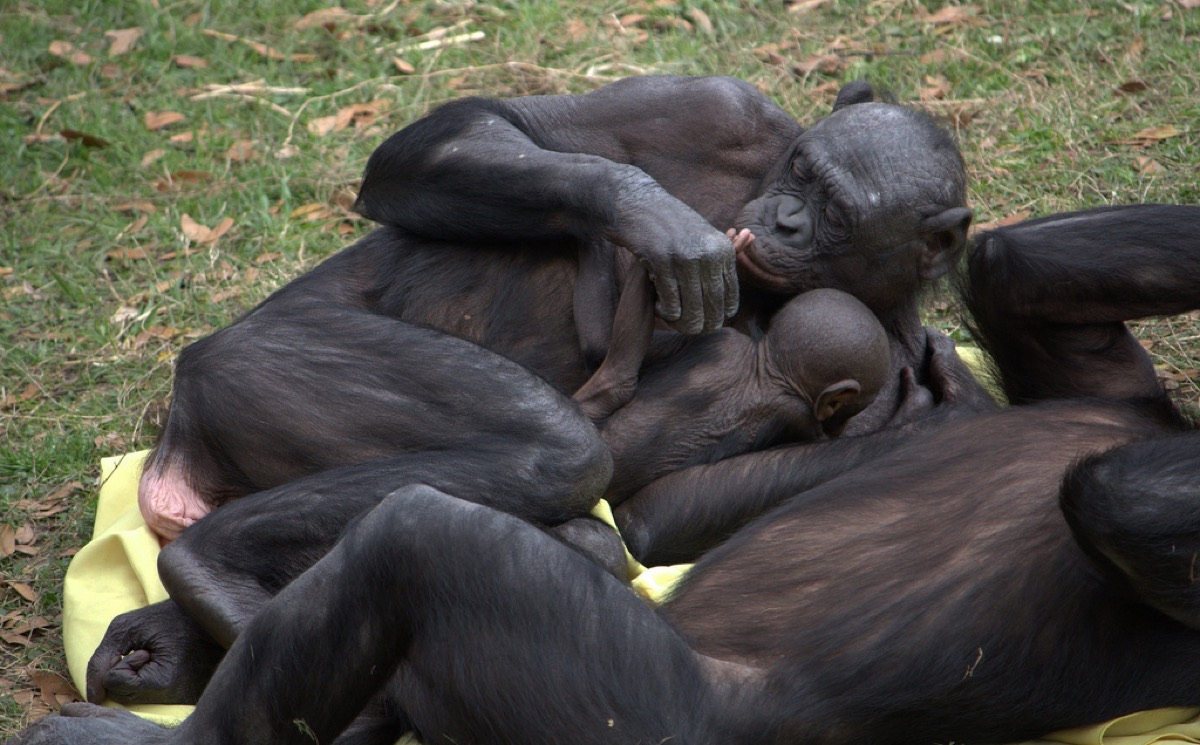
Kissing turns up across the animal kingdom and nobody can say what it is for, since the fitness benefit is unclear. Part of the trouble is definition: a human one smuggles in human meaning. Brindle and colleagues defined it without us at the center: directed oral-oral contact within a species, with some movement of the lips and no food passed. Then they ran the trait back down the primate tree. Where does it start?
In the ancestor of the large apes. Observations across the Afro-Eurasian primates, reconstructed with , put kissing in most living large apes and likely in Neanderthals too. It first evolved in the ancestor of that group, between roughly twenty-one and a half and seventeen million years ago. Several life history variables correlate reasonably but imperfectly: multi-male mating systems, diets, and .
Kissing can be observed across the animal kingdom, and it presents an evolutionary puzzle because the fitness benefits are unclear. Behaviors usually persist by paying for themselves, and nobody has established what this one pays.
Brindle and colleagues start by fixing the definition, deliberately without us at the center. Kissing here is a non-agonistic interaction involving directed, intraspecific, oral-oral contact with some movement of the lips or mouthparts and no food transfer. That last clause rules out feeding, which otherwise swallows half the candidate cases.
With that definition they collated basic observational data across the Afro-Eurasian primates and used Bayesian phylogenetic methods to reconstruct the history. Kissing occurs in most extant large apes and likely also occurred in Neanderthals, first evolving in the ancestor to this group somewhere between about twenty-one and a half and sixteen point nine million years ago.
The correlates are suggestive rather than decisive. Multi-male mating systems, non-folivorous diets and premastication all track kissing across the apes reasonably well, and none of them perfectly. The authors are explicit about the caveat hanging over the lot, since very little observational data exists. They offer the result as a starting point for generating and testing hypotheses rather than as an answer.
wat. Older than our species by a very long way, and apparently inherited rather than invented.
wat wat
Putting a date and a branch on a behavior turns an unanswerable question about why people kiss into a testable one about what changed in that ancestor.
How do we know?
Brindle, Talbot and West defined kissing without reference to humans, collated observational data across Afro-Eurasian primates, and reconstructed its evolutionary history with Bayesian phylogenetic methods.
What is still unknown
The authors enter a major caveat about how little observational data exists. A reconstruction is only as good as the records fed into it, and absence of a report is not absence of the behavior.
Learn something?
Where to next
 Why do cicadas come out every 13 or 17 years exactly?evolution
 How do penguins decide who has to stand on the cold outside?behavior
 Why does a wombat go to the trouble of leaving its mark up high?behavior