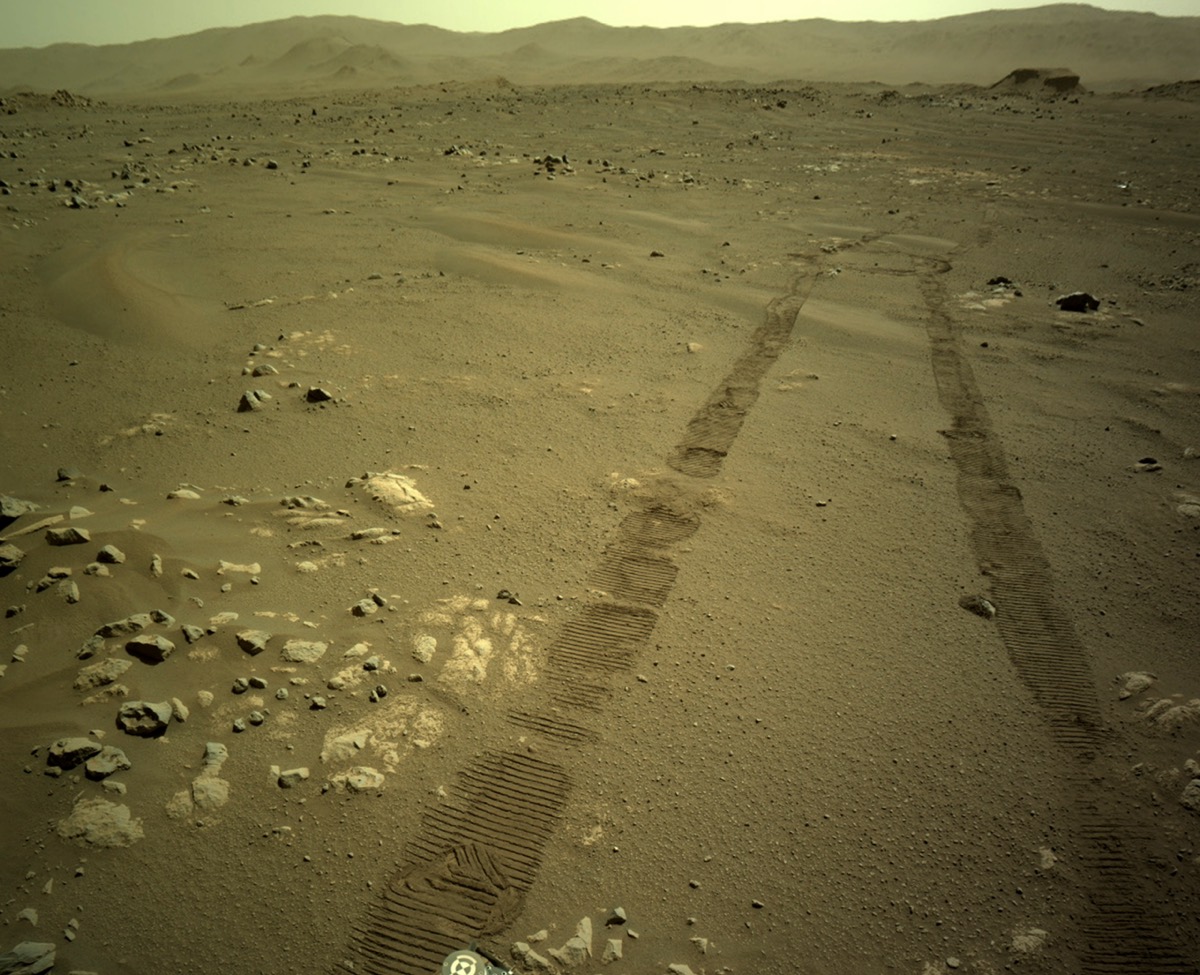
Orbital images showed a fan-shaped body of sedimentary rock at the western margin of Jezero crater, which is the signature of a river delivering sediment into standing water. Orbit cannot see the faces of that fan. Perseverance landed in February 2021 and could.
It changed character. in the outcrops record deltas advancing into a lake, while the uppermost fan strata are , which imply deposition by episodic high-energy floods. The succession marks a shift from sustained water in a persistent lake to short, violent flows.
Observations from orbital spacecraft showed that Jezero crater contains a prominent fan-shaped body of sedimentary rock deposited at its western margin. Perseverance landed there in February 2021, and this analysis covers images from the three months after landing.
The fan has that were invisible from orbit, and those faces record the hydrological evolution of the crater. Reading them is a matter of stratigraphy: which layers lie on which, and what each layer is made of.
The lower part speaks of patience. Inclined strata in these outcrops are interpreted as evidence of deltas that advanced into a lake, which requires water standing there long enough for a delta to build.
The top of the fan speaks of violence. The uppermost strata are boulder conglomerates, implying deposition by episodic high-energy floods, so the succession records a transition from sustained hydrologic activity in a persistent lake to highly energetic short-duration fluvial flows. The exposed stratigraphy and boulder sizes also allowed past lake level and to be estimated.
wat. Steady flow into a lake first, then boulders carried by sudden floods.
wat wat
A planet drying out leaves a sequence rather than a snapshot, and this is the sequence, in the order it happened.
How do we know?
Mangold and colleagues analyzed rover images from the three months after landing, reading the exposed stratigraphy of distant cliff faces and the sizes of the boulders to estimate past lake level and water discharge rates.
What is still unknown
This is three months of images of outcrop faces from a distance, early in a mission whose later work can revise it.
Learn something?
Where to next
 What does a dust devil on Mars sound like passing right over a microphone?Mars
 Are the dark streaks on Mars flowing water?Mars