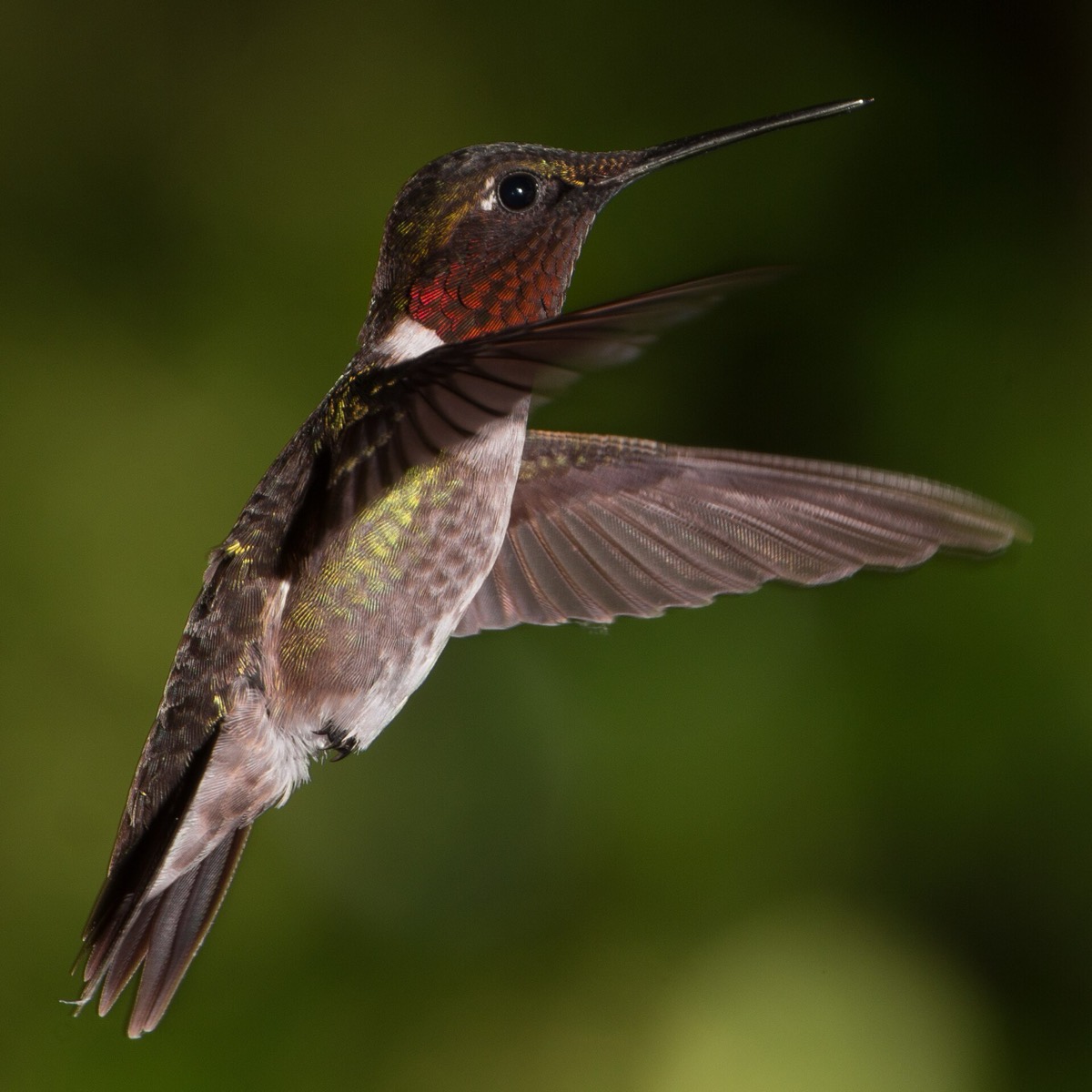
A hummingbird’s upstroke and downstroke mirror each other almost exactly, which is why the wingbeat had been modeled on an insect’s, with each half carrying about the same share of the weight. That assumption went into the standard aerodynamic models and into the experiments built to test them. Warrick and colleagues measured the wake of hovering rufous hummingbirds instead. Is the split really even?
Three quarters to one. The downstroke produces about seventy-five percent of the weight support and the upstroke only twenty-five, so a symmetrical motion turns out to hide a badly asymmetrical force. Inversion of the bird’s on the upstroke is the likely reason. The wake also carried formed during the downstroke, a mechanism typical of insect hovering.
Hummingbirds hover like insects and are built like birds, and the resemblance to insects runs deep enough that their aerodynamics had largely been modeled on insect lines. The visible reason is the wingbeat: unlike most birds, the upstroke mirrors the downstroke almost exactly.
Kinematic symmetry got read as force symmetry. If the two halves of the cycle look alike, the reasoning went, each must carry about half the weight, which is what insects of a similar size do. That assumption sat inside widely used models and inside the experiments run to check them.
Warrick and colleagues went to the air instead of the bird. Using on hovering rufous hummingbirds, they measured the wake the wings leave behind, which is where the momentum given to the air actually shows up. The split came out at roughly three to one in favor of the downstroke.
Part of the gap is probably the wing itself, since a cambered wing inverted on the upstroke is a worse lifting surface than the same wing the right way up. The wake also showed leading-edge vortices forming on the downstroke, which suggests the bird works at a low enough to use a trick central to insect flight. Close to an insect, then, and still not one.
wat. The wings go up and down in mirror image, and yet three quarters of the lift arrives on the way down.
wat wat
A widely used assumption turned out to be wrong by a factor of three, which means every model that inherited it was describing a bird that does not exist.
How do we know?
Warrick, Tobalske and Powers used digital particle image velocimetry on hovering rufous hummingbirds to measure the wake, which is where the momentum handed to the air actually shows up.
What is still unknown
One species, hovering in place. How the split shifts in forward flight, or across the range of hummingbird sizes, is not addressed here.
Learn something?
Where to next
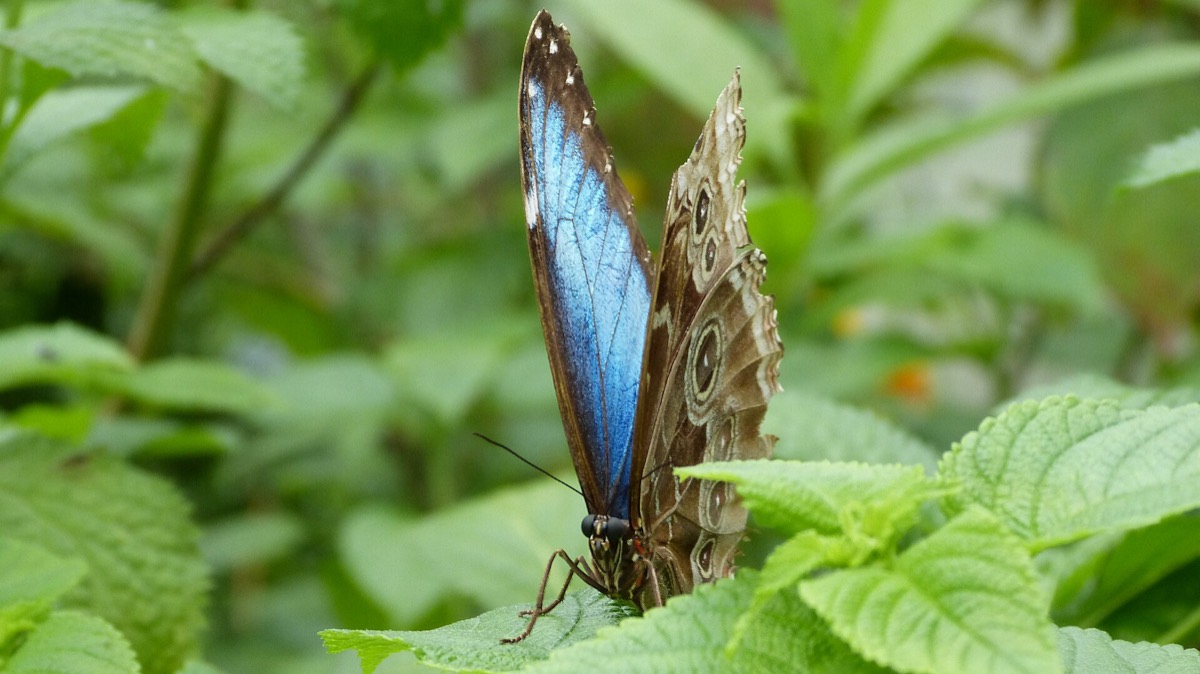 The wings are blue, and there is almost no blue in them. How?wings