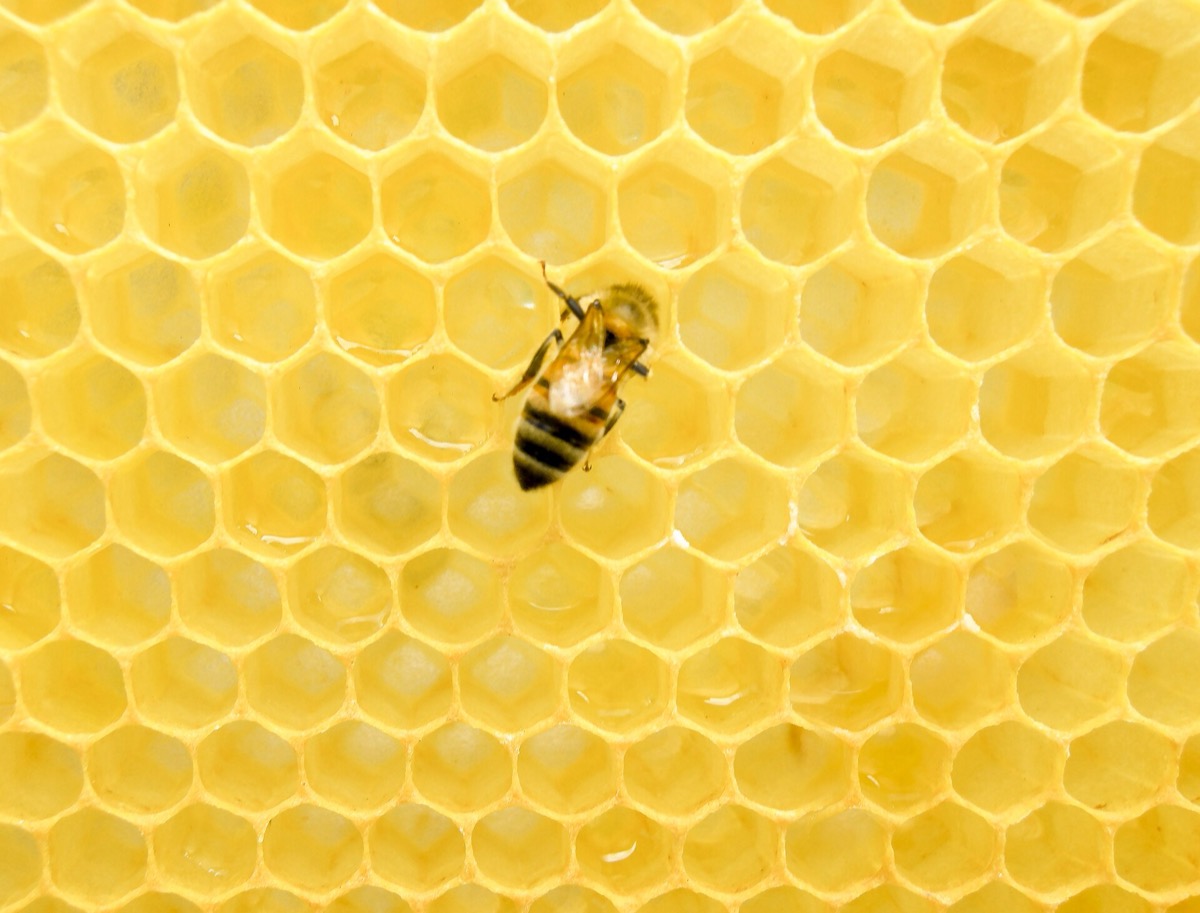
Bees build in hexagons, and the shape has been held up as nature’s economy since antiquity: refers to the problem in his fifth book. Admiring a pattern is not the same as proving it optimal. The claim needed is that nothing else does better.
Yes, and the proof took until 1999. The honeycomb conjecture states that any into regions of equal area has at least that of the regular hexagonal grid. Thomas proved it, in a preprint that year and a paper in Discrete and Computational Geometry two years later.
The honeycomb conjecture states that any partition of the plane into regions of equal area has perimeter at least that of the regular hexagonal grid. In plainer terms, no way of dividing a surface into equal cells uses less boundary than hexagons do.
The question is old. Pappus refers to the problem in his fifth book, so the observation that bees appear to have found the efficient answer predates the mathematics needed to test it by a very long way.
Proving it is harder than it sounds. The comparison runs over every possible partition, including regions with curved or irregular boundaries, which is why an apparently obvious statement resisted proof for so long.
Hales closed it at the end of the twentieth century, in a 1999 preprint and a 2001 paper in Discrete and Computational Geometry. The same mathematician settled the Kepler conjecture on how densely spheres can be packed.
wat. Pappus noticed it; the proof arrived about seventeen centuries later.
wat wat
It closes the gap between a pattern everyone finds beautiful and a statement that can be checked.
How do we know?
Wolfram MathWorld states the conjecture, notes the ancient reference and credits the proof to Hales, pointing to his 1999 preprint and the 2001 paper in Discrete and Computational Geometry.
What is still unknown
The theorem is about equal-area regions in a flat plane, which is not quite the problem a bee is solving in wax.
Learn something?
Where to next
 Did Alan Turing really prove the halting problem attributed to him?proof
 A bee sees a blank card. Is it, to the bee, less than one?bees
 How does a thin film solve a geometry problem without calculating?geometry