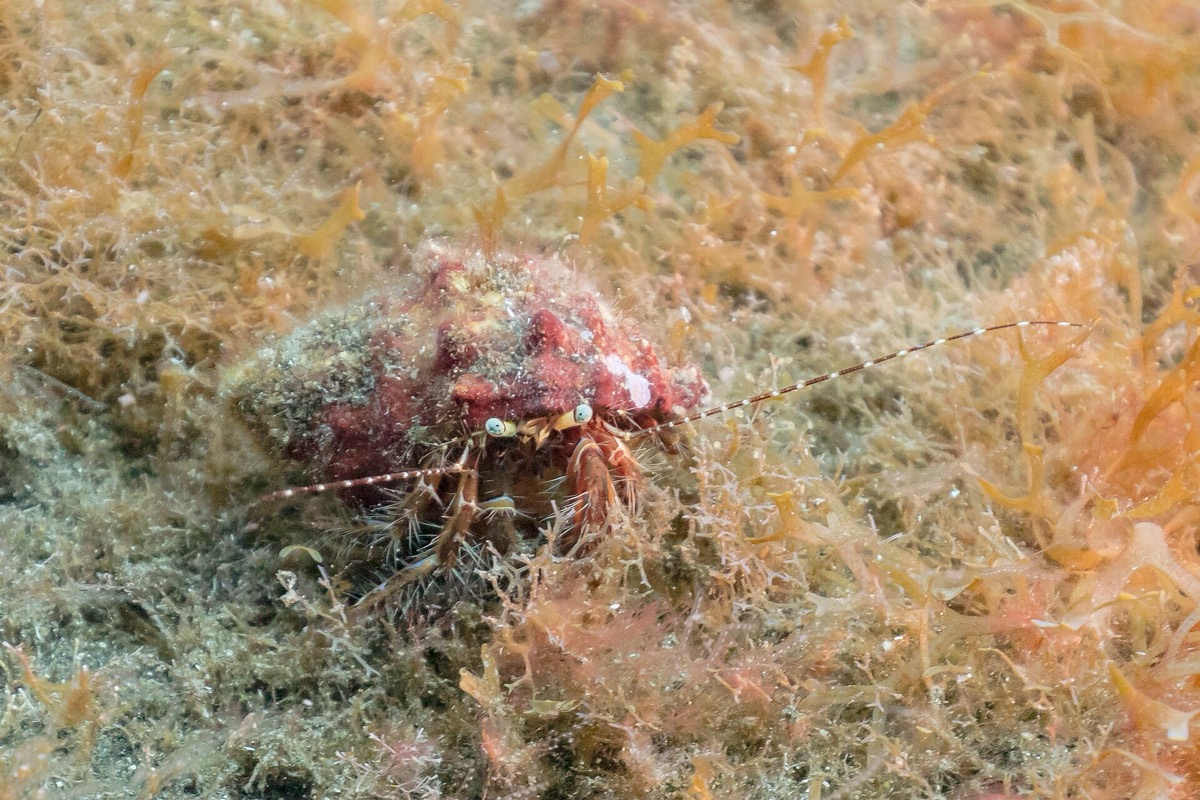
An animal with eyes, antennae and chemical senses may still lean on one of them for everything social. Testing that means removing a sense and watching, and almost nobody has followed the blinded animals back out into the wild. Steele and Laidre put opaque covers over the eyes of , then released blinded and control crabs both into the wild and into captive groups. What falls away?
Their own approaches, and only in the wild. Blinded crabs initiated significantly fewer social contacts with other crabs than controls did on the beach, while other crabs did not single them out for different treatment. In captivity the effect vanished: blinded and control animals behaved alike. The setting, not the sense, is what decided whether the difference showed up at all.
Animals usually carry several senses and do not use them evenly. For social behavior in particular, one channel may be carrying almost all the load, and the only decisive way to find out is to take that channel away.
Few studies have done it and then followed the animal into its own habitat. Steele and Laidre worked with social hermit crabs, Coenobita compressus, applying opaque material over the eyes to blind individuals temporarily. They then released animals and non-blinded controls both onto the beach and into .
In the wild the blinded crabs initiated significantly fewer social contacts with . The asymmetry is the interesting part: they were not differentially targeted by other crabs, so the change is in what the blinded animal does rather than in how it is treated.
In captivity none of it appeared. Blinded and control crabs showed no differences in social behavior at all, which argues that experiments in natural settings are essential to seeing what the loss of a sense actually costs. For a social animal leaning heavily on vision, losing it changes the social life dramatically, and a tank is the wrong place to notice.
wat. Cover a hermit crab’s eyes and it stops approaching others, but only once it is back on a real beach.
wat wat
A result that appears in the field and disappears in a tank is a warning about where behavior gets studied, not only about what hermit crabs do with their eyes.
How do we know?
Steele and Laidre temporarily blinded social hermit crabs with opaque material over the eyes, released blinded and non-blinded animals into the wild and into captive social settings, and recorded who initiated contact.
What is still unknown
Covering the eyes is a blunt manipulation that may affect an animal in ways beyond sight, and the blinding is temporary, so what a permanently blind crab would do over a longer stretch is untested.
Learn something?
Where to next
 A fish has no cortex like ours. So how does it tell faces apart?vision
 How does a group of male elephants decide it is time to leave?society
 Does a bee see the world differently once it starts moving?vision