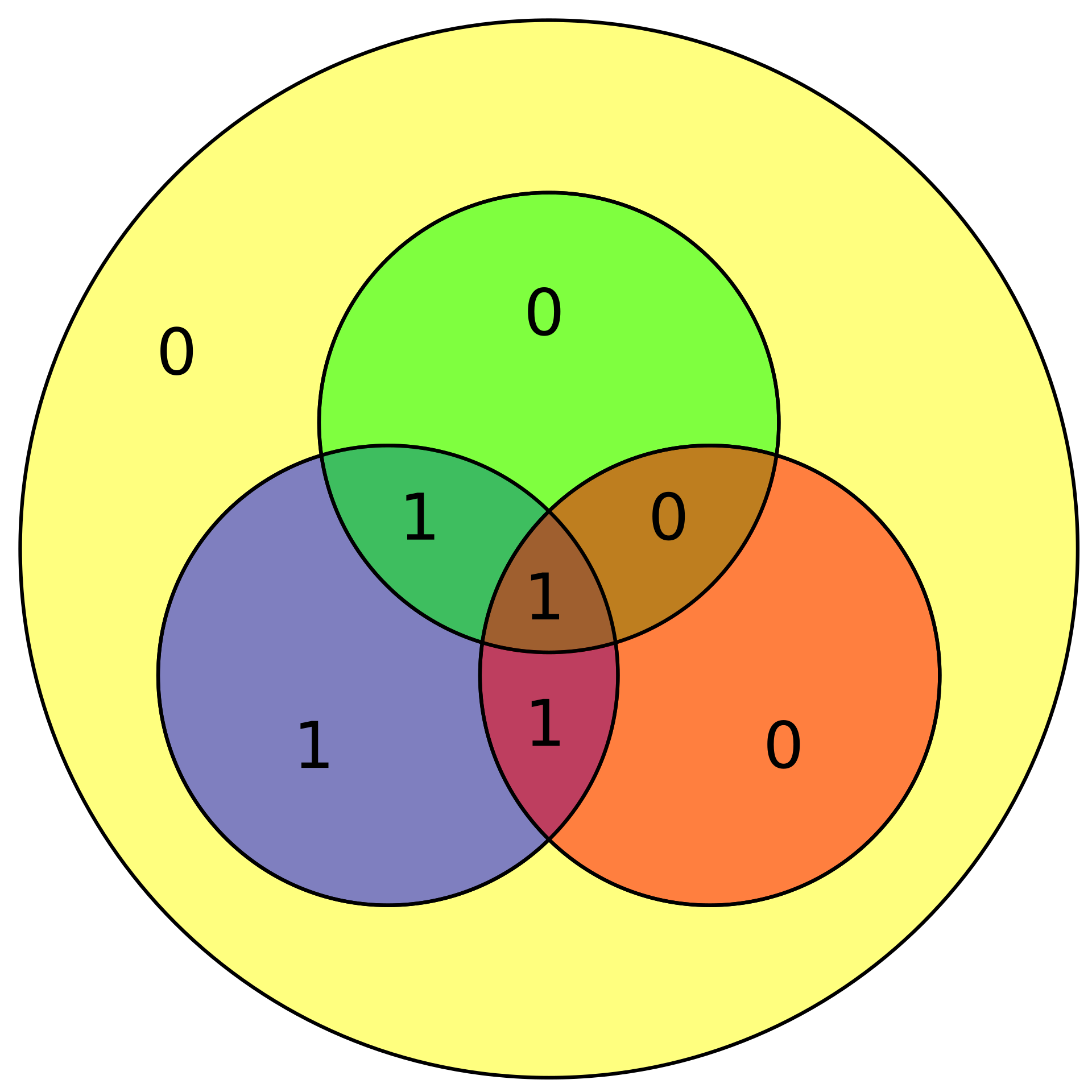
Using no more redundancy than the job requires. A binary Hamming code is a whose has columns consisting of all the nonzero binary vectors of a given length, each used exactly once. MathWorld states the consequence plainly: Hamming codes are single error-correcting codes.
Perfect is a technical term rather than praise. It means the code packs its codewords so tightly that every possible received word sits within one bit-flip of exactly one codeword, with none left over and no ambiguity. The smallest useful member of the family is the Hamming code that protects four data bits with three extra ones, giving a .
Error-correcting codes exist because channels corrupt what passes through them, and the interesting question is how little redundancy you can get away with. A binary Hamming code is a linear code with a parity-check matrix of a particular kind. Its columns consist of all the nonzero binary vectors of a given length, each used exactly once.
That construction sounds abstract and is really a filing system. Each column of the matrix corresponds to one bit position, and each row to one parity check. Because every nonzero pattern appears exactly once, the pattern of which checks fail identifies which single bit went wrong, with no two positions sharing a signature.
MathWorld’s summary of the consequence is the heart of it: Hamming codes are perfect single error-correcting codes. Perfect is a precise term. The codewords are packed so that every possible received word lies within one bit-flip of exactly one codeword, leaving nothing ambiguous and nothing unused, which is why the redundancy cannot be trimmed.
The familiar member of the family is the Hamming code that protects four information bits inside a seven-bit word, which MathWorld gives as the case where the construction parameter equals three. Two cautions about this card. It is written from a mathematical definition rather than from Hamming’s 1950 paper, which the browser could not reach, so it describes the object and not its history. And the property is single error correction: two errors in one word are outside what these codes promise.
wat. Three extra bits are enough to find and fix any one wrong bit among four.
wat wat
Detecting an error only tells you to ask again. Correcting one means a message damaged in transit can be repaired where it lands, which is what makes storage and deep-space links possible at all.
How do we know?
Wolfram MathWorld defines the binary Hamming code by its parity-check matrix, states its parameters and its perfect single error-correcting property, and cites MacWilliams and Sloane’s standard treatment of error-correcting codes.
What is still unknown
A mathematical definition rather than a history or an account of the original 1950 paper. It also states the limit of the family implicitly: these codes correct a single error, and say nothing about two.
Learn something?
Where to next
 How often does a quantum computer make a mistake?errors
 Why do cicadas come out every 13 or 17 years exactly?mathematics
 Why do we picture compound interest as weaker than it is?mathematics