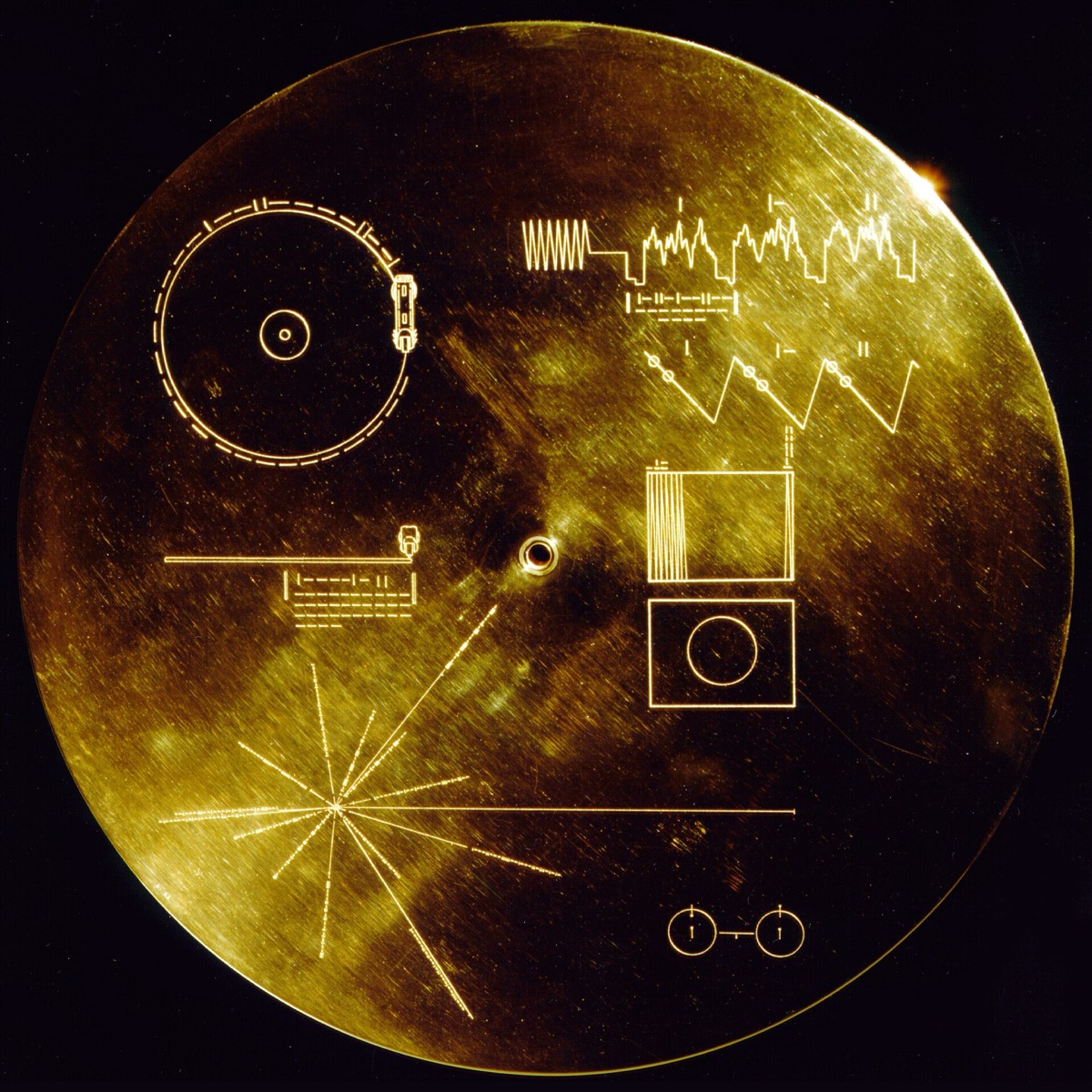
Voyager one launched in nineteen seventy-seven to visit Jupiter and Saturn, and kept going. In nineteen ninety-eight it overtook Pioneer ten to become the , and in two thousand and twelve it crossed the into interstellar space. Each of the two Voyagers also carries a greeting to whoever might eventually find it. In what format?
A phonograph record. Each spacecraft carries a thirty centimeter record, with a cartridge, a needle and symbolic instructions for playing it. On it are images and sounds chosen to depict the diversity of life and culture on Earth. The craft were expected to remain operable through twenty thirty, and the record needs no power at all.
Voyager one is a robotic interplanetary probe launched in nineteen seventy-seven that visited Jupiter and Saturn and became the first spacecraft to reach interstellar space. It was half of a with Voyager two, built to take advantage of a rare orbital positioning of Jupiter, Saturn, Uranus and Neptune that permitted a multi-planet tour.
The science came first and was substantial. Data and photographs from the Voyagers’ cameras, magnetometers and other instruments revealed previously unknown detail about each giant planet and its moons. Jupiter’s complex cloud forms, winds and storm systems. A ring around Jupiter. Volcanic activity on Io, the first seen beyond Earth. And the braids, kinks and myriad ringlets of Saturn’s rings.
The distance records followed. On the seventeenth of February nineteen ninety-eight Voyager one overtook Pioneer ten to become the most distant human-made object in space. By two thousand and four both craft were well beyond Pluto’s orbit, and in two thousand and twelve they became the longest-operating spacecraft, having worked for thirty-five years and still transmitting periodically. On the twenty-fifth of August that year Voyager one crossed the heliopause.
And each craft carries a greeting to any form of extraterrestrial intelligence that might eventually find it. A gold-plated copper phonograph record, thirty centimeters across, accompanied by a cartridge, a needle and symbolic instructions for playing it, contains images and sounds chosen to depict the diversity of life and culture on Earth. The Voyagers were expected to remain operable through twenty thirty; the record was built for considerably longer than that.
wat. Two spacecraft on their way out of the solar system, each carrying a record, a needle, and instructions for an audience nobody has met.
wat wat
Every other part of the mission has a shelf life measured in decades. The record is the only component designed on the assumption that the spacecraft will outlast its own electronics.
How do we know?
Britannica’s entry on Voyager one, which covers the mission, the instruments, the crossing into interstellar space, and the record each spacecraft carries.
What is still unknown
An encyclopedia entry. It describes the record and its contents in outline without listing what was selected, or by whom, or on what principle.
Learn something?
Where to next
 Why would a spacecraft send its data home by laser?spacecraft