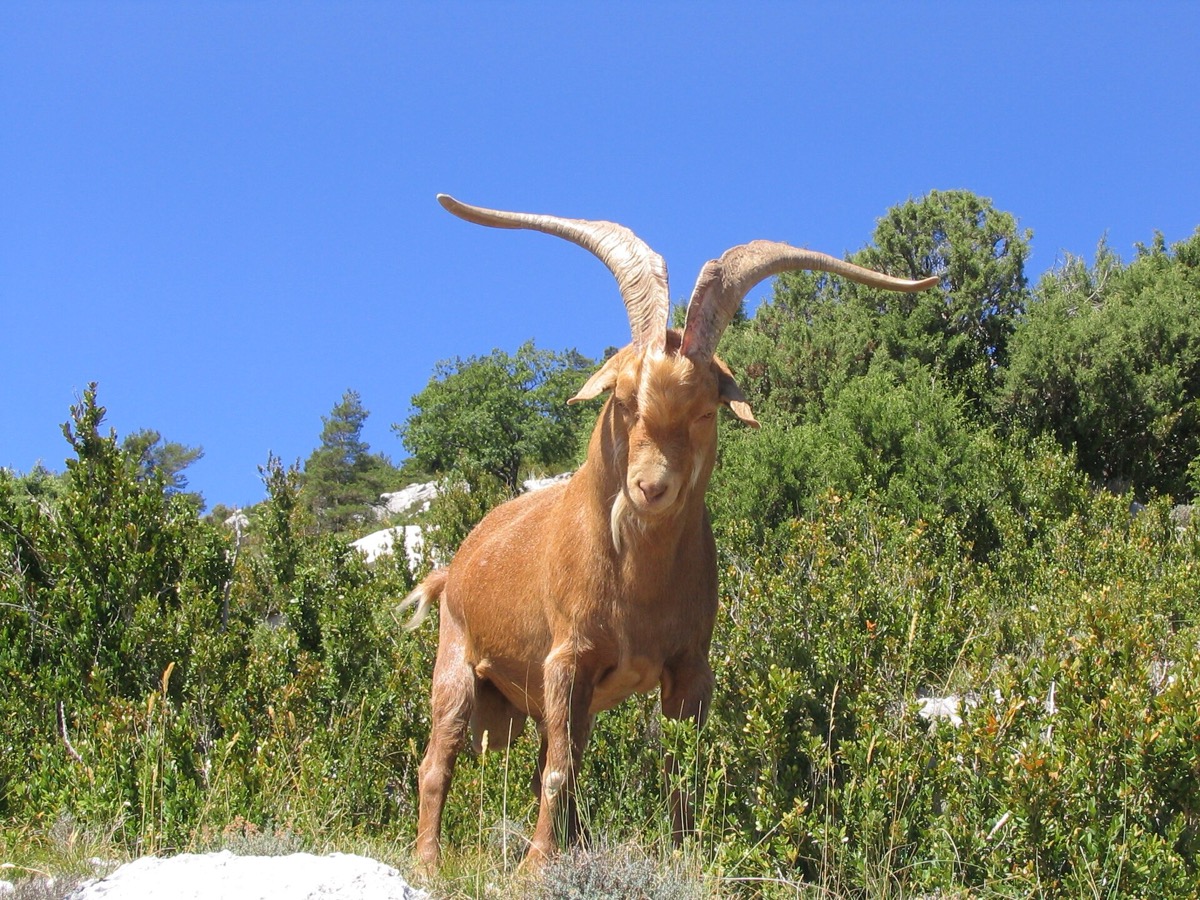
Dogs and horses were bred to work alongside people, so their sensitivity to a human face surprises nobody. Goats were bred for milk and meat. Researchers hung two photographs of the same unfamiliar person on a wall, one happy and one angry, 1.3 meters apart, and released goats from four meters away to do as they liked for thirty seconds. What did the goats go to?
They went to the happy face first, and only from one side. Across four trials the goats interacted first with the positive photograph, which means they read human at all. But the preference showed up only when the happy picture hung on the right. With it on the left, no preference appeared, which points at how the two halves of a brain divide this kind of work.
Living with people has reshaped animals, and dogs and horses are the standard examples of the cognitive side of it. Both were bred to work in partnership with us, which makes their sensitivity to a human face easy to explain. Goats were bred for milk and meat, so nobody expected much.
The setup was a with two photographs of the same unfamiliar person fixed to one wall, 1.3 meters apart. One showed a happy expression and one an angry one, differing in while being the same face. Goats entered from four meters away and had thirty seconds to do whatever they liked, across four trials.
Overall they interacted first with the happy photograph. That alone is the headline, because it means an animal domesticated for production picks up human facial emotion. Then the asymmetry: the goats interacted first, more often and for longer with the positive face when it sat on the right, and showed no preference at all when it sat on the left.
Side effects of this kind usually reflect the two hemispheres of a brain handling different jobs, since each eye feeds mainly to the opposite side. The authors read the whole result as evidence that reached further into animal cognition than previously assumed. Keep the measure in view, all the same. Four short trials and an approach toward a photograph is a thin behavioral base, and approach is not the same thing as feeling.
wat. Goats chose the smiling photograph over the scowling one, and only when the smile was on their right.
wat wat
Goats were domesticated for production rather than for company, so the usual explanation, that working animals were selected to read us, does not cover this. Domestication may reach further into animal cognition than anyone assumed.
How do we know?
Nawroth and colleagues showed goats paired photographs of one unfamiliar person looking happy or angry, 1.3 meters apart in a test arena, across four trials of thirty seconds each.
What is still unknown
Four trials of thirty seconds each, photographs rather than people, and first approach as the measure. Going to a picture is not evidence that the goat felt anything about the face.
Learn something?
Where to next
 Does a horse know the difference between a smile and a scowl?facial expressions
 If you hold a pen in your teeth, do cartoons get funnier?emotion
 What has to happen in your head for something to count as awe?emotion