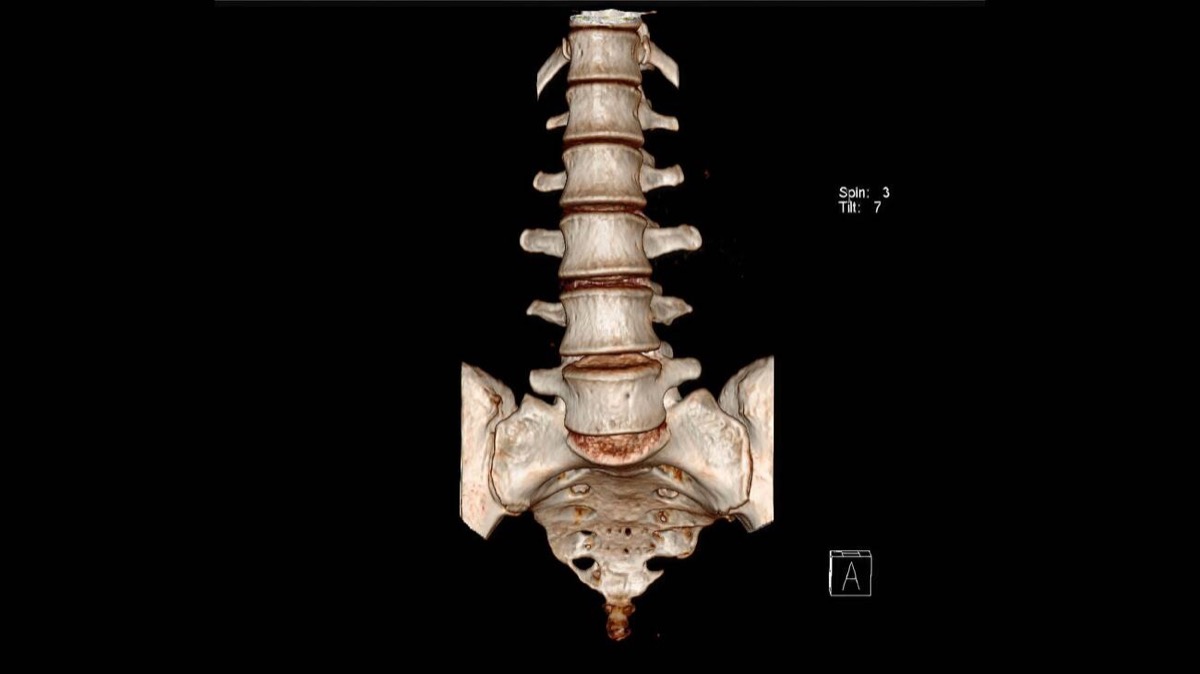
Walking on two legs works because the lower back curves inward, a that stacks the trunk’s over the hips. Pregnancy breaks that arrangement, shifting the center of mass forward of the hips exactly when balance matters most. Either women cope with it or something about the spine is different. So lumbar vertebrae were compared between the sexes, and then against fossil vertebrae.
The female lower spine is built differently for it. Human females have evolved a derived curvature and reinforcement of the lumbar vertebrae that compensates for this . And the same dimorphic pattern appears in fossil vertebrae of , which places the adaptation to fetal load before the evolution of our own genus Homo. The problem is older than we are.
As Darwin predicted, bipedal posture and locomotion are the key distinguishing features of the earliest known hominins. Hominin axial skeletons carry many derived adaptations for it. They include a lumbar region elongated both in the number of vertebrae and in their lengths, and a marked posterior concavity of wedged lumbar vertebrae known as a lordosis.
The lordosis does mechanical work. It stabilizes the upper body over the lower limbs by positioning the trunk’s center of mass above the hips, which is what makes upright standing sustainable rather than a constant muscular effort.
Pregnancy breaks the arrangement. The changing body shape and the extra mass shift the trunk’s center of mass forward of the hips, which in a two-legged animal is a genuine balance problem rather than a minor inconvenience. A quadruped carrying the same load along a horizontal trunk has nothing comparable to solve.
The finding is that human females have evolved a derived curvature and reinforcement of the lumbar vertebrae to compensate for this bipedal obstetric load. Similarly dimorphic morphologies in fossil vertebrae of Australopithecus suggest the adaptation to fetal load preceded the evolution of Homo. Note what kind of evidence that is: comparative anatomy and a fossil pattern, with function inferred from shape rather than measured.
wat. Women’s lower vertebrae curve and brace differently, and the same difference shows up in Australopithecus fossils millions of years before Homo.
wat wat
It shows one adaptation creating the need for another. Standing upright solved a locomotion problem and handed pregnancy a balance problem, which the skeleton then had to answer separately.
How do we know?
Whitcome, Shapiro and Lieberman compared lumbar curvature and vertebral reinforcement between human males and females, and examined dimorphism in fossil Australopithecus vertebrae.
What is still unknown
Comparative skeletal anatomy rather than an experiment, and the fossil claim rests on dimorphism in a small number of Australopithecus vertebrae. Inferring function from shape is the standing limitation of this kind of work.
Learn something?
Where to next
 What is the appendix actually for?evolution
 What are wrinkled fingertips for?evolution
 Is there anything a beard is good for in a fight?evolution