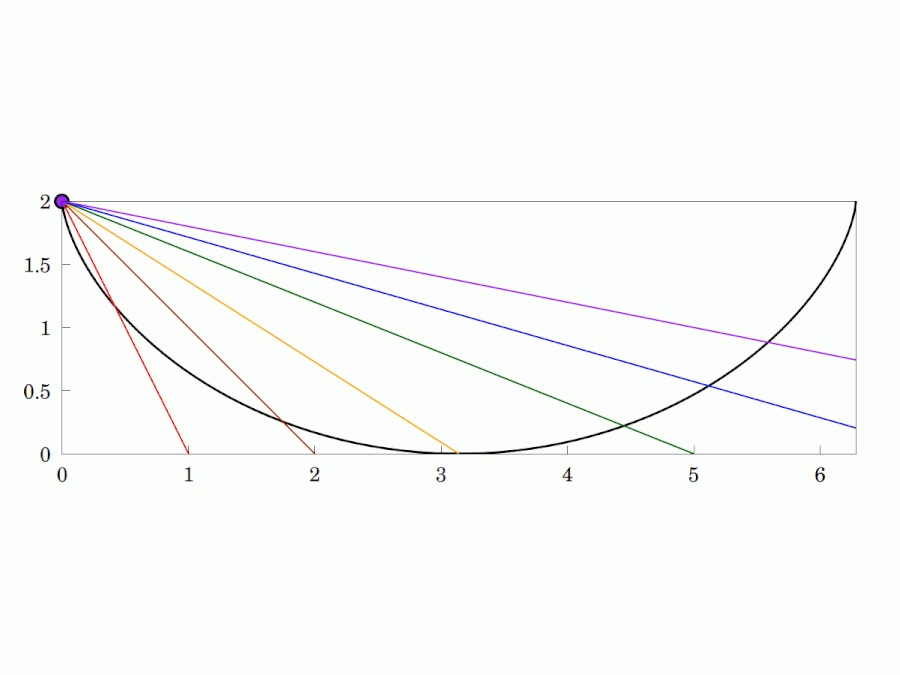
A straight line is the shortest route between two points, and the instinct is that it must also be the fastest for something sliding down under gravity. The brachistochrone problem asks for the curve that takes the least time. The two answers are not the same curve.
A segment of a . Along it the bead may actually travel uphill for a distance, and the path is still faster than a straight line or any other line. The name comes from the Greek brachistos, meaning shortest, and chronos, meaning time or delay.
The brachistochrone problem asks for the shape of the curve down which a bead, sliding from rest and accelerated by gravity, will slip without friction from one point to another in the least time. The term comes from the Greek brachistos, meaning shortest, and chronos, meaning time or delay.
The answer is a segment of a cycloid rather than a straight line. Along that path the bead may actually travel uphill for a distance, and it still arrives sooner than it would along a straight line or any other line.
The problem drew a remarkable field. was challenged in 1696 and solved it the next day, and Leibniz, L’Hospital and the two Bernoullis found it too. argued by analogy to light refracting through layers of varying density. It became one of the earliest problems in the .
A human story sits behind it. Johann had originally found an incorrect proof that the curve is a cycloid, and challenged his brother Jakob to find the required curve. When Jakob did so correctly, Johann tried to substitute that proof for his own.
wat. The quickest way down dips below the straight line and still wins.
wat wat
It is one of the earliest problems in the calculus of variations, a field built to answer questions of this shape.
How do we know?
Wolfram MathWorld states the problem, names the solution and sets out who solved it, including the integral for the travel time that the calculus of variations handles.
What is still unknown
The idealization matters: a bead sliding from rest, accelerated by gravity, without friction.
Learn something?
Where to next
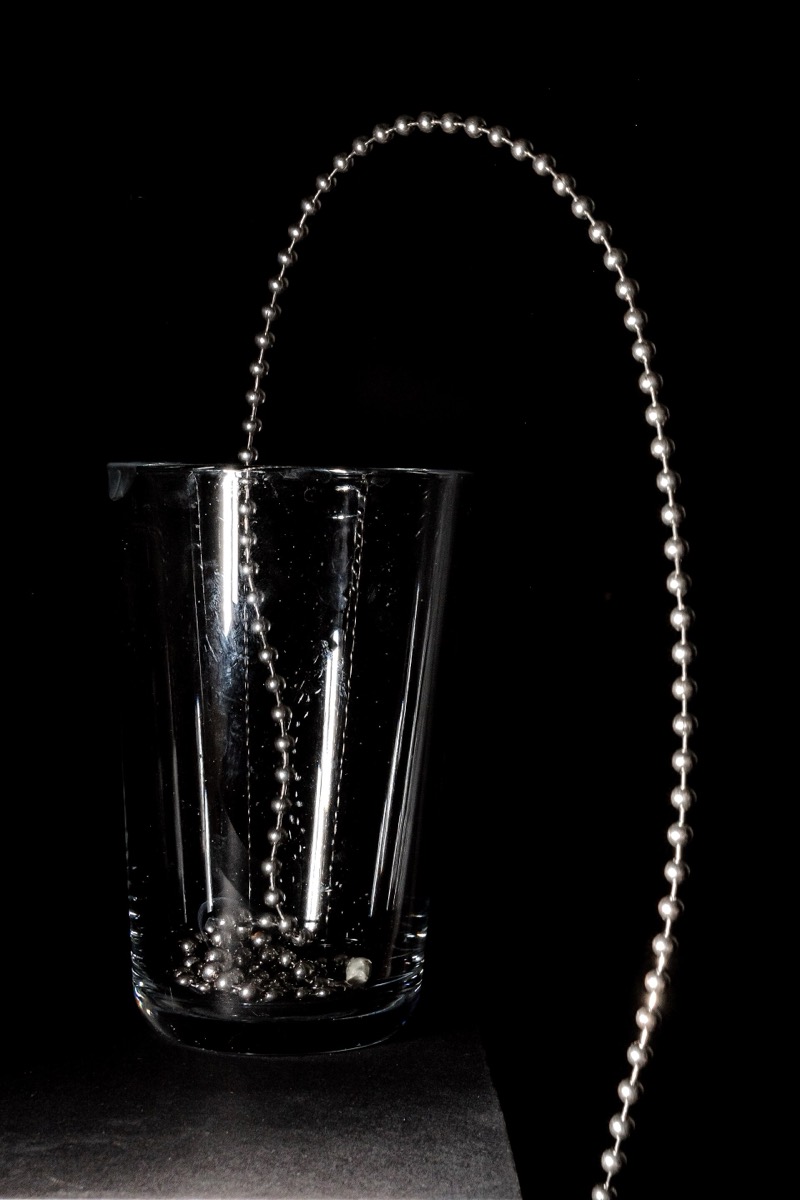 A chain pours from a cup to the floor. Why does it rise into the air first?motion
 What enormous wave is moving through the stars around us?motion